
Click Here to Get Your Free Personalized Wealth Roadmap!
If someone offered to buy the business you’ve spent years building, would you take the money and walk away, or sell part of it, stay involved, and build something even bigger?
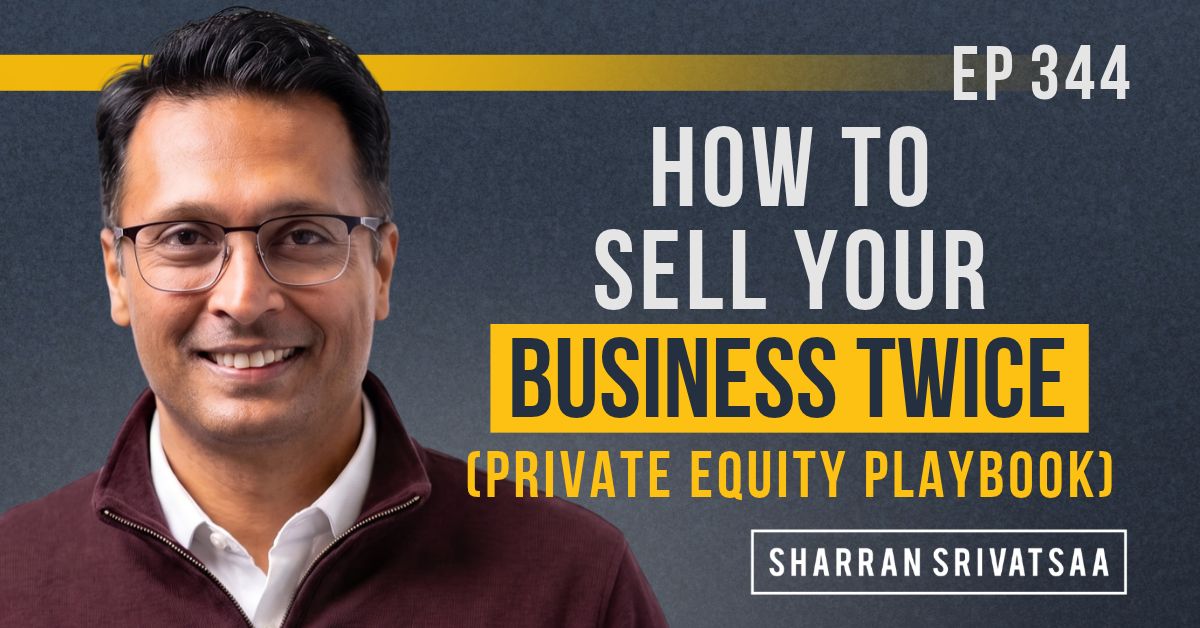
In this episode, Sharran breaks down how private equity works, why investors buy businesses, and how business owners can benefit from bringing on a financial partner. He explains the private equity process and unpacks the “second bite at the apple” which allows founders to take some money off the table and retain equity for a future payday.
But selling isn’t always the best move. Sharran explores why founders and private equity firms sometimes clash, how to evaluate potential buyers, and why his “soft shop” method can help business owners understand what their company is worth and what it would take to increase its value.
“The value is not in buying your business today. The value is in buying low and selling high.”
~Sharran Srivatsaa
Timestamps:
00:00 – Public equity vs. private equity: what’s the difference?
02:02 – The four-step private equity investment process
04:53 – How business owners get paid through the second bite at the apple
08:26 – The 2 and 20 model: how private equity firms make money
11:40 – Why founders and private equity firms often clash
17:40 – How to determine if private equity is right for your business
20:10 – The soft shop method: find out what buyers think your business is worth
24:18 – Strategic buyers vs. financial buyers: know the difference
Resources:
– The Next Billion by Sharran Srivatsaa
– Board Member: ARC Multifamily Real Estate Investing
– Board Member: The Real Brokerage
Connect with Sharran:
– X
– YouTube
– Threads
Transcript:
[00:00:00] Private equity invests over $1.5 trillion every single year to buy companies, which means entrepreneurs and business owners have a proven way to make an insane amount of wealth through this private equity vehicle. But unfortunately, most people don’t understand exactly how it works. So today I’m gonna break down for you everything that you need to know to understand how private equity works, and at the end, I’m even gonna tell you how you can consider selling your business to private equity.
[00:00:30] Now You may be thinking, what is private equity? Well, uh, we have to define equity first. Equity is ownership, specifically in a company or in an asset. There are two forms of equity. The first is public equity, and the second is private equity. Well, what is public equity? Public equity is owning a piece of a stock, which is a publicly traded company like Apple or NVIDIA or Microsoft or GE.
[00:00:57] They’re publicly traded companies, and you can own a piece of them, [00:01:00] and that is generally called equity. That’s what we also call the equity markets overall. That is public equity. Well, less than one percent of companies are actually publicly traded, meaning you and I, as a retail investor, can actually have access to something like that.
[00:01:15] But over ninety-nine percent of companies are private. Your company is probably private. You probably own most of your business in any way. Well, when somebody owns a piece of a private company, that is called private equity. So if you bring on an investor, uh, in your company, that is called a private equity.
[00:01:33] But most people own their own businesses, and that is private equity. Equity is the key component of America because there’s two amazing wealth creation opportunities in America, and we call it the golden stairways. It’s either investing in real estate or investing in businesses. And both of those involve owning equity.
[00:01:50] And so when you understand the concept of equity, you understand the concept of ownership. And unlocking the concept of ownership is where all the money comes from for entrepreneurs. Now that we understand [00:02:00] what public equity and private equity is, how does it actually work? How do private equity firms work, and how does this process actually work?
[00:02:06] There is a flywheel, and let me explain the pieces of the puzzle for you so you get a sense of what a private equity firm’s motivation is. Private equity firms go out and, uh, use a business model of investing in companies. Their entire job is to buy low and sell high. Well, what does that mean? If I invest in a company today, which is your company and is starting to grow, well, I get to buy it at today’s valuation.
[00:02:32] And based on that, if I can give you capital and give you expertise and give you a network to grow, then you are going to increase the value of the business. Therefore, I get to buy low and sell high. This is the thesis that most private equity investors use to go out and raise money. They don’t actually use their own money.
[00:02:49] They go out and raise money from investors. So step one of this process is going out and raising money from investors to invest in the theme of building America and the world. The [00:03:00] second is, once you raise the money, you have to go and find companies to invest in. So most private equity firms have a thesis.
[00:03:06] They say, “We invest in medical companies. We invest in service businesses. We invest in professional services. We invest in roll-ups. We invest in real estate.” So they go out and find companies that are perfect fits for them. This is really important because private equity is not generic, it’s specific, ’cause they raise the money to specifically go after an investment theme.
[00:03:28] The third is then they go out and buy the business itself, and I’ll explain the structure of how they buy the business in just a second, but they go out and buy the business. And once they buy the business, now they have the ability to actually operate and fix it or help the entrepreneur in some way.
[00:03:43] They wanna buy low and sell high, so they have to do something to create more value over time. And then finally, they sell the business. So it is raising the money, finding the businesses, investing in the business, helping the business grow, and then actually selling it. If you think about it, [00:04:00] the tough part about this process is that it takes time.
[00:04:03] So private equity firms, when they raise money, they raise money on a seven to 10-year fund cycle. So they go to you, the investor, and say, “We’re gonna go invest in professional services, and this is a 10-year time horizon because we need to buy a business today and let it grow over a 10-year period and then exit it so that you see the overall growth trajectory of the business.”
[00:04:26] The 10-year fund cycles are why most investors are illiquid for the time, and the number one investors into private equity firms are institutions, pension funds, and large corporations because they have money to stand the test of time when it… when all of this happens. So we’ve answered two questions so far.
[00:04:45] Number one, what is private equity? And number two, how does it work? And the question that is probably on your mind is the question number three, which is how do they make money? When I think about how somebody makes money, you want to make sure that all parties involved [00:05:00] get to make money. There are two parties that are involved in the private equity process.
[00:05:03] The first is the business owner, that the business that they actually buy, and the second is the private equity firm themselves. So let’s break both of those down. What is in it for a business owner to sell their business to private equity? Well, let me explain. If there is a HVAC company that is, you know, doing $3 million in EBITDA and $10 million in revenue, so $10 million in EBITDA with 30% operating margins, which is actually pretty standard.
[00:05:28] Now, the private equity firm says, “Well, we want to invest in this business.” Well, what is the business owner gonna get? The business owner is gonna get a multiple of EBITDA or a multiple of earnings, a multiple of profit. And they tell the business owner, “We believe that this business is worth four times your profits, of three million times four times, which is $12 million.”
[00:05:49] And for that, they don’t give you the whole 12 million because now they’re partners with you as the business owner. So they say, “We’ll give you 50% of this money up front, and you’re gonna take the other [00:06:00] 50% of equity, and we are gonna go and build the bigger company together.” This concept is called the second bite at the apple.
[00:06:08] The reason why business owners are interested in private equity is because they get two bites at the apple. The first bite at the apple is taking some liquidity off the table, meaning you get some risk and you get paid for what you built so far, and you get paid more for actually continuing to work in the business and get paid a little later.
[00:06:26] How this works is if my business is doing $3 million in profit or EBITDA, and I’m getting a $12 million valuation, that is four times EBITDA. Well, if I’m only getting 50% up front, I’m getting a $6 million check today. I get a $6 million check today, but the other 50% of my company I leave in the business, and the private equity owns that.
[00:06:45] So I get to own that along with the private equity firm, and now our job together is to grow the rest of that company so that I can then sell it again and get the second bite of the apple when the private equity firm wins and I win simultaneously. [00:07:00] This is very interesting to most entrepreneurs for two big reasons.
[00:07:04] Reason number one is that they get to, they call it take chips off the table. They’ve worked for 10 years building this business. They’ve not seen a big chunk of money come to them. They’ve got the benefits of an owner, but not a big chunk of b- come to them. But they also have their identity tied in the business.
[00:07:20] They want to continue operating the business. They want to … They don’t know anything else, and they want to grow, but they don’t want all the risk in their business. This is why they get to take some chips off the table for their family and still continue to work in their business, maybe with a financial partner to get a second bite at the apple.
[00:07:36] That is why this is exciting for most entrepreneurs. Okay. Well, we understand the second two bites at the apple for a business owner overall, and I’ll give you the mechanics of how this works, but what is in it for the private equity firm? How do they make money? Private equity firms work generally on an interesting model where they take money from investors, and their job is to make a return [00:08:00] for these investors, especially if these investors are holding onto their money for seven to 10 years, and this is called an illiquidity premium.
[00:08:07] They have to pay investors something, and something much bigger than what they can get in the public equity markets, right? So if I were an investor and I gave a million dollars to private equity, I should at least expect more than what I would generally get at 10% on the S&P 500. So I’m, I’m paying for more.
[00:08:25] So what do the private equity firms do? Their m- business model, generally speaking, is called a two and 20. What that means is there’s a 2% management fee, and they get 20% of profits, which is called carried interest. Let me break those two components down for you. The 2% management fee, this is their let’s keep the lights on money to actually have the operational staff on the team, legal, accounting, and their key operational expenses to run the business.
[00:08:53] So if they raise a $100 million private equity fund, they get to charge a 2% management [00:09:00] fee, which is $2 million, to keep the lights on and operate the business because they have to go raise the money, find the businesses, do the deals, and wait because none of them are getting paid until this business actually sells.
[00:09:12] The 2% management fee happens every single year, and they’re owed that management fee just to keep the lights on. That is not considered a fee that is going to make anybody wealthy. Now, it does sound like a lot for $2 million. However, that gets spread out pretty quickly among the operations of the business overall, and it’s not designed to make a profit.
[00:09:32] This allows them to build the right infrastructure to go out and invest in these companies overall. The 20% is the profit. They wanna– The incentives are aligned for the investor because the only way that the private equity firm makes money is if they create that much of a return and they get 20% of the profits generated in that return.
[00:09:52] So their job is to take the $100 million invested and figure out how they can create the maximum amount of profit so that [00:10:00] they get 20% of those profits, and that profit is called carried interest. Now, uh, to the private equity firm, this is very interesting because for two reasons. First, they get paid to build this business, you know, overall.
[00:10:14] Second, they get to use investor capital. Third, they get the business operators to run the businesses that they invest in. And fourth, they get to take on leverage and financially engineer this overall to get the highest possible profit share for themselves. And please note, this profit share, called carried interest, is also tax efficient They don’t have to pay ordinary income on that.
[00:10:39] They only pay capital gains on it because they’ve waited for a percentage of time. This is why private equity firms love doing this, and former investment bankers or wealth advisors or brokers or operators choose to do private equity because they understand the business landscape so well, they now want to become investors and operators so that they don’t have to do, quote, “the dirty work,” but they can raise the [00:11:00] money and invest it in companies.
[00:11:02] So for a business owner, the benefit here is they get two bites at the apple. One, to take risk off the table, and two, to see if they can get a second sale of the company, so you get to sell your company twice. For a private equity firm, it is a two and 20, so they get a fee to operate the business at a base level and then hope they get a key portion of the profits, so they’re all incentivized to grow the profits overall.
[00:11:25] That is the mechanics of a private equity firm. Now, you may say, “Well, Sharan, that makes sense. Why am I hearing all this pain about, you know, private equity firms, uh, not being fun to work with?” So question number four that I, I get asked often is, why do people hate working with private equity firms? Why do private equity firms have such a bad reputation?
[00:11:46] And I believe the reason for that is because of the founder’s conflict. Well, what does that mean? A founder or a business owner actually starts to build a business because they believe in something. They want to create a [00:12:00] impact in the marketplace. They see a pain, a problem, and they want to attack and solve that problem.
[00:12:05] They have some expertise. Maybe they’re HVAC or a plumber, or they are a garage door manufacturer, or they’re a coach or a consultant, or they are a private equity investor or a, a property management person. What they end up doing is they see this, this opportunity, and they go attack that opportunity. But they build a business from scratch.
[00:12:20] They put their ethos in the business. They build culture. They understand the economics. They, they retain employees for a long time. They understand that spending money on local events and, uh, donating to local charities and having the, the right compliance structure and building media, they understand the things that an external investor does not see as potentially valuable to the business.
[00:12:41] They built the business in such a way to actually get it to the point where someone else is invest- interested in investing in it But when an investor is disconnected from the business, that is where the founder’s conflict happens because an investor comes in and says, “Well, why do you have all these other additional expenses?
[00:12:58] Why are you doing [00:13:00] local market charities? Why are you doing social media that’s not generating any views? Why are you not doing Facebook ads? Why do you have three people in accounting and not just two? Why do you have four customer service reps? Why do you door knock with flyers? Why? This all looks like it’s extra expenses because I don’t see a direct attribution to the revenue.”
[00:13:17] But we all know when we run our businesses, there is no direct attribution a lot of times. We know by r- by running the business that it has created the massive amount of goodwill that has dramatically reduced CAC that allows us to drive this business. And private equity firms a lot of times don’t understand that, and that is where the founder’s conflict happens.
[00:13:35] There is where private equity firms now start to see what these companies do since they now own a majority of it, and they want to reduce these expenses. They go into subtraction mode. They believe that most business owners run heavy on expenses, and they can come in as buyers and reduce those expenses.
[00:13:56] This is why private equity firms are [00:14:00] called financial buyers. Their job is to engineer the P&L statement to make that more efficient because their entire goal is to package that business for the second sale. Because if they can’t package the business for the second sale, then they don’t get paid. Now, every private equity investor that I talk to says that is not true.
[00:14:20] You know why? Because they want to be the good guys. They want to be the rescue capital where they give the business owner two bites at the apple. But yes, they have the understanding, they have the w- But the incentives are the same. If a private equity investor cannot get the second bite at the apple and cannot package the business for sale, they don’t make money for their investors, which means they don’t get to raise another fund, which means they go hungry.
[00:14:41] They never get the big payday The incentives are important, and I think the founder’s conflict forces these private equity firms to take control of the business and start subtracting and cut expenses constantly. And when they cut expenses constantly, it creates this founder’s conflict. And the founder now says, “Wait a minute, don’t [00:15:00] do that.”
[00:15:00] And the private equity firm says, “Well, we’re gonna subtract more to make this P&L look better because we have to sell it.” And that conflict gets tenuous, and the only way it gets resolved is because whoever is the majority owner, and that almost always ends up becoming the private equity firm. They get to choose what they do.
[00:15:19] And there are stories upon stories of how private equity firms have done things like this, stripped businesses of their ethos, and because of that, they have lost all business value. It is not the fault of the private equity firms, but it is their problem because they just didn’t know that that’s what actually drove the business.
[00:15:38] And this founder’s conflict is why private equity firms get so much hate and, and, and are misunderstood. This is another reason why when you’re thinking about selling your firm to private equity, you have to figure out how to institutionalize the ethos in some way because if you don’t do that, they’re gonna strip it out because they don’t see anything else.
[00:15:55] They just see the P&L statement overall. There is a great Charlie Munger [00:16:00] quote that says, “Show me the incentives, and I’ll show you the behavior.” Right? The reason for that is the incentive for the business owner is to get two bites at the apple and continue running this business that they truly believe in.
[00:16:12] The incentive for the private equity firm is to get that big sale, so they are gonna do whatever it takes to get majority control, to package the business, and then sell it I’ll give you a pro tip here. If you want the best of both worlds, what you should do is consider a minority sale, where you can sell less than 50% to a private equity firm, so you get your first bite of the apple, you get the capital that you need, but you still own a majority of the company, and you can then take on the majority of the decision-making and outvote the private equity firm members.
[00:16:45] Now, the, the… Well, you say, “Well, if Sharan, if that is the case, why doesn’t everybody do it?” Well, there’s two reasons why most people don’t do that. Reason number one is a lot of private eq- equity firms know that business owners are gonna do that, so they just don’t want to be in the game because they know that they can’t package the business for sale.
[00:16:59] And the [00:17:00] second is the way private equity firms disincentivize business owners from doing that, taking a minority position, is they just give you a lower valuation. They say, “If we’re going to invest majority, we will actually give you a higher multiple. If we’re gonna give you a minority, we’ll actually give you a lower multiple.”
[00:17:14] And that is their way of getting control in this process. So now that you understand kind of the general landscape of how private equity works, you have to realize that with over $1.5 trillion being invested every single year in private equity, this is a phenomenal way for business owners like you to actually get liquidity, maybe a second bite at the apple, take chips off the table, and get paid for what you have built.
[00:17:39] And so if you’ve never heard this process before and you are thinking about considering selling your business to private equity, if you wanted to see if that was the right fit for you, I wanna give you the playbook of how this works. And the reason I tell you this is because I have sold my business to private equity.
[00:17:53] My partners and I built a property management roll-up that we built over a three-year period and [00:18:00] sold to private equity for $198 million. My partners at acquisition.com, Alex and Leila Hormozi, sold their business, Gymlaunch, to private equity as well. Over the last 15 years, I’ve invested in over 130 companies.
[00:18:11] Many of them were actually bought by private equity. So I have a deep understanding of the space. I actually ran a private equity firm, and running a private equity firm taught me so much about how entrepreneurs want the second bite at the apple. And when you are an entrepreneur yourself and you run a private equity firm, you change the model because you want the incentives to be aligned.
[00:18:30] And so I wanna tell you how you can consider selling your business to private equity. I wanna give you three important steps in this process. Step number one is you want to figure out if private equity is actually interested in buying a business like yours because you cannot shove, you know, a round peg in a square hole or a square peg in a round hole.
[00:18:50] The reason is that for private equity to work, most of the time your business needs to be able to take on different financial structures like debt And that is why you don’t see a [00:19:00] lot of private equity in the technology space because technology companies generally don’t have a lot of debt on them because they’re not cash flowing businesses.
[00:19:07] So if you’re, if you’re a general service cash flowing business anywhere in the world, you now have the ability to take on debt, and that allows the private equity firm to c- to financially engineer it so that you can get two bites of the apple. And the way I would do that is I would just Google private equity firms that– to see if they do deals in your industry.
[00:19:25] So if you’re in HVAC, type in private equity firms buying HVAC in Google and do research to see if there are private equity firms that have bought HVAC companies. If you’re in property management, do research to see if private equity firms have bought in your business. Generally speaking, it is my experience that if you run a services business And it is, uh, cash flowing and growing.
[00:19:47] You are a really good target for private equity because you’re a perfect candidate for two things: one, to get a second bite at the apple, and two, to get on financial engineering so that you can get two bites of the apple and the private equity firm can win as well. But I wanna give [00:20:00] you the exact strategy that I used to help sell my first company that we took from 300 million to 3.4 billion and sold it to Douglas Elliman.
[00:20:09] And this strategy is the soft shop method, because most of us don’t know what our business is actually worth. When I was running Telus Properties, I realized that I did not know the business plan for my business. I, I could easily look at last year’s numbers and add 10% and make that the goal for next year’s numbers.
[00:20:27] Instead, what I did was I took the business and I soft packaged, meaning I got it ready for sale, and then I talked to private equity buyers and strategic buyers, meaning non-private equity buyers, and I asked them what they would pay for the business. For example, the conversation would go something like this.
[00:20:43] I would say, “Hey, we’re considering selling the business. I wanted to come to you first. Here’s all our mechanics, here’s all our metrics, here’s our business plan. What do you think?” And then they say, they, “Sharran, based on what we see today, we would like to offer something around $100 million for your business.”
[00:20:56] I said, “Well, I really appreciate that. Thank you. Why?” And they give you the reasons why. [00:21:00] Then I say, “Well, uh, my partners and I are actually targeting 175 million. What would it take for us to get to 175 million?” If that is the case, what they do is like they say, “Well,” now they have to justify not giving you 175 million, so they justify all the reasons why it’s not worth 175.
[00:21:16] And the reasons that they have justified that it’s not worth 175 million actually becomes your business plan for next year. So I took that as my business plan for next year. I went and executed on it, and I came back the year after and I said, “Uh, remember last year you told me that if I had these three, these five things in place that would be worth 175 million?
[00:21:34] I did all of those plus two more based on this. What, how do you look at our business now?” And then now they are forced to give you the right rationale. They say, “Well, Sharran, it’s not only 175, but it feels like it’s 220.” Say, “Well, my partners actually want 270 million. What would it take us for us to get there?”
[00:21:51] And then they give you the rationale of why it’s not there yet, and that becomes your business plan for next year. The number one mistake that entrepreneurs make when they’re building a business is [00:22:00] that they set the business plan for their business without any external validation of what the market will see from a value perspective and just based on last year’s numbers.
[00:22:08] Because if you are going to extract massive value from your business and you want to get a high multiple and you want to sell your business, that is not based on what you think the business is worth. It’s what is based on the market thinks that the business is worth, and not only the market, but a specific buyer And you might as well get the exact business plan from the specific buyer so that you can go execute on that business plan for yourself because two things happen when that is true.
[00:22:30] Number one, you get to execute on a, and validate a business plan that you like, and second, you also get to go show this buyer that your business can withstand and is accessible and approachable with that same business plan because they see their ideas working in your business because then they believe that your business can take on more, which makes you a perfect target and candidate.
[00:22:50] Now, at the end of all of this, when you soft shop your business and you realize that you know exactly how to write your business plan, and maybe private equity is the right idea, [00:23:00] you may also consider not selling your business, and this is what I call the sell or build. You now in this process have this idea of saying, “Well, based on everything that I heard, is it better for me to sell my business, maybe get two bites of the apple,” or, “I’m actually good with the lifestyle that I have.
[00:23:17] I like the autonomy that I have. I own 100% of my business right now. I see the market growing, which is why private equity wants to invest in me. I’m just gonna continue to build, and maybe I’ll just keep soft shopping the business. Maybe I’ll do a self-funded private equity. Instead of private equity putting debt on my business, maybe I’ll put debt on my own business.
[00:23:32] Maybe I’ll get all my own private investors and still contain and control the whole part of the business.” I’ve talked to multiple investors. In, in fact, my best friend right now has got an offer for $70 million for his private eq- for his firm, and he is considering not selling it to private equity because he feels like he can grow it faster, and he is happy with his lifestyle, and he just doesn’t want the external control because he knows the exact plan that private equity [00:24:00] used for the next 10 years that he can build, uh, for himself.
[00:24:02] So he’s, he did the sell versus build analysis, and the only way you can do a sell versus build analysis is if you soft shop your business. Now, I’ve given you a sense of how the private equity firm works, and the key component that I wanna tell you is that there are two types of buyers for any company.
[00:24:21] Number one is a strategic buyer, and a strategic buyer is where you have someone like Facebook or Meta buying Instagram. They are– One company buys another company because they, they feel like there’s a strategy associated with it, and they can roll in the operations, and net-net, they either wanna take a n- competitor out of the market or, or combining those operations make them a bigger firm.
[00:24:40] That is a strategic buyer. I’ve sold both my companies to strategic buyers because they now see something in your business that is worth so much more for them, and they absorb your business into it because they wanna take the competitor out of the market. The second type of buyer is a financial buyer.
[00:24:55] Financial buyers are– They do financial engineering and are very value and spreadsheet [00:25:00] focused. They want to optimize the value of the business so they can package it for sale A private equity is considered a financial buyer, or in the deal world, they call them spreadsheet buyers. They, they want to buy the business based on what the spreadsheet actually tells them.
[00:25:15] Well, when you have financial buyers, what do financial buyers generally do? They bring financial expertise to the deal. Their job is to financially engineer the deal so that you get paid today, maybe you get paid later, but they need to get their result overall. At acquisition.com with my partners Alex and Leila Hormozi, we are building the modern day private equity firm, where we realize that the value that we need to be able to bring to the table is a lot more than just the money.
[00:25:42] Because you can get the money if your business is actually working well. We can financially engineer the deal. I can always put a spreadsheet together and get debt or equity or whatever you need to do. The value is not in buying your business today. The value isn’t the buy low, sell high. The value is in buying it today and figuring out how to get all [00:26:00] the, uh, accretive value add to the business.
[00:26:02] Our job is not about what we do here. Our job is this delta, and we’ve been thinking, how can we maximize this delta with the platform that we have? How can we maximize this delta with the brand that we have? How can we maximize the delta with the distribution that we have? There’s a qui- great quote that says, “First time founders focus on product But second time founders focus on distribution.
[00:26:24] And getting this delta up is where the significant value is because we take a business that’s already working and then supercharge it. So our model as a modern-day private equity firm is not just to write the check to buy the business, but to build a category king. We, over the next 10 years, are focused on building category kings.
[00:26:43] We have already have, uh, two category kings in the pipe, and we just invested in a, in a major company that is gonna become the next category king. And our goal is not to invest in a bunch of small companies, but to put our capital behind one large category king, and then use our brand, our [00:27:00] distribution, our expertise, and our operating ability to help that business grow.
[00:27:04] Because in every other financial buyer-based private equity firm, what happens? They just give the entrepreneur their liquidity and they say, “Go do it, but I’m gonna subtract and cut all your expenses.” We thought how amazing would it be for us to take our brand, our operational chops, our media, our experience, and, and, uh, to actually push and develop these category kings ourselves.
[00:27:26] Which is why we believe that the modern-day private equity firm is gonna offer a lot more than just being a financial buyer. And to prove this to you, the number of inbound invitations or requests that we get for investment is thousands of companies a day. Most private equity firms have to go out and find companies to invest in.
[00:27:45] We get these inbound companies for one reason alone, because we’re a growth-focused investor, not a financial buyer role. So I’ve told you everything that you need to know about how private equity works as an industry, how you can potentially sell your business to private equity. But [00:28:00] most importantly, I want you to figure out the mechanics of exactly how this works.
[00:28:04] I broke down my entire business model of how I sold a business to private equity for $198 million. I give you step-by-step how we thought about the idea, what we actually did, the exact deal terms, and the mechanics of how we broke it down. If you want to check out that video, click here