
Click Here to Get All Podcast Show Notes!
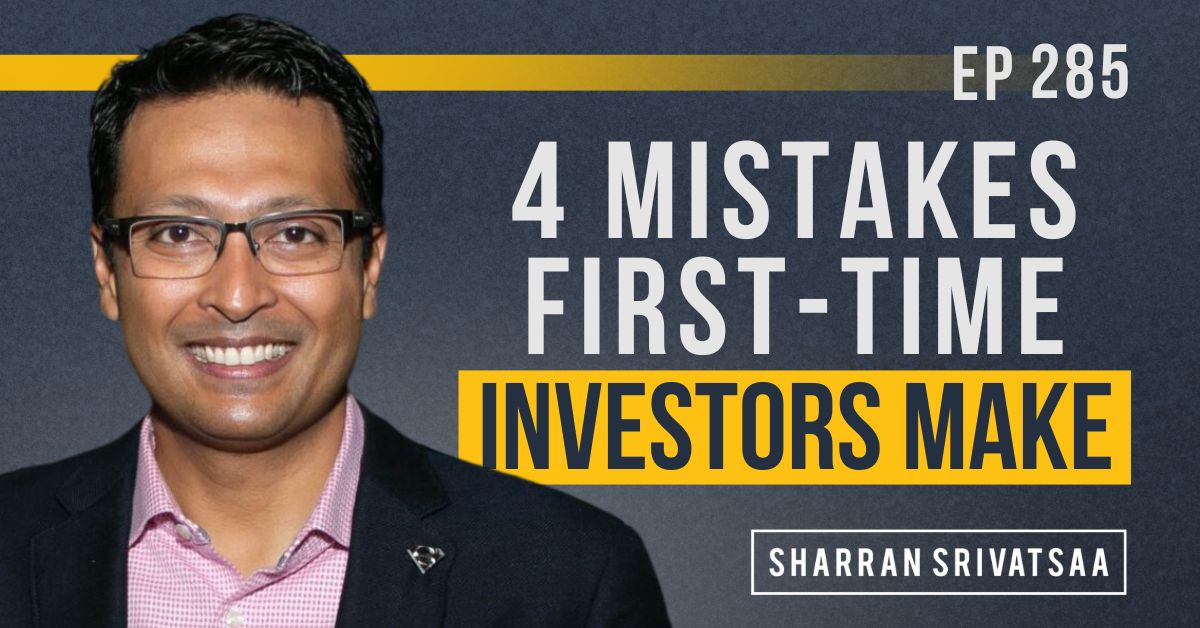
If you think investing is just about picking the right deals, think again. The biggest losses don’t come from bad investments–they come from avoidable mistakes. In this episode, Sharran reveals the four traps that new investors often fall into and the simple decision frameworks that protect your money, confidence, and future wealth.
He breaks down why embarrassment is expensive, how peer pressure can destroy portfolios, why the wrong operator can cost you everything, and how FOMO can lead smart people into making poor decisions. A lot of people don’t fail because the market beat them–they fail because they allow emotions and ego to get in the way.
Get ready to learn how to think like a disciplined investor and make smarter moves from day one. Listen in to upgrade your investing mindset and avoid the painful lessons most people learn the hard way.
“You don’t get rich by investing–that’s a myth. You get wealthy by learning to become a good investor.”
– Sharran Srivatsaa
Timestamps:
01:41 – The real danger of your first few investments
03:06 – Mistake #1: Hiding your ignorance instead of asking questions
05:32 – How investing in groups sharpens your discipline
06:24 – Mistake #2: Peer-pressure investing & the script that saves you
09:45 – How to reject deals without burning relationships
10:50 – Mistake #3: Trusting operators blindly
11:31 – Why good operators matter more than good ideas
13:57 – Mistake #4: FOMO & chasing trends
15:12 – Evaluate every deal against your next financial goal
19:32 – The real path to becoming wealthy
Resources:
– The Next Billion by Sharran Srivatsaa
– Board Member: ARC Multifamily Real Estate Investing
– Board Member: The Real Brokerage
Connect with Sharran:
– X
– YouTube
– Threads
Transcript:
[00:00:00] Hey, this is Sharran Srivatsaa. Welcome back to the Business School Podcast. And I gotta tell you the truth. When I started investing, I made a bunch of dumb mistakes. Even with the Goldman Sachs background. I’m not joking. I had ego and fomo and peer pressure kind of run me. So on this podcast, I’m breaking down for you the four mistakes that first-time or early investors make and how you can solve it.
[00:00:22] I break it all down for you step by step, starting right now.
[00:00:31] One thing is for certain: just because it’s tried and true doesn’t mean it’s working right now. So the big question is this. Where can you learn what is working right now? The strategies, the tactics, the psychology, and the exact how-to. How to grow your business, how to blow up your personal brand, and supercharge your personal growth.
[00:00:53] That is the question, and this podcast will give you the answer. My name is Sharran Srivatsaa, and Welcome to Business School.
[00:01:06] All right, today I’m gonna give you the cheat code. This is what I wish I knew before making, I don’t know, a hundred plus investments that I’ve made. So if you are kind of earlier in your investing journey, this is probably for you, and I would wager that every single one of us are earlier in our investing journeys, right?
[00:01:23] If you are not a day-to-day professional investor, then you, we, this is not what we do day to day. So I think it’s important to know kind of the, the, the. Eliminating the mistakes that first-time investors make will already make you a significantly better investor. The reason I’m telling you is, is that it’s important because most of the time, the first few investments that we make shape our, not just like what returns we get, but.
[00:01:48] I dunno. It shapes my confidence. If the first deal you invested in totally crushed it, you’d be like, man, I’m really good at this. But if it didn’t, if you kind of got crushed, if you didn’t work out well, it would take time to almost kind of rebuild the trust and the confidence that you have with yourself.
[00:02:02] And you naturally end up being a little bit more gun-shy and that. You know, that kind of takes a long time to get over, and then you miss the power of compounding. You miss power opportunities, and you miss a lot of things. By the way, if you are unfamiliar, I was a banker on Wall Street at Goldman Sachs and Credit Suisse.
[00:02:19] Uh, as you know, I’ve had a chance to build two publicly, uh, $2 billion companies, one publicly created, which makes you understand Wall Street even more. I’ve kind of invested in over a hundred plus deals after a hundred-day stop counting. And I will tell you this, looking back, I wish that someone had.
[00:02:35] Kind of given me a little bit of insight into these things, and I’ve realized that, you know, when I talk to people and if they can share with me the mistakes that they have made, most of life I have figured out is just doing fewer things wrong, making fewer mistakes because you don’t, it’s very hard to, you know.
[00:02:53] It’s very hard to fix a bad diet, right? So if you just don’t have the bad diet in the first place, you would win way more. And so I will tell you the good news is that most kinds of early mistakes are easily avoidable if you know what they are. And today I’m gonna give you four of these mistakes. So mistake number one is.
[00:03:08] Probably the biggest one, which is I think it’s being embarrassed to kind of show that you don’t know what’s going on. So, being embarrassed to show ignorance on a particular topic. So I will tell you this, when I started investing, I would just pretend like I understood more than I did and just to make myself be and look cool.
[00:03:27] Uh, looking back, clearly this was dumb. And so any conversation that I would have, investors that would pick me on stuff, I would just nod. I, even though I was confused and. Lo and behold, what do you think happened? I made investments. I made commitments without fully understanding a bunch of things. I learned very little in the process, the some win some deals, won some deals, lost, but here’s what was bad about that.
[00:03:53] Because of this whole thing, I really think that I was not only stressed about the deal itself. But I lost more money than I should have ever had. So if I actually understood it, I would not have been stressed about the deal. And if I was not stressed about the deal, I would actually understood what investment to make.
[00:04:07] And if I understood what investment to make, I would’ve lot less lost, less money. Therefore, I should probably not be embarrassed. Now, how do you not be embarrassed? And I think that’s very difficult. And so what I decided to do was my kind of advice, number one on how to not stop being embarrassed to show ignorance of this stuff is like I just tell people, Hey, I don’t know much about these things.
[00:04:28] Hey, I’m a really simple guy. Hey, would it be okay if I asked you a thousand easy questions? Like when I talk to people who. Are pitching me a deal. I literally use this phrase, and I love this phrase. I use it in sales conversations a lot because it reframes the number of questions you’re gonna ask. And I say, Hey, I’m a really simple guy.
[00:04:45] Is it okay if I ask you a thousand easy questions? So clearly they know that it’s, I’m not gonna ask a thousand questions, but they know it’s gonna be a lot. So they don’t say, Oh my gosh, this guy’s gonna ask me a lot of questions. And secondarily, I say, can I ask you a thousand easy questions? What I’ve done for myself is given myself permission to ask a bunch of simple questions, and now.
[00:05:02] Force them to be simplistic and help me understand the foundations of these things. So the key in all of this is like, number one, to have some scripting around asking, Hey, I’m a really simple guy. I don’t know much about this. I wanna support you. Is it okay if I ask you a thousand easy questions?
[00:05:17] And. Instead of being like all sophisticated and trying to do chat GT research to figure out, you know, you figure out what the sharp ratio of a deal is and what the efficient frontier is, and you know, because you know what cap rate compression is, you don’t need to know any of those things. Right. And that’s why this is important.
[00:05:31] So. The solve in all of this is to just find a way to invest in groups. If you have a group, if you have an investor group that you invest in, I would just commit to, you know, kind of doing your first five deals, eight deals in the investor group. By the way, investor groups will never force you to do things.
[00:05:48] So you can say, Hey, I, you know, I don’t feel comfortable about this. Or, Hey, I’m already com promised my liquidity elsewhere right now, but. They will continue to show you deals as long as you’re involved, as long as you’re engaged, and as long as you follow their process. Investing in groups is a really good thing.
[00:06:01] My favorite way to invest is investing in groups because when someone brings you the deal, they have a sense of responsibility around it. They are in the game with you. You can ask questions of them. You can, uh, sidebar conversations with the group. Different people in the group have different expertise, so they can kind of like jump in and explain things in a much better way.
[00:06:16] So I’m a big fan of investing in groups to solve this idea. The mistake number one, of being embarrassed. And so that’s mistake number one. Here’s mistake number two. I really believe that often we succumb to peer pressure. So succumbing to peer pressure is really like mistake number two. And the reason is most of us will probably find it difficult.
[00:06:40] I’m gonna at least me to say no when a friend or somebody that you respect invites you to a deal. Especially if there’s status involved overall, right? So most people, and here’s the crazy part, most people worry that, you know, saying no or declining, that you want to make this investment will either make you look uninformed or worse, make you look poor, or that you, you know, you’re just gun-shy and don’t wanna participate.
[00:07:02] They’ll think you’re a wimp. And by the way, I’ve been there too, and like. The social pressure can be significantly more intense on stuff like this because it is, is way more intense. It’s the pressure of the type of car you drive or the type of house you live in because everybody knows your home’s a low value.
[00:07:16] The way to overcome this is to prepare a script in advance that I’m gonna give you that I use all the time. And so when I don’t want to do a deal, here’s literally what I say, right. I literally will say this or send them a text message, and I’ll say, Hey Jimmy, I’m going to pass on this one. I’m already committed to another opportunity for this allocation.
[00:07:34] Thank you for including me, and I would love to consider a future one with you. Right? So think about that script says so. See, Jimmy was giving me the deal. I’ll say, Hey Jimmy, I’m going to pass on this one. So you always lead with the clarity. I’m already committed to another opportunity for this allocation.
[00:07:48] Two things there. One, I’m allocating some resources. Two, I’m already committed, means I have something else that I’m doing with this money that I’m not gonna tell you what it is. Thank you for including me. That means, you know, hey, I appreciate the thought, but I would love to consider doing a future one with you, not.
[00:08:02] I’d love to do a do one with you. I would love to consider doing a future one with you. That means, hey. I’m in the game with you, right? So the, the, I will tell you the crazy part of what I’m sharing with you this, what other people do instead. The first thing that they do is that they ghost, they’ll, they’ll literally tell the person who invited them to the deal and will say, Hey, let me think about it.
[00:08:21] And they’ll just ghost. And that, that, that person now has the pressure to follow back up three or four times. And this is really bad because if you do this, you won’t get any show, you won’t get shown any deals in the future. That’s why this is important. You don’t say, let me think about it. And if you’re not interested, just wait around and if they have to follow up, you have screwed up.
[00:08:37] Because of this, you will not get shown deals in the future. And I will tell you, you want to get shown all the deals in the future. I will. You have no idea how many deals I get. I see. I see hundreds of deals a month. When I say, when I say hundreds, I’m not joking. I probably see 10 to 20 deals a week.
[00:08:52] Right? Every single deal that I get, I respond very clearly to them. And a lot of times it’s exactly the script. Hey, I’m gonna pass on this one. I’m already committed an other opportunity for this allocation. Thank you for including me, and I would love to consider future one with you. You know, and they keep sending me more deals.
[00:09:06] Now, if at some point I would, because the, the reason you may say, well, Sharan, I don’t like the oil and natural gas deals. It’s not, I wanna see every deal because it, I see how a deal is presented. I see how a deck is sent to me. Maybe I flip it to someone else that I’ve been talking to about it. It helps me like relate to industries.
[00:09:21] It figures out how I can present my information in a different way. I want to see every single deal, like I’m a deal guy. I wanna see every single deal that’s presented. If there is a deal that is out there, I need to know about it. And the more deals that I see, the more structures I can see, and the more structures I can see, the better structuring I can do for others.
[00:09:35] And I learn all my deal structuring, looking at other deals, I just don’t come up with random deal structuring, right? And so I cross-pollinate deal ideas into the deals that I’m working on. Here’s the second thing that people do, which is really irritating. They make up fake excuses. Please don’t do this.
[00:09:50] The problem here is that everyone knows what a fake excuse is, and what does it do? It makes you lose credibility and trust in, they just won’t show you stuff anymore. So don’t make fake excuses. Just tell them the truth. The truth is very freeing. So please don’t make up fake excuses. And here’s number three, just to be cool.
[00:10:09] Don’t ask a lot of questions to show interest, even if you’re not interested. If you’re not interested. Just to be, just don’t ask a lot of questions. If you’re not interested, if you’re interested, ask a lot of questions. If you’re not interested, don’t ask a lot of questions because now they’ll feel like you wasted a lot of their time, and you are just kicking the tires even though you are not interested.
[00:10:27] That’s just not fair to the other person. The reason I’m sharing this with you, if you just have the simple script, people will kind of respect you for it and do it over and over again because you want to preserve, I don’t know, the relationship in some way while also protecting. In this situation, your decision-making process.
[00:10:45] So don’t let people bully you. Don’t let people peer-pressure you. Right? So that’s. That would be my recommendation. Here’s mistake number three: trusting the operator of the deal blindly. So I will tell you that many kind of early investors assume that the strength of the idea, like whatever idea, the startup idea, the real estate deal idea, determines the outcome.
[00:11:04] And I will tell you that is not entirely true. I’ve seen that happen in my life multiple times. Over time, you will realize it is all about execution because. When you’re investing in something, it is, is almost passive for you. You’re not working on it. What is passive for you needs to be active for someone else.
[00:11:21] Meaning if I’m going to write a check to somebody, that means I am deploying financial resources, meaning I’m not deploying time, operational capacity, et cetera. If I’m deploying financial resources, someone else has to do the work. Who’s doing the work here? Uh, meaning like good ideas are sexy, but like I get that good ideas can open doors.
[00:11:37] It can, I don’t know, give you more new opportunities. It can make you famous on brand, but the operator. The person who’s wielding the, the sword to like. Makes or breaks the deal. And I will tell you this when things go wrong, and I will, I’m telling you right now, when things go wrong and good up, then things almost always go wrong.
[00:11:55] And I will tell you, things always go wrong. You want someone that you trust in the captain’s chair, if you will, who has like the, the tenacity, the mental toughness, the grit, the emotional integrity. They know that you will, they are your ambassador in this process. They will, they will do whatever it takes to protect the company and in turn your investment because they need to realize that the.
[00:12:16] Not quitting is the most heroic thing you can do by, if you don’t know that court, it’s an Aquaman court. Not giving up is the most heroic thing you could do. So because of this, I will tell you, I’ve made it a standard practice to like really vet these operators, as you know. To me, the operate. I want to bet the op, good people, good intentions, good rationale, good contracts.
[00:12:33] I wanna vet the deal and the person running the deal. By the way to do this, if the deal is significant for us, I and I have not worked with the operator before. I do what I call a, a mutual, a mutual background check. So let me give you a script that I generally would use to, to talk to the operator. ’cause I wanna see what this operator’s done in the past.
[00:12:51] So I say, Hey Jimmy, we want to make sure that we are good partners to each other. For that, we’d like to offer a mutual background check where you can run a background check on us and call our references and we’ll do the same with you. What am I doing there, right? I’m doing a mutual background check. Now if I say, Hey, Jimmy, I wanna do a mutual back, a background check on you.
[00:13:09] He’s like, well, you don’t trust me. I’m saying, no. I wanna be good partners. I want you to do a check on me and check my references, and I wanna do a check on you and check your references. Right? And because you want to protect your downside and all this, you have no idea. By the way, I will tell you right now, I had a consulting client who paid me a lot of money for consulting, and then I invested in his company.
[00:13:30] I lost more money than. Most people will make in their careers because he was running two sets of books. And then after all of it, my partner was like, did you write a background check on him? I was like, no. And then when I did, he had like, he had a felony, and I was like, okay. So I don’t even care that he did.
[00:13:47] I would’ve at least asked him about it, and it would’ve given me a red flag. And by the way, I’m all about second chances and people being honest, I just wanted to know. And I did not know this. It’ll allow you to do better diligence overall. Alright. Here’s mistake number four. Uh, is this big idea of like chasing trends, uh, mainly because of fomo.
[00:14:03] FOMO is a. FOMO is real, by the way. Fomo, fear of missing out. FOMO is real, and I feel it all the time, and I try really hard to beat myself out of it. And I will tell you, having done this for a long time, you know, being a professional investor for 20 plus years, I will tell you I. Hot opportunities are constantly changing.
[00:14:24] There’s always a season for hot opportunities. We’ve gone through the crypto craze. We’ve gone through real estate markets. We’ve gone through multifamily. We’ve gone through flip fixes and flips. We’ve gone through Airbnbs. We’ve gone through, I don’t know, Forex trading. We’ve gone through penny stocks.
[00:14:38] We’ve gone through like it is nonstop. There’s always something else. But while I don’t know, while kind of like the details of the deal shifts, there’s. The emotional pool. I don’t know what, how else to call it. The FOMO is totally real. And this is where most kind of early investors get swept up in this excitement.
[00:14:58] They want to have that locker room conversation that they did this investment deal, and then that’s the shining penny for them. So I will tell you this, the way to solve that. Is to tie every investment to the next milestone in your journey. And like, let me explain what I mean. You gotta tie every investment that you’re doing to the next goal in your journey.
[00:15:16] I’ll give you an example. So let’s say for example, if your next goal is to build 12 months of cash reserves, I don’t know, I’m just making this up. I’m just assuming, let’s say your goal is to have 12 months of cash reserves, meaning, let’s say you want, let’s say you spend a, you spend $20,000 a month in your personal nut, and that’s, so that is 12 months times to a 20,000.
[00:15:37] That’s $240,000. If that is your goal, then your question should be, Hey, does this opportunity help me achieve that? So I take every opportunity that I have and I layer it on the focus of my next upcoming goal or, or the future upcoming goal, and I just evaluate against. Now, sometimes the next goal and the future goals are different, but that’s why you have clarity of the future.
[00:15:58] But this is a really good way to avoid the fomo, right? Number two is like, give you another example. So if your goal is to generate like your first passive income check, like, you know, where you write a check into an investment and you get the first passive income check, well. Because of that question.
[00:16:14] You should, if you said, Hey, does this, does, does, does contributing more to your, your SEP IRA or your defined benefit plan get you closer to getting your first passive income check? The answer is no. Right? So I’m not telling you whether you should put money in retirement accounts or anything like that.
[00:16:30] That’s not my jam. What I am telling you is if the goal is to generate your next passive income check and you don’t have that right now, you’re putting. $63,000 in your SEP IRA is a dumb idea because that is not gonna generate you your first passive income check. Right? Or putting it in Bitcoin is not a good idea.
[00:16:48] ’cause you’re like, man, I got it at the, I’m getting in at the right time. Well, it’s not achieving the goal. It’s not about, and it doesn’t matter where Bitcoin ends up in 30 years. It only matters if you hit your next goal so that you can hit the next goal after that. So you can build the confidence in yourself that you can hit more goals.
[00:17:03] So my recommendation would be. When you measure opportunities against like your next specific goal, it’s way easier to kind of ignore what the FOMO is and what the distraction is, ’cause I have not found any other way because otherwise, if the time horizon was unlimited. So think about this for a second.
[00:17:21] If you had an infinite time horizon, which what that means is you have, you know, you’re not, you don’t really need the money tomorrow and you have unlimited capital, then you can take a lot of. Then you can take a lot, then you can make a lot of bets, right? All of us don’t have unlimited capital and we don’t have an infinite time horizon.
[00:17:39] Now you may, I don’t, so I’m like, all right, so I have, I don’t have unlimited capital. I, you know, I have access to a enough, and I don’t have an unlimited ti, you know, infinite time horizon. I. I have a certain goals that I want to hit for myself, my family, my company, et cetera. So I’m thinking, all right, so how do I take that goal against the project that I have and evaluate it?
[00:18:02] If it fits, great, I wanna explore it. If it doesn’t fit, no thank you pass. Right? That allows me to know that it’s a, it’s a good idea to have something to diagnose against. Otherwise, you don’t have a benchmark. You don’t have a filter. I wanna like solve this myth for these for, for first seven investors or early investors, which is, I honestly thought that just constantly investing in things would make me wealthy.
[00:18:26] And I wanna just remove that thinking for you. Warren Buffett said something amazing, and he said, you know, assume that when you graduate from college or when you’re starting a professional career, you had a punch card, and then this punch card you had 10 holes you can punch. Essentially, those were 10 investments that you could potentially make.
[00:18:44] Ask yourself. Every time you make a sizable investment, which putting a thousand dollars in Bitcoin is not gonna change your life, you’re making yourself feel better about yourself. If you’re gonna put a thousand dollars in Bitcoin, and okay, you put a thousand dollars in Bitcoin and it went up a hundred x, okay, a hundred x over 20 years, now you have a hundred thousand dollars.
[00:19:05] Well, in 20 years that a hundred thousand dollars is probably worth, you know, time value adjusted eight, $12,000. You could have not done that at all. It doesn’t mean anything. It doesn’t dramatically change your life. But instead, if you said, Hey, I have, you know, I have a hundred thousand dollars, and this is a sizable bet for me, and I only had 10 bets that I could make in my life, what bet would I make?
[00:19:30] Right? And so the reason I say this is it is not about just investing itself over time. I will tell you this, I have realized the big difference that you don’t get rich by investing. That’s a myth. You get wealthy by learning to become a good investor. There’s a big difference. The you don’t get good by just investing.
[00:19:52] You want to become a good investor, and that is a skill, and you can only learn that skill slowly through mistakes. Or you can do this by just avoiding the mistakes that. People like me have made so that you don’t have to make them. So the four mistakes that you should avoid are, number one, stop being embarrassed to show ignorance.
[00:20:13] Essentially, if you invest in groups, it’s significantly better. Number two, don’t succumb to any peer pressure. And if someone’s gonna peer pressure into something, have a script, say, Hey, I’m gonna pass on this one. I’m already committed to another opportunity for this allocation. Thank you for including me.
[00:20:26] I would love to consider one with you for the future. Right? Number three is don’t trust the operator blindly. Do what we do, which is, you know, you run a mutual, you offer to run a mutual background check, and number four, do not chase deals out of fomo. And the main way to think about that is you want to have every investment be a solution to the next milestone or the next goal that you have, and that always makes sure that you’re making progress towards that.
[00:20:52] Uh, honestly, I will tell you these are probably what I wish I knew before making what a hundred plus investments. So these are the four mistakes. First time investment making and hopefully how to avoid them. If you like this. Hey, can you do me a favor? Can you screenshot this? Poster on social and tag me.
[00:21:04] That way I can make more like this for you. I’ll know that you like this, otherwise I have no idea. So do me a favor, share this with somebody if you think it’ll be helpful. But most importantly. Screenshot this and tag me that way I can make more like this for you.
[00:21:23] Hey, this is Sharran. I have an awesome free gift for you just for listening to the podcast. As you may know, I’ve got a chance to build $2 billion companies the hard way. So if you like this episode, you’ll love getting the exact playbooks from those wins. It’s on my Substack, called My Next Billion. It has the exact frameworks I wish someone had given me when I was figuring it all out. Now you get the real lessons from the trenches as I go for a three-peat and build the next billion. So everything’s free at mynextbillion.com. Please check it out at mynextbillion.com.