
Click Here to Get All Podcast Show Notes!
We’ve all read endless lists of predictions—what’s trending, what’s coming next, and what to watch out for. But what good are these predictions if they don’t provide a roadmap for success?
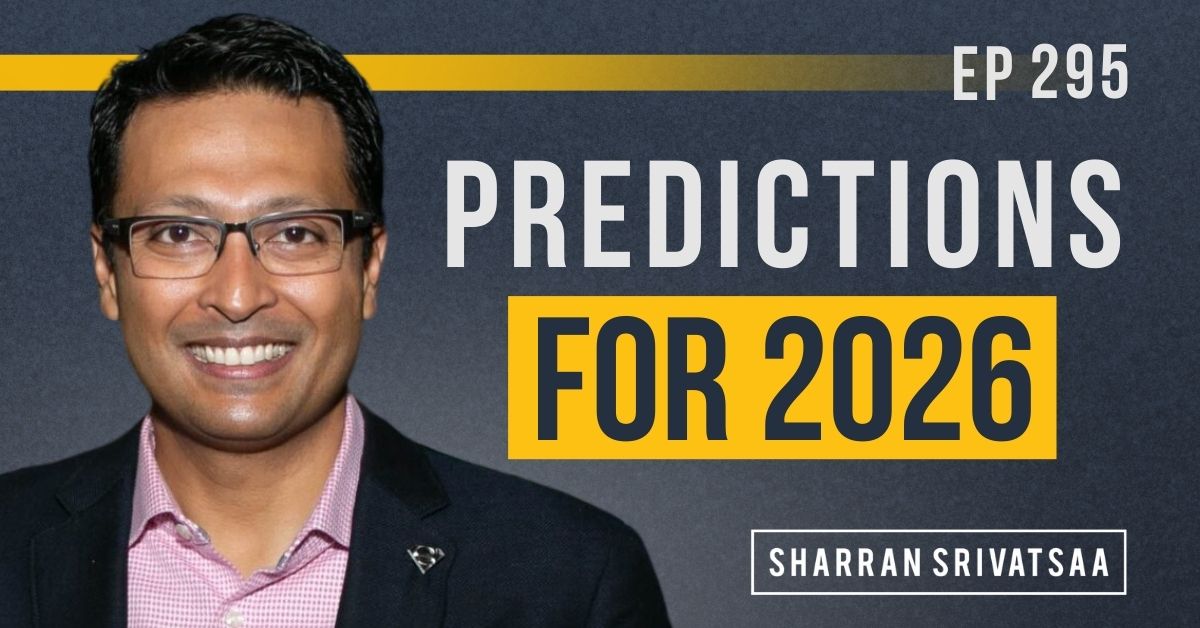
In this episode, Sharran breaks down his viral post on predictions for 2026 and gives you the tools to turn those ideas into actionable strategies. You don’t need to agree with every prediction, but Sharran’s goal is simple: To give you an unfair advantage.
Whether you’re building your personal brand, making smarter investments, or positioning your business for growth, this episode will help you think ahead, just like Wayne Gretzky skating to where the puck is going.
If you want to stay ahead of the curve, the key question isn’t, “What’s next?”—it’s, “What will you do if this is true?”
“Predictions are predictions. They’re not about certainty; they’re not a law. They’re not truth. Thereby just saying, hey, if this were to be true, how would I position myself right now?”
– Sharran Srivatsaa
Timestamps:
01:41 – Why predictions are useless if you don’t act on them
03:25 – The power of defaults and behavior
03:52 – Google Gemini and the future of AI
05:45 – Attention does not spread evenly
09:08 – Why hyperlocal content is making a massive comeback
11:21 – The importance of distribution over product
12:48 – The return of boring business models
14:35 – How AI can help you grow your business
15:49 – Why entertainment and personality are key to content creation
17:06 – Big winners get bigger over time
Resources:
– The Next Billion by Sharran Srivatsaa
– Board Member: ARC Multifamily Real Estate Investing
– Board Member: The Real Brokerage
Connect with Sharran:
– X
– YouTube
– Threads
Transcript:
[00:00:00] Hey, this is Sharran Srivatsaa. Welcome back to the Business School Podcast. And I wrote a list of 26 predictions for 2026, and it went viral on social media. But I will tell you that predictions are useless if they just sound interesting. You read them, and you tag them, and you share it overall. So in this episode, I’m not gonna read you that list.
[00:00:15] That makes no sense. I’m gonna take that list and walk you through a few ideas that actually. Will be profitable for you and help you win because I did all the work of thinking through them for you. You don’t have to agree with what I say, but it may give you the unfair advantage. I’m gonna break this all down step by step for you, starting right now.
[00:00:36] One thing is for certain. Just because it’s tried and true doesn’t mean it’s working right now. So the big question is this, where can you learn what is working right now? The strategies, the tactics, the psychology, and the exact how to, how to grow your business, how to blow up your personal brand, and supercharge your personal growth.
[00:01:00] That is the question, and this podcast will give you the answer. My name is Sharran Srivatsaa, and Welcome to Business School.
[00:01:13] Okay, let me start by telling you why I wanted to do this episode. A few weeks ago. I wrote a list of predictions for 2026. Honestly, it was nothing fancy. It was 26 predictions for 2026. Just things that I think are likely going to happen if the current trends keep kind of playing out, and I wanted to give myself kind of a playbook for what I’m looking forward to, where I can bet on.
[00:01:32] I will tell you that. Post kind of went viral. A lot of people read it, especially on it went viral on Twitter and, and on my substack. And I noticed something that most people read. Predictions like content. They essentially kind of scan them. It’s kind of cool. They agree or disagree. I get a bunch of hate.
[00:01:48] They either move on or they forward it to a friend. Nothing really changes, and I’m telling you. Not the point. That’s not why I wrote it. So today I wanna actually do something a little different for you. I don’t want to read you these 26 predictions for 2026. You could go read them on, you know, on socials if you want.
[00:02:04] But I wanna talk about how to actually use these predictions, and these are just ideas for me, but maybe you have them too. I’m not saying I’m right, but I’m telling you that to make better decisions, you need a little bit of time and attention. I’m gonna show you how I actually broke all of this down, so I’m going to take.
[00:02:19] A handful of the predictions that I made, and I’m gonna group them into simple ideas for you. And for each one, I’m gonna explain why it actually matters, you know? And maybe if that may tell you what you can do differently. I, if you assume that is true. So I’m always telling you to assume that if these were true, would you do? That’s what I want you to read at.
[00:02:37] So anytime, by the way, you read any predictions, I want you to ask the question, if these were actually true, what would I do that allows you to figure out. Judge and validate the prediction overall. By the way, you don’t have to agree with any of these, but I hopefully they give you a heuristic, a shortcut to thinking on how you would actually do something like this.
[00:02:55] But I will tell you this, you should be able to point to at least one idea about where the world is heading because if you cannot, you will always respond to things after they change, which is no bueno. By the way, you know, all of you know my love for hockey, which is when Wayne Gretzky said he skated where the puck was going to be.
[00:03:12] That I think the idea applies well outside of hockey too. People who could get ahead tend to just be positioned early. They tend to have better optionality, and I think that’s the opening kind of frame for this episode. So let’s get into the actual stuff. Big idea number one is I really think that defaults shape behavior.
[00:03:30] What I mean by that is this shows up if more places than you think. Right? Did you know that when, you know, in the driver’s licenses, when they started automatically pre-checking the box of an organ donor, the organ donor donor stuff, like, went up by like 300% because. Default shape behavior in AI, in platforms, in how we buy and make buying decisions.
[00:03:52] And I will tell you, one of my predictions is that Google Gemini is gonna become the most used AI model. I, I will tell you, it’s not because it’s the best, it’s actually pretty good. It has the highest and largest context window of all of them. But because it just shows up super tidily inside of Google.
[00:04:07] So if you’re a Microsoft user, I actually know an entire Microsoft company that is switching to Google just because of how far Google and Gemini integrated with everything that they do. And. My point is, I will tell you that most people already use Google. Almost everyone has a Gmail account. They do not research tools.
[00:04:22] They just click what appears first. And by the way, the same thing happened with Amazon. People just say they want, they’re like, oh, I want alternatives. They want to, but then they just go buy from Amazon anyway. Why? They, they just say, oh, I want something cool from Etsy. They, they don’t, they just go from buy, from Amazon.
[00:04:36] Anyway. I know people who don’t buy stuff because it’s not on Amazon. Like, that’s insane because it’s familiar, it’s easy, it’s fast. It’s got the one-click shopping, you know, it’s gonna show, show up. Right. I will tell you that defaults remove a ton of operating friction in people’s lives. Default remove like buying friction.
[00:04:53] So when something is easy, people will just choose it because it’s easy. So here’s. The, I don’t know, the idea, the behavior shift that I want you to consider. If you are building something, don’t assume that people will go looking for you. You have to make it easy for them. Ask where people are already spending time.
[00:05:11] Ask where people are already doing something, and how do you like just. Fit into that. This could mean building on top of the existing platform. This could mean a partnership where someone else endorses your services. This could mean using channels that already have attention. This could mean getting people not to leave Instagram and click DM so that they can start to DM you.
[00:05:28] What can make it easy? Don’t make things hard. Don’t sell. Don’t sell people’s work. If your plan and depends on changing habits, I will tell you right now it’s super hard to execute because the brain is super lazy and does not wanna change anything. Alright, based on that, here’s big idea number two, which is I think there the attention overall is gonna be into fewer people in fewer places.
[00:05:50] And what does that mean? It’s that attention does not spread evenly, for example. I’ve been writing on Substack because I believe that last year, Substack was going to become the YouTube of writing. YouTube is just gonna win big time, right? However, Substack, it started on Medium. Medium screwed up by changing their business model.
[00:06:06] Substack is now the, the big winner. There are other platforms like BHI and Ghost and things like that. They’re all newsletter platforms. There’s a big difference between a newsletter platform and a writing platform, and a writing because you’re not looking for a newsletter platform on YouTube. You’re looking for a writing platform on Substack, a small group of writers gets the most attention.
[00:06:25] Like my Substack audience has been growing organically and naturally, just because I’ve been writing more and more on Substack and the, the people that read. And subscribe to you are the re are readers, so you get the best possible readers. And on the opposite, I will tell you that LinkedIn is filling up with so many AI posts because there’s so much automation and so many tools.
[00:06:43] Like I see examples of systems out there where you can just pay somebody and they will take a bunch of your podcasts, and they will automatically just build LinkedIn AI posts and just slap them all over, and they’ll automatically build bots that. Comment for you overall, which is insane. This makes real writing, by the way.
[00:07:01] You can say, oh, that sucks. But I actually think it’s, it’s, it’s, it’s better because this makes real writing way easier to notice. By the way, if you’re not on LinkedIn, you should watch my stuff because you could tell that, you know, that is not. AI-generated content. That’s what’s important, and this is makes real writing super easy to notice, and I’m telling you, the same thing is happening on YouTube.
[00:07:20] This is the main place for reviews. This is the main place to build your brand. This is the main place to build audience growth because it is hard as building long-form is very difficult. Short form is easier to build, like you can pull out a phone and shoot something. But building long-form, getting the packaging right is hard.
[00:07:34] So as all these platforms, as they mature, people just stop browsing. They stop like screwing around. They follow a few voices that they trust. That’s why you’re probably listening to this podcast. You probably are not listening 20 podcasts, you’re probably listening to four. So the takeaway is really simple.
[00:07:48] Trying to be average does not work. Just trying to pump out more content, chop it up, and put it up in different places does not work. Trying to be everywhere does not work. You gotta pick one place, you gotta find a good format. You gotta find out. How you can do that? Well, it’s gotta be like art to you.
[00:08:03] You gotta commit toit. You gotta do it for a long time. This is like, I don’t know, I think 300-some episodes of this podcast. That’s 300 plus weeks. Most of you have been listening to me like, that’s insane. I love you so much for it, and you commit to it. Can you imagine if this I just turned on an AI version of this podcast, where you would just listen?
[00:08:19] Like that would be weird. You know that this is not AI, right? Like I am actually recording this at a studio, talking live and. Yes, I have maybe a few bullet points of notes ahead of me because I wrote all of this down. But how do I implement this for you so that you can listen while you’re doing other things and say, okay, cool.
[00:08:34] I got that big idea here. So I will tell you this. When all the content starts to sound the same, the realness, the humanity will start to stand out much faster. May in writing, may in speaking, may in ideas, but I think we. Output is not a problem anymore. Everyone can create output. You can hire people to create output.
[00:08:51] You can get VA to create output. You can get AI to create output. If you think that making more videos is the answer, it is not the answer. Making better videos is the answer. Making better content is the answer, and it’s going to be that not only do you have to make better, you have to make more of the better, but you gotta start making better first.
[00:09:06] Right? And this gonna be idea number three. If you sell. If you sell anything and you sell like high locally, this is the year of hyperlocal. It started last in the last year. It’s really gonna crush this year, this, this next. It’s all about the year of the hyperlocal, which means creators who focus on like one city or one region or one area are gonna become like very, very well known there.
[00:09:26] They’re not gonna become like this famous online personality. They’re gonna be recognized locally. They’re gonna, this is gonna be like the real business stuff, like restaurants and gyms and real estate, and you know, like local services and pizza shops. I like, I will tell you at the same time, Facebook organic reach is super, super underpriced, which means most people.
[00:09:43] Stop paying attention to Facebook, and now it’s got this, it’s back. So local content still performs very well because Facebook and Meta can do one thing well. They can. They understand how to show your stuff to a local audience. They figured out local targeting. Community posts are really good, practical posts are really good.
[00:10:00] This is not exciting stuff, but it works. And the big idea is that if you run a local business where your, your clients are all local, stop trying to reach everyone in the world. Stop trying to have your videos go viral. Do you want your videos to be seen by your perfect audience? By a perfect local audience?
[00:10:15] And that’s exactly what you want. So focus on the people who live near you. Post about local topics, show your face, be recognizable. This is the year of hyperlocal because local trust will go faster and because most people will see you offline, I will tell you there’s never been a greater time to be a local celebrity.
[00:10:32] If I were, if I were a real estate agent or a mortgage broker, or a a, a local general contractor or a local dog walker or local barber shop right now, I will tell you over the next 18 months, I would plan on. What would I have to do to become the mayor of this town? If I were running for mayor, what would I do?
[00:10:49] And I would run that campaign because when you run that campaign, everybody knows who you are, and that’s what you need to do. And it has never been easier to be able to do that in the next 18 months. I will tell you, I right now, I could, if you gave me 18 months and not a lot of budget, I could become the mayor of lag, uh, of Laguna Beach because I would make every single person knew who I was and love me for it.
[00:11:11] That’s exactly how you could do it, because you are going, the world has given you the platform to be able to do that. Alright, this gets me to the next big idea is a lot of people talk about product. If product is king. I will tell you that distribution is the kingdom, uh, and, and, and meaning. The next idea is, is all about leverage.
[00:11:30] If product is. Really, distribution is the kingdom. Most creators are building tools and make content. They have audiences. They spend all this time and video get a videographer. They’re like, this is a year of video. I’m gonna make seven videos. And some dumbass coach said that, you know, you know you’re not only as good as your last seven videos.
[00:11:45] Well, sure that’s interesting, but. Most of these tools will, will not become these large software companies. Most people will not become, you know, fancy viral creators. This, these does not make them failures. Like distribution lets you launch things. It lets you test ideas. It lets you generate revenue without needing to randomly scale.
[00:12:04] It shows up. You don’t need investors. They don’t care about slides. They don’t care about working products. They want to see something real. What you need is distribution. So let’s build things that people can use, even if it’s small things. You, this is where you get an email list. This is where you get a social media following.
[00:12:20] This is where you get DMs. How do you get people to do things? Because when you can reach people, when you have a thousand true fans, even small things are amazing. You can launch earlier. Distribution literally allows you to learn and shorten the feedback loop. So if you could partner with somebody. To get your distribution.
[00:12:36] If you can make your own distribution, you have to wake up in the morning and say, Hey, how do I get more people to see my stuff? And if you do that, you win. And I’ll tell you, the fastest way to win is figuring out who could distribute your ideas. Right? Here’s the next big idea. Boring things make people a lot of money, and let me light them up for you.
[00:12:53] Email outperforms paid ads for soup. So many businesses, direct mail is growing again. You know why? Because people just gave up on direct mail, and our mailboxes are empty. Like I, you can visibly see less things in the mailboxes, therefore, but. People check those every single day. In the investing world, private credits are attracting capital quietly, or what is, what is private credit?
[00:13:12] Private credit is where you loan money to private businesses, and they pay you a rate of return that they can’t get money from banks for. So you get to, you get to make more money than the average person in index funds. You may say, oh my gosh, Sean’s giving investment advice. I’m not. I’m just telling you that more and more money are going to index funds because I have friends who can’t afford a house right now, and they would rather have their down payments sit in an index fund and keep growing along with it.
[00:13:33] Uh, why? Because interest rates may drop a little, but borrowing is still super expensive. None of this is exciting, right? Private credit is not exciting. Email is not exciting. Direct mail is not exciting. It doesn’t make you famous. Index funds are not exciting, but that’s what keeps working, right? And I think there’s this, this feeling to chase what’s new.
[00:13:51] But the returns come when people, when all the newness, all the hype is kinda worn out. I hate using the word hype. It feels like I’m reading from a script, but I’m not. Returns come when like the people have stopped talking about the thing. So if you can stick with it longer than the hype, if you can stick with it longer than the buzz, that’s when you win.
[00:14:09] So I would tell you this, if you’re a business and you know, all the expensive channels are not working for you, I would kind of check out the revisit the old boring channels. Can you just go back to email? Do you have like your. You know, 50, a hundred emails, uh, clients. Can you email them? Can you direct mail them?
[00:14:24] Can you give them simple offers? Can you give them free consulting? I will tell you. That is how you win right now, because the boring stuff makes people a lot of money. Let’s talk about AI for a second. This is kind of like my, my, my last two things. Ai, a lot of people think that AI is gonna take away jobs and things like that.
[00:14:39] I, I actually think it’s the opposite. AI is gonna help businesses grow. I don’t think it’s going to remove a. Responsibility or take jobs away? I think that the tools that help bring in customers matter more than tools that only save time. All the businesses wanna do is they just don’t wanna cut costs.
[00:14:55] They want to grow. So when AI makes mistakes, someone will still own the outcome, right? You want somebody to still, ’cause otherwise you don’t have delivery. You don’t have control over delivery. I will tell you, there’s gonna be more. AI slop in contracts that people hack together with AI and ChatGPT, that all these attorneys are gonna fix, like lawyers have, have, are set for life, or at least for the next 10 years, because there’s so much crap in AI’s contracts right now that people just try to hack it themselves and.
[00:15:24] I think that the shift is gonna be, not to avoid AI, but to use AI for growth, to use AI to actually generate revenue, to use AI, to bring in customers. So your job should not be like, Hey, how can I use AI to cut costs? Your job should be, how can I use AI to grow my business, to get more customers, to get more revenue?
[00:15:40] And I think that’s where the, that, I think that’s the frontier right now. All the other tools will figure out the quality of stuff later. This brings me to my kind of, my last two points. We also forget this. The next big theme for me is like people go online to be entertained. Like we forget that. I believe that in this next year, comedy creators are going to get a ton of watch time.
[00:16:00] People want to watch short, and then, people are now gonna watch, wanna watch short-form content on their TVs. Then they’re gonna scroll the phones at the same time as they’re on their TVs. And I think Avengers Doomsday and the Odyssey are going to be the biggest movies that are gonna carry the box office because of Hollywood.
[00:16:15] It is just not doing well as a business. People want things that are easy to watch. People want something familiar. People want to take their mind off. People want to look at their phone as a place of safety and a place of entertainment. They wanna be happy that is the happiest devices in their pocket.
[00:16:30] So if you create content, remember this, entertainment matters. If you just wake up and tell them, Hey. Here’s how you grow your business in three steps, or here’s how you actually, you know, buy a piece of real estate, or here’s how you, this is your mortgage rate update for the day. Like, think about how to make that more entertaining.
[00:16:46] And you wonder why the cat videos actually get a lot of views. The cat videos get views because they’re entertaining, entertainment. If you can just put entertainment into things, entertainment is what wins. And I will tell you, not everything needs to teach stuff. Sometimes the value is actually to give people a break from the real world.
[00:17:04] Right? Last but not least. I really think that the big winners get bigger over time, and what I mean by that is I’m not a big crypto guy, but I think Bitcoin ownership. Is going to concentrate because people who’ve been betting are gonna keep betting more. And I, I think large platforms are gonna keep getting more share.
[00:17:20] When companies are starting to scale, they start understand that they’re making more money, so they’re gonna put more money into scaling more. You’re probably gonna make more money by owning something as opposed to renting something. I, I think the big winners are just gonna get bigger over time. So my question for you is, what was one area where you won this year where you feel good this year where you built something this year and you’re like, man, I’m really good at that thing.
[00:17:40] It’s already big. How can you double down on that thing? Big winners, I actually think win more. I think that’s pretty powerful. Alright. I hope you got the point of this episode. What I was I trying to do here? I wanted to, I, I was not trying to get you to agree with every prediction. I was not trying to get you to act on all 26.
[00:17:56] I was maybe pick one or two ideas, but I, I wanted to ask you [00:18:00] this. I wanted to ask a simple question, which is, if this is true, what would I do differently? Meaning, if any of this is true, what am I gonna do? What are you gonna build? How are you gonna spend your time? I, predictions or predictions? They’re not about certainty.
[00:18:13] They’re not a law. They’re not proof. They’re about just saying, Hey, if this were to be true, how would I position myself right now? And then it’s a no. It’s downside protection. It’s like you’re doing it, and if something happens, great, you take advantage of it. And if you, if that doesn’t come about, at least you are ready for it.
[00:18:26] And then you get to win no matter what, because there’s no extra investment. If you have to wait a fit for things until they’re already true, that obviously means that you’re too late. So my question for you is, how do you do what Wayne Gretzky did? How do you skate to where the puck is? How do you pick a direction if you don’t like any of the things that I suggested to you?
[00:18:47] How do you make a small bet? How do you. How do you just say, Hey, I think the world’s going here and I’m gonna bet on this happening, and if it works, great. If it doesn’t work, cool. At least I tried. That’s one I want to give to you. So the next time you see a prediction, I want you to ask this question, which is, if this were true.
[00:19:04] What am I gonna do? Alright, I hope that was helpful. If you think this could be helpful to somebody, or if you’d like this, can you do me a favor? Can you screenshot this episode and tag me? That way, I can make more like this for you. So please screenshot and tag me, and I can make more like this for you.
[00:19:16] And if you, if you wanna see the list of all 26 predictions of 2026, I’ll put ’em in the show notes, and it’ll be bullet points so you can just read through all of them. And, uh, it’s on Twitter, all of that of course. So hopefully this is helpful to you. If you like this episode, screenshot this and tag me.
[00:19:29] That way I can make more like this for you.
[00:19:38] Hey, this is Sharran. I have an awesome free gift for you just for listening to the podcast. As you may know, I’ve got a chance to build $2 billion companies the hard way. So if you like this episode, you’ll love getting the exact playbooks from those wins. It’s on my Substack, called My Next Billion. It has the exact frameworks I wish someone had given me when I was figuring it all out. Now you get the real lessons from the trenches as I go for a three-peat and build the next billion. So everything’s free at mynextbillion.com. Please check it out at mynextbillion.com.