
Click Here to Get All Podcast Show Notes!
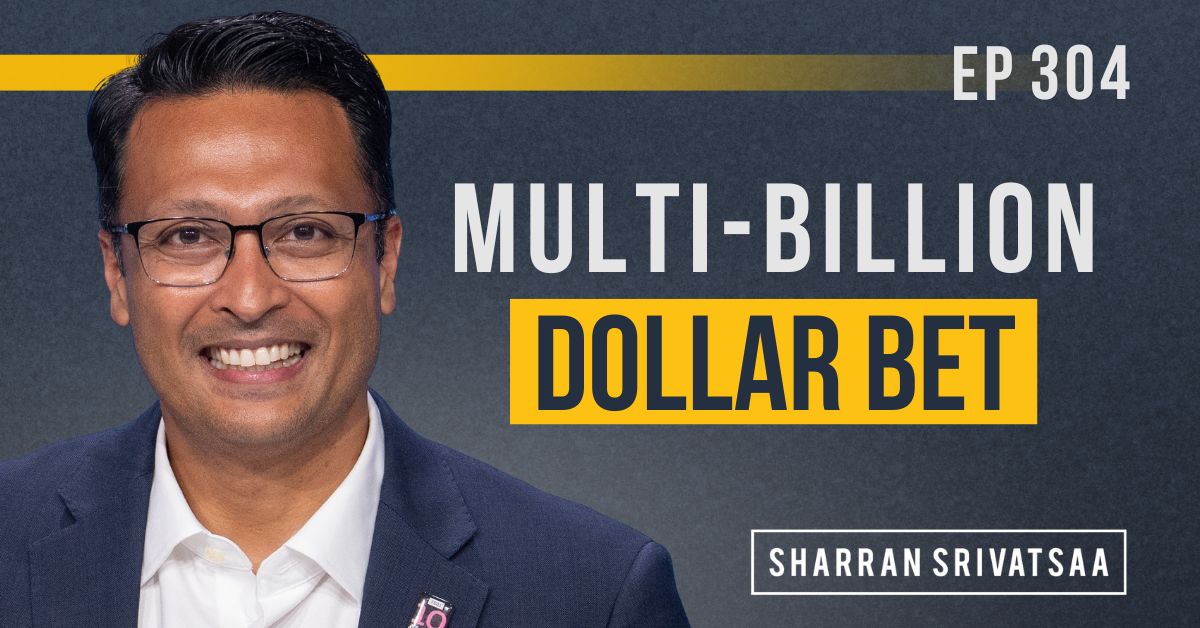
What does it take to build a multi-billion-dollar business? In this episode, Sharran pulls back the curtain on one of the biggest strategic moves at Acquisition.com—building a multi-billion-dollar business model. He walks you through a major decision to redesign their company structure, focusing on how a shift in leadership roles and responsibilities can lead to explosive growth.
Sharran discusses the importance of building capacity before scaling and how they doubled the business size while integrating new executive leadership. He also touches on how embracing AI-first thinking and focusing on category kings are key strategies for future dominance.
If you’re looking to grow your business or take your career to the next level, this episode is filled with lessons and strategies that will help you scale intelligently, build infrastructure, and lead with vision.
“The bigger the vision, the more you need very focused people fully in their zone of genius to make this come to life.”
– Sharran Srivatsaa
Timestamps:
02:09 – Decisions and choices leading to the desired result
04:11 – The importance of capacity before scaling
10:08 – How to build a brand from the ground up in real estate
11:30 – The role of AI-first thinking in future growth
13:00 – Insight into Leila Hormozi’s upcoming book
14:08 – How a House of Brands strategy drives business flywheel momentum
16:43 – Why focusing on a few “category kings” will bring major success
Resources:
– The Next Billion by Sharran Srivatsaa
– Board Member: ARC Multifamily Real Estate Investing
– Board Member: The Real Brokerage
Connect with Sharran:
– X
– YouTube
– Threads
Transcript:
[00:00:00] Hey, this is Sharran Srivatsaa. Welcome back to the Business School Podcast. And in this episode, I’m gonna take you behind the scenes and share with you something that probably no business owner, no entrepreneur, no CEO will ever share with you. And it’s all centered around this one quote, which is, most people only see the decisions you make, not the choices you have.
[00:00:17] And in this episode, I’m gonna pull back the curtain on one of the biggest moves that we’ve made@acquisition.com and explain to you exactly why we made it all step by step, starting right now.
[00:00:34] One thing is for certain. Just because it’s tried and true doesn’t mean it’s working right now. So the big question is this: where can you learn what is working right now? The strategies, the tactics, the psychology, and the exact how to, how to grow your business, how to blow up your personal brand, and supercharge your personal growth.
[00:00:56] That is the question, and this podcast will give you the answer. My name is Sharran Srivatsaa, and Welcome to Business School.
[00:01:09] All right. I wanna share something that honestly makes me a little uncomfortable to talk about. Not, not because it’s bad, actually, it’s quite the opposite, because I genuinely don’t love sharing all of the stuff publicly, because some stuff needs to stay private. But a lot of what I’m gonna tell you, many of our employees@acquisition.com haven’t even heard of yet, and I’m sharing it with you in full detail, uh, because I think it’s important for you to see.
[00:01:34] The how things work behind the scenes of a fast-growing business that may be appealing to you as well. So here’s what we’re doing. I’m gonna peel back the onion on one of maybe the biggest moves since we’ve ever made@acquisition.com, the behind-the-scenes decisions, the sequence of it, the why behind all of it.
[00:01:53] And you know, I always believed in sharing the real stuff. It’s like there’s no highlight reel, there’s no, you know, I’m sure there’s a press release somewhere, but the actual decisions that are happening in real time and how. How I’m going through them, and maybe that’ll benefit you as well. So let me start with something that has been sitting with me lately.
[00:02:07] To set the stage, there’s a quote that I keep coming back to, which is. People only see the decisions you make, not the choices you had. I’ll say that again. People only see the decisions you made, not the choices you had. So think about that for a second. Every successful person you’ve ever admired, every company that you’ve ever maybe studied, every leader that you’ve ever followed, you saw the outcome you saw.
[00:02:31] Uh, the, the, the decision, but you never saw the sequence of choices that actually got them there. You never saw the fear. You never saw the doubt. You never saw the aspiration. You never saw the ambition. You never saw the conversation at 11:00 PM when someone said, are you actually sure about this thing?
[00:02:46] And then you wonder. Why your path feels harder than theirs. Look, you’re like, how did that person make it and feel? Feel so simple. So here’s what I’ve realized, and then nobody shows you the behind-closed-doors decisions. Nobody shows you the sequence of things that happen. And without seeing the sequence, you can’t really learn from it.
[00:03:02] You can’t really admire it, you can’t really appreciate it, you can’t really study it after the fact. You can’t really use that learning in your life. So I’m gonna show you a little bit of the sequence. Alright, so before I get into specifics, I wanna talk to you for a second about why I think this matters for you.
[00:03:16] Because I bet you’re probably going through something similar right now. Maybe you’re thinking about your next big move. Maybe you’re wrestling with whether or not to make a certain investment. Maybe you want to bring on someone new to the business as an employee or a partner. Maybe you want to take the job, maybe you want to ask that girl out.
[00:03:30] I, I don’t know. All these decisions have the same shape of sorts. There’s fear, there’s shame, there’s doubt. There’s this little voice in your head that says, what if I’m wrong? It sounds, I will tell you identical to whether you’re making a multimillion dollar move or whether you’re figuring out the next chapter or whether you should, you know, stop living in New York and move to San Francisco, and when you watch someone else go through this in real time, I think something kind of shifts internally and gives you the courage, the confidence to be able to do that.
[00:03:56] So I actually think it gives you permission. Permission to make the hard call, permission to bet on yourself when nobody else can see what you actually see yet. So. I’m doing this. So let, let me give you all the, lemme give you the T as they would say. So here’s what’s happening@acquisition.com. We are redesigning and evolving into a managing partner-led model where my partners, Alex, Leila, and I are each going super deep on very specialized areas to build what I call a bigger and better future together.
[00:04:25] So as of this year, I’m stepping into the, you know, CEO role to execute our plan to build the private equity business model of the future. My. Bestie. Layla is stepping into the role of executive chair with her focus on building a world-class media machine for us, and also deploying a lot of strategic investments that I will tell you about in a second.
[00:04:45] And many of you know my partner Alex. Alex Hormozi is going to continue, and honestly, he’s the money monster. He’s gonna lead the charge on building the Operating Money models, which is the title of this, you know, third book, the Guinness Book of World Records Book, building the Money Models across our entire portfolio.
[00:05:01] We believe that. You know, this managing partner-led model where Alex, Leila, and I go deeper on the specialized areas is what’s gonna create a bigger and better future for us? Now, I know this sounds what needs to sound like outside. Oh, it sounds clean. It’s tidy, it’s obvious, but I, I’ll tell you the behind-the-scenes part of all of this.
[00:05:17] Last year in August, which is not that far ago, we made $106 million in 72 hours. The obvious move for us was, you know, making a hundred plus million dollars in a weekend, all without leaving our offices, was an obvious move to kind of strike when the iron was hot. To run that same play again, to keep that momentum going.
[00:05:37] We could do that, but we did not do that. My partner, Layla, was my. You know, she, she is one of the times when I saw her, her true, you know, visionary form, and she called it immediately, she said, Hey, we’re not doing another one of these until we build the infrastructure to support something, something completely bigger as to what comes next.
[00:05:56] And I will tell you that decision was very uncomfortable for everyone because that meant that we almost had to put our massive engine on pause to build capacity because growth only comes with capacity. And I’ll tell you what followed after that. This was the most constant, like our Q4. Essentially, the last four and a half months was the most concentrated period of what we are calling the organizational building that we have ever done.
[00:06:20] Uh, we doubled the size of our business. Essentially, we doubled the size of the headcount of our business. We brought on six new C-suite executives in one single quarter. Like, think about that for a second. We had, we built a completely new C-Suite team. Where essentially Leila and I were running everything outta the six.
[00:06:37] Two of them came from inside. The business that we promoted from within two of them came from our personal network, and two of them we ran a full external search process to build out a six-person brand-new executive team. And you, you need to know that why this matters. So you may be choosing, I know the scale and scope may be smaller or bigger than what you’re looking for.
[00:06:55] But I, I want you to think about that. We just didn’t look and say, we’re just gonna promote our way out of this gap. We did not just hire our way out of one either. We did both at the same time with the same standard. And that’s the behind-the-scenes version, right? I want you to see that. We actually had to pause the business to grow the business, and nothing hurts me more than hitting pause for a little bit.
[00:07:16] Now, of course, the there was, there was stuff that was running in the background. When I say pause, we paused on new initiatives. We paused on the big ideas. We paused on new infrastructure. We paused on launching new companies. We paused on making new acquisitions, but we still did a bunch of things. But that pause was very material that actually gave us a little bit of time and capacity to do the next thing.
[00:07:35] And so the big lesson from for us here is I wanna share with you that if you are planning on doing something big, you may want to like figure out if you have the right capacity to do it. Otherwise, if you take this approach of, I’m just gonna figure it out as I go along, you’re gonna hit the roadblocks and not be able to live into that capacity.
[00:07:51] Right. So the reason this whole kind of redesign of revolution of this, you know, trifecta makes sense is, is actually very simple. I’ll tell you what that means. The bigger the vision, the more you need focused people fully in their zone of genius to make this come to life. I’ll say that again, if I can remember it.
[00:08:10] The bigger the vision, the more you need very focused people, fully em embedded and entrenched in their own zone of genius to make this come to life. When you know, when Alex and Alex Hormozi and I were all touching everything, we were each what quote brilliantly and, and individually involved, but we slowed each other down, right?
[00:08:28] Because. Anyone was doing not, not, not that anyone was doing anything wrong, but every decision required us to context switch between the future and the present and the past, and the money and the people and the infrastructure constantly, which means none of us was doing either job as well as we thought it was deserved.
[00:08:43] So now. The restructuring, the re redesigning of this model makes it a lot of simple. One of us lives in the future and pulls it forward. Thinking about what building towards that, what capital to deploy, what brands to create, what the next 10 to 25 years look like. The other person stays today and moves as fast as possible to hit that three-five-year goal.
[00:09:03] Running the business, supporting the leadership team, hitting the targets, making the money work. And when you’re divided that way, both jobs get done. You actually get to live in the future and pull the future forward. You actually, then you, the other person gets to live in the present and drive towards the future, and it’s very hard to accordion, as I like to say, accordion between the past and the future.
[00:09:21] It’s very hard to do that in one person’s head. Right. And the, the, I will tell you the quality of the decisions that have come out of this is just the first few weeks is already, I would say, noticeably different. ’cause we are living in completely different timelines of the business, which allows us to grow the business in record time.
[00:09:39] So think about how amazing that is. Like if I’m growing the business, if I’m growing, if, if the, if there was a. If our business existed in a five-year chunk and I was responsible for growing that chunk, and then Layla was responsible for growing the five to 10 year chunk. We have two parts, two dimensions of our business that are growing simultaneously, which would’ve never happened otherwise.
[00:09:59] So let me actually tell you what we’re building because this is where it kind of gets genuinely exciting. This may be exciting for you ’cause there may be a chance for us to work together in some way. And so we need five big things that we’re working on right now. Number one, on the real estate side, we are building a a billion dollar real estate portfolio in the next three years.
[00:10:14] We already. Have over 300 ish million dollars worth of assets in 14 plus properties, over 3,500 multifamily units. And we’re actively growing that. In fact, we’re doing this on the Leila brand, and so we’re building a brand-new class, a multifamily experience under the Leila brand in the southeastern United States.
[00:10:32] So super excited for that. And I want you to be clear about like, what makes this different, right? We’re not just going out and buying so single family homes and housing. We are running the business. Of multifamily, the very, you know, operating system and the philosophy and the tools and tactics and frameworks that build acquisition.com and what we teach our portfolio companies are what we’re applying to property management, to tenant experience, to brand building.
[00:10:57] So we’re overlaying our business ideas on top of a real estate asset, which literally has never been done before. There is no brand in the residential real estate business. It actually means something to people living in it. And we are building that brand, which is the Layla. So if you are interested, you can actually go to our site and look at a CQ Re, which is a CQ real estate and acq re dot, you know, acquisition.com.
[00:11:16] I believe we’re thinking about. We may be inviting our network, which is maybe all of you, to co-invest with us. If that is interesting to you, go take a look now so that, uh, as in when we open it up, you may be the first one on the VIP list. Alright, cool. Number two, we are rebuilding our business to be AI first, and I wanna be specific here because it’s not what you think.
[00:11:35] It’s not, we’re not getting people to use more AI. That’s not the answer. We are re we realize that people were all the people on our team were trained differently. We have to go super hard to level up every single person inside our business to become AI-first. Otherwise, different people are gonna be starting to think differently if AI is the default starting point, not a tool that you add on top of what you’re, what you’re doing.
[00:11:58] Everyone thinks AI right now is a chat, GPT, or a cloud chatbot where you ask it questions, like that is not the answer, there is. There’s. The era of autonomous agents is here, and each person deploying a team of autonomous agents is important, but no one knows how to do it, and we can’t teach it in, in a haphazard way.
[00:12:17] Every single person in our organization needs to be thinking AI first. So the question I’m like personally obsessed with right now is not how do we use AI to replace work? It’s how do we use AI to make every single per person on our team meaningfully better at what they do and happier at what they do.
[00:12:33] That means that the entire organization’s skillset needs to have a new baseline. Right now, if everyone was, you know, I don’t even think most organizations have a basic understanding of using a chatbot. We want to level up the entire organization to a completely new baseline. If not, we will never win. So that’s definitely number two.
[00:12:51] AI first on my mind. Hey, if you have done anything like this for like teaching an AI first principle to any business, just hit me up. I’d love to talk to you about it. Number three, I’m really excited to just kinda give you a sneak peek into a book that Layla’s writing. Layla’s writing a book on all the leadership lessons learned from building the business.
[00:13:08] And I wanna be like ultra specific and precise about what this book actually is, because it is not a business book in the traditional sense. It is. I work with Layla every day. It is the 10 plus years of how. The decisions she’s made, the things we think about, the hires, the fires, the builds, the culture, the complexity, and how you lead to certainty, like a formula that you can use.
[00:13:31] And in fact, the main reason we have been doing this is actually for ourself. And I explain what that means. I’ve been close enough to like see what, how she does it. And I will tell you she’s the best of the best. And a lot of this is what we are doing with our own teams. What, what we are super excited about is we’re, we’re, the book is being written as an operating manual for acquisition.com and all our portfolio companies.
[00:13:56] So we’re gonna train our teams on this, which means if we can do that, then it’s probably good enough for at least in part T you as well. So that’s big, big number three, which, uh, Layla’s book is coming. I think that’s gonna be awesome. But number four, I’m sorry, uh, part number four. We are moving to this House of Brands idea.
[00:14:12] And so if you think about, you know, this, this big idea of what you know, we’re calling Disney a business. You have Mickey, Minnie, Donald, Goofy, all you have is the house of brands. And that house of brands powers this, this entire flywheel of the business that we have, which is why we brought on a new chief media officer, and you’ll hear about him soon.
[00:14:28] He’s a total badass. Here’s the first frame I want you to think about. Most people building a personal brand are focused on content, the posts, the videos, the followers, the reach, that is literally the character at play. What they’re not building is the infrastructure that makes the characters actually last and get monetized over time.
[00:14:46] I want you to think about this. I don’t know if you know the story of, I’m a big Disney fan, by the way, the Walt Disney originally built. His, his mean character was all Oswald. The rookie Lucky Rabbit Universal stole Oswald from Walt Disney, and that. The whole character crashed. But Oswald at that time was a fan favorite.
[00:15:06] So was Betty Boop, Mighty Mouse, and Woody Woodpecker. They were fan favorites during their time. But why is, you know, a Woody Woodpecker not as famous as Mickey Mouse? And the answer is one thing and one thing alone, which is the infrastructure of Disney. Think about how Disney. Uh, Walt Disney sketched Mickey Mouse on a train ride home.
[00:15:23] He didn’t just create a, a new character. He realized that he never wanted his character to be lost to a universal, some of their studio ever again. So he built a machine that made Mickey Mouse the character last forever. The studio, the distribution, the licensing, the parks, the flywheel, the churros on the stand, like every single thing that happens, was built in to serve.
[00:15:45] That getting the character to our homes and to our lives and on the t-shirts of our children like that was what was amazing. If the character gets people’s attention that if that is the job of the character, then the job of the machine is to ensure that it never stops. The job of the machine is to get the longevity of it overall, we are very fortunate to have three very strong personal brands in our space right now.
[00:16:07] Like we’ve got the three cannons and what we’re building underneath them, which is essentially, my job is this machine, and so you’re gonna see some. Genuinely insane approaches to content and show formats that Alex, Leila and me, and plus some surprises that we have never seen coming. I will tell you this, the world needs way more than a carousel or real.
[00:16:27] The world needs way more than an Instagram live. Like we’ve got to do better because content is evolving so fast that we have to step forward. So that is like a big, big thing that’s coming. I’ve saved the best for the last, or an important thing for the last, and I haven’t talked about this publicly, which maybe I’ll do a separate episode on. This is the idea of category kings.
[00:16:46] One of the things that we’ve been thinking about is how, what is our commitment for the next 10 to 20 years? So we’ve made a commitment to build the next batch of Category Kings. Well, what does that mean? We are going to buy, build an investor partner to create a dominant company in each market segment that we enter now.
[00:17:06] Clearly, we can’t do a hundred of these. Uh, and we definitely don’t want to, but we have like our focus and our eye set on a very specific few industries, very specific few markets, and we’re going to point the entire media machine and the operational infrastructure of acquisition.com directly at these partnerships.
[00:17:24] And we will make them category kings because when you have so much focus of what Alex calls the dead star focused on, you know, creating. So much media and operational excellence in one or two category-defining businesses. We get to win really big. So our, we are really, really focused over the next, you know, call it 10 to 20 years of building a handful of category kings that will be powered by acquisition.com.
[00:17:50] Uh, by the way, if you believe that you are the building, designing, creating a category king, watch for our next announcement, and it will tell you exactly how to, how to maybe get involved with all that. So here’s what I kind of wanna leave you with. I’ve been very lucky. I, I got to build $2 billion companies, and I missed.
[00:18:06] While I was in it, in the trenches, I missed documenting this journey as I went along, all the lessons and the struggles and the celebrations and the trials and tribulations, they lived in my head and maybe on like a random social post with a story or something like that. And honestly, looking back, that was my biggest regret.
[00:18:24] I’ve forgotten the lessons myself, let alone sharing them with you. And that’s why I started writing. That’s why I started. If you’re not watching, my substack called. You know, the next billion. It’s literally the story of how we are building the next billion-dollar enterprise. And so I really believe that when you can watch something unfold, when I can tell you the story of the.
[00:18:44] The strategies, the tactics, and the moves that we’re making, and to understand the why behind each one. I really think it’s something kind of translates and clicks for each one of us. It clicks for me. Maybe it’ll click for you. While the size and scope may not be bigger or smaller than what you’re working on, you get to see the decision-making process.
[00:19:01] You start to understand not just what we did or what we’re doing, but how that may apply to something in your own life and in your own situation. And it may or may not, but at least you can see that there’s a lot of thought going into all of this. That’s what I really hope. I really, I, I believe that you are probably facing some version of the same decisions that we are facing right now, and my hope is that watching us go through it, seeing how we’re sharing about it, watching the sequence of us rolling this out, seeing the fear.
[00:19:31] That that is real and moving and making the moves still gets made gives you a little bit more clarity and a little bit more courage for you to make that big decision for yourself too. So that is the reason I’m doing this. So, uh, hope this was helpful to you. Excited for the three brand domination to come your way.
[00:19:47] Excited to build some category Kings, excited to maybe have you co-invest in real estate with us. So this was my way of maybe sharing with you what. I haven’t even shared it with a lot of other people on our team, so hopefully this is helpful to you. Hey, if you like this, can you do me a favor? Can you screenshot this and tag me?
[00:20:00] That way I can. Kind of make more of this genre for you. So if you like this, please do me a favor, screenshot this and tag me, and I can make more like this for you.
[00:20:16] Hey, this is Sharran. I have an awesome free gift for you just for listening to the podcast. As you may know, I’ve got a chance to build $2 billion companies the hard way. So if you like this episode, you’ll love getting the exact playbooks from those wins. It’s on my Substack, called My Next Billion. It has the exact frameworks I wish someone had given me when I was figuring it all out. Now you get the real lessons from the trenches as I go for a three-peat and build the next billion. So everything’s free at mynextbillion.com. Please check it out at mynextbillion.com.