
Click Here to Get All Podcast Show Notes!
You’ve been posting consistently, but your subscriber count still isn’t growing. You’re putting in the effort, but it feels like you’re just spinning your wheels. What if there was a simple, proven strategy that could get you 100K subscribers in less than 63 days without the daily grind?
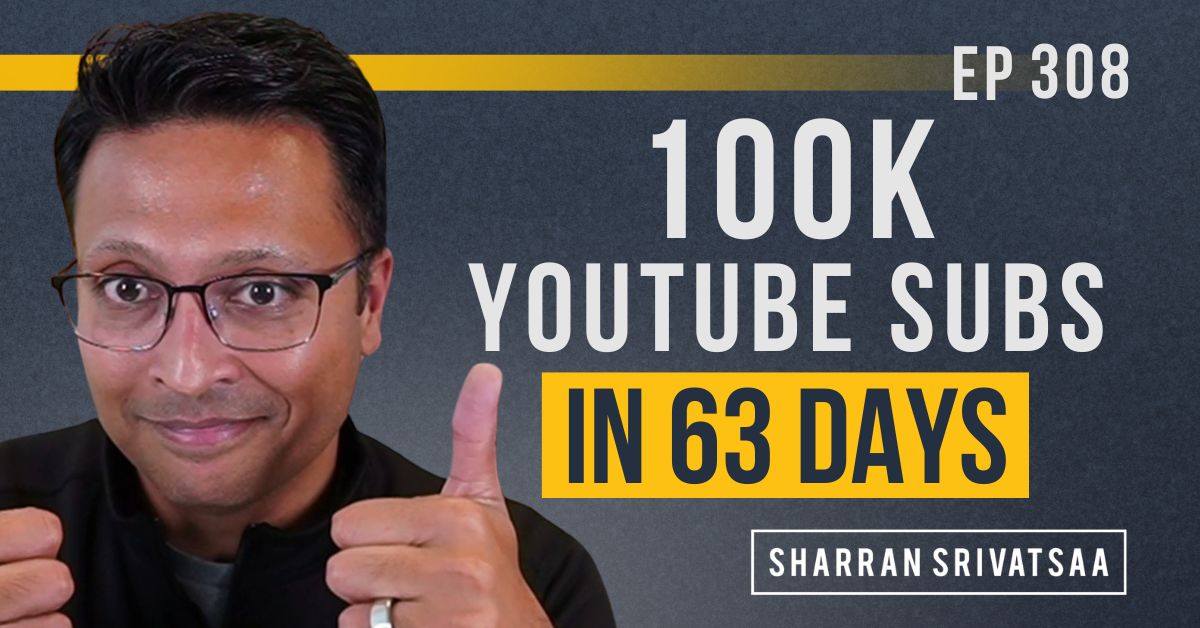
In this episode, Sharran reveals the strategy behind growing his YouTube channel to 100,000 subscribers in just 63 days with only five videos. But it wasn’t just about content creation–it was a business lesson that anyone can apply to their own growth strategy.
Sharran walks listeners through five key principles that fueled his success, highlighting how each element contributes to sustainable growth, both on YouTube and in any business venture.
This episode is full of insights for creators and business owners alike, showing how small, focused efforts can lead to massive results when executed strategically.
“When the content feels real and authentic, people keep watching because it’s this voyeuristic attitude where they get to see your life.”
– Sharran Srivatsaa
Timestamps:
03:13 – Creating content that only you can make
06:14 – Why five videos were enough
06:48 – Keeping videos connected for seamless growth
08:29 – Responding to comments to build a loyal following
11:05 – The value of a consistent visual identity
13:52 – How the team contributed to the growth
Resources:
– The Next Billion by Sharran Srivatsaa
– Board Member: ARC Multifamily Real Estate Investing
– Board Member: The Real Brokerage
Connect with Sharran:
– X
– YouTube
– Threads
Transcript:
[00:00:00] Hey, this is Sharran Srivatsaa. Welcome back to the Business School Podcast. And in this episode, I wanna tell you about how we hit a hundred thousand subscribers on YouTube in under 63 days by posting just five videos. And this is actually not a content creation. Lesson in any way. This is a business lesson. These are the things that you could do both on and off camera, on and off the field.
[00:00:21] And when I looked back and figured out why we did this, I came up with five important lessons that you can implement in your life and in your business right now. So let me break down step by step, the five reasons why we were able to hit a hundred thousand YouTube subscribers in 63 days just by posting five videos.
[00:00:36] And I break it all down for each step-by-step, starting right now.
[00:00:45] One thing is for certain: just because it’s tried and true doesn’t mean it’s working right now. So the big question is this. Where can you learn what is working right now? The strategies, the tactics, the psychology, and the exact how to, how to grow your business, how to blow up your personal brand, and supercharge your personal growth.
[00:01:07] That is the question. And this podcast will give you the answer. My name is Sharran Srivatsaa, and Welcome to Business School.
[00:01:21] In this episode, I wanna take you behind the scenes and tell you about how we crossed a hundred thousand subscribers on YouTube in just 63 days, and we only posted five videos. That’s it, just five videos, and we didn’t even post them. Often, we post the five videos every two to three weeks. Now, when I looked at this, I kept asking myself, why did this work?
[00:01:40] You’re probably asking yourself that too, because it clearly wasn’t. The volume of posts, it clearly wasn’t the frequency. It wasn’t like we did daily uploads and made a, you know, a hundred plus posts a day. Each video actually made the next video easier to watch, and I really think that someone watched one than another, than another.
[00:01:58] And when, and. That starts happening. I really think the channel grows faster. So just for your benefit, here were the five videos that we put out. Number one, everything I learned from being around the top is 0.1%. Number two, everything I learned at Goldman Sachs in 17 minutes. Number three, once you understand.
[00:02:16] Investing, you understand money. Number four, the seven rules of Money. This one actually got its trick tracking at 1.3 million views right now. And number five, how to create generational wealth. The crazy part is if you have not watched anything else, you should watch this video. It’s actually my favorite one that got the least number of views.
[00:02:30] I will save that for another time. Anytime you like something, it’s probably not gonna do as well. That’s it. Like five videos, 63 days. We did uh, over a hundred thousand subscribers, probably one of the fastest growth to a hundred thousand YouTube subs of anyone that I know. And when I stepped back, I realized that there were.
[00:02:45] Five things that actually made the difference, and I wanna walk you through exactly what they were. Now, it doesn’t matter where you are in this journey, I think that you understanding this, you are recognizing this will allow you to be a better advisor to your team, allow you to maybe level up your content, but understanding this is a business idea, not a YouTube idea.
[00:03:02] So you’re like, Hey, I don’t care about content run Well, this is not a content thing, this is a business thing. So I really think you will benefit from this overall. So I, I’ll keep all these five things short and get right into it. So number one. Make one of zero content. Well, what does that mean? The first lesson that I, is this idea of one of zero content, meaning content that only you can make, right?
[00:03:24] Zero. Like no one else can make this thing. What is the content that only you can make? Because here’s truly what happens when it comes to YouTube. Most people try to make content that sounds smart, that has some hacky, like, you know, has the best of the best YouTube scripts of people that use that are out there.
[00:03:40] But the content people actually trust and want more of comes from experience. They want to hack the experience curve so that they can learn something from you that they don’t have to experience themselves. So lemme give you an example. If, for example, I say in some video concept that, hey, you need to do X, Y, Z, because consistency matters.
[00:04:01] That makes sense logically, but it doesn’t really hit the point home. But if I said, Hey, I have run the 5:00 AM club for the last 14, 15 years. I have wake woken up at 5:00 AM every single day for 15 years in row, even though I’m a night owl. That is a completely different result because that’s one of zero content that only I can see, that I don’t know anyone else who has woken up at 5:00 AM.
[00:04:26] For 15 years in a row, they were a night owl, and actually have documented proof about it, right? Because. Now there is history behind, there’s experience behind it. There’s something tangible behind it. There’s proof behind it, and people can connect with that in a lot of ways. So when you think about your next video, I would say don’t just start with the ideas.
[00:04:45] Start with the things that you have actually done. Or if you have the idea, try to use an example of something in your own life. If you say, Hey, this is about going through a struggle, then talk about a struggle in your own life. If you say, this is about how you need to have courage when you lose money, we’ll talk about the time you had courage when you lost money.
[00:05:00] If this is about. You know, going for something big, but then not making it. Then talk about going for something big when you not making it. You have to tie the concepts that you talk about to your own experiences, because that’s what makes one of zero content. Now, you could also talk about it, about someone else’s experiences, and what somebody else has done.
[00:05:18] That’s okay, but when you make content about someone else, you are just like everyone else because everyone else can make that content. Now, you may be able to be a better reporter and tie it all together, but it has to have your personal take on things because. One of zero content is extremely helpful, right?
[00:05:34] I did not say, here are what the top 1% do. I said, here’s what I learned from the top 1%. So now I tell the story of my interaction with the top 1%, and that’s what really makes a difference, right? Because when you do that. The do the job in today’s world with everybody wanting to pop out AI-based content is you want content that feels real, that feels authentic, and when it compresses, someone’s a chance to get to know you and your life’s experience.
[00:05:57] So, like if I’m taking 10 years’ worth of experience and bringing to 10 minutes for someone else, they don’t have to go through the that 10 years of experience. That’s the cool part here. So big lesson there. When the content feels real and authentic, people keep watching because it’s this voyeuristic attitude where they get to see your life.
[00:06:14] By the way, I really think this is why the five videos work, every one of them came from my lived experience and my learned stories. It was Goldman Sachs, or building companies, or investing, or with the wealth creation journey. These were, while these were broad. Ideas that I apply to everybody. These were the implementable ideas came from my personal experiences.
[00:06:36] And I think that one thing changes how people receive the content because it feels like it’s done before, and they can learn from that experience. Alright, big idea number two is, so if you take nothing else away, take this one away, keep your videos connected. And I say this as my second lesson because.
[00:06:53] YouTube is not just a set of individual videos that you just post, and you figure out which one hits. I really think it’s a collection or a portfolio of your work. When someone finishes one video, the next click actually is important. If your videos are random, the next click is hard to do because.
[00:07:10] People don’t, are not random in their heads, but if your videos connect in some way, the next click, the next watch becomes easier. All five of these videos focused on money investing in wealth. They had this broad theme of money tied to it. So when someone finished one video, the next video kind of sort of made sense.
[00:07:27] And then the next one, and then the next one, the next one, someone is not watching one video, they’re watching three or four. They’re going down this labyrinth of videos, and that’s when growth really starts to take off when it comes to YouTube. So. Before you publish a video, ask yourself one question.
[00:07:42] If someone watches this, what should they watch next? If you don’t know that answer, the content just may be too disconnected. I think about this as if each video is a chapter, a disconnected chapter in your book, right? It doesn’t have to be. Sequential. If each video is a disconnected chapter in your non-sequential book, then it makes sense because it’s totally okay if you have 10 different chapters in one book.
[00:08:07] The book is generally of one topic, but all those chapters kind of sort of refer to something. It does not have to be sequential. And I think I ask myself when I wanna put out a video, I don’t say that’s a good video idea. I say, would that chapter make it in my book? If it does, then it has a place in my, in my portfolio on YouTube.
[00:08:23] If it doesn’t, I have to find a way to get that message to actually. Become a chapter in my book. Right? So here’s kind of like big idea number three, which is, I know this is really basic. I’m going somewhere with this, which is respond to comments now, because the, just imagine this. Liking video takes one second.
[00:08:43] People can just kinda like fumble, like, right, but writing a comment actually takes a minute, takes effort, takes people out of their flow of things. So when someone stops, writes a comment, even if it’s an emoji or they just say first comment or whatever, I try to respond, and I could do a better job, but.
[00:09:00] You start to learn what people actually care about. You start to learn what confused them. You start to learn what they like. You start to learn what was helpful to them. You start to learn. You know, you start to see the hate, and you’re like, ah, maybe there is a hate pattern here, especially early on. It gives you a sense of like what people are doing, and for most people, you are not getting.
[00:09:16] Hundreds or 200 hundreds of comments, you’re probably getting, you know, a dozen total. Just not even responding to those is crazy because if you don’t respond to the first 12, you’re never gonna respond to the next one, 20. Right. And so I think it become harder later on and I. I tried to respond to these comments.
[00:09:33] They just kept coming. I remember the time when I was commenting on each of these videos, and I just finished like 20 of them, and then another new 20 showed up, and I just did 20 more. Another 20 showed up. Like I was actually had to pull over while I was driving just to record these comments because I realized that recording these comments gave me so much understanding of what.
[00:09:51] People want. And one of the videos that we actually made, we actually scraped all the comments, and we realized that that was supposed to be the topic of the next video because a lot of people just asked for that same thing. So it informed us on what actually comes next. But I will tell you, early engagement will bring stronger relationships because.
[00:10:08] The early people are the ones that are supporting you, and stronger relationships do what? They build stronger channels, right? So in a lot of ways, I would say if you’re not responding to comments, you need those early true fans to support you early on because they form this really supportive base of people that keep coming back to you because you.
[00:10:26] Recognize them and reinforce their behavior of responding to these comments. I, I also will tell you, this shapes the next video, right? Like I just said, you’re not guessing, you’re actually responding to what people are already telling you. So even if you don’t make a completely new topic based on that video, you can then reference, Hey, I know that many of you are interested in blank, right?
[00:10:45] Many of, and when you do that, they actually, your editors can actually put screenshots of the comments in there. That shows proof that you’re actually responding to the comments and you care about what the comments are. When people start to see that you care about the comments, they start to comment and people start to comment.
[00:10:58] It shows it to more people, and there’s this really good reinforcing loop. So just you should respond to your comments, especially on YouTube. All right, number four. This is gonna sound awkward, but lemme tell you the big reason. It’s build a visual identity. And if every video looks different, it becomes harder for people to recognize your content right off the bat.
[00:11:17] If you were at a bar and you saw the Joe Rogan show, you know exactly the episode. The setting that he’s in. If you saw an old school friends episode, you know exactly what that said. And if you saw a Seinfeld episode, you know exactly what that said. If you saw a Bridgeton episode, you know exactly what that said.
[00:11:34] And if you saw CNN, you know exactly what that said in right? If you, you, if you saw a White House correspondent talk, you know exactly what that said. And people recognize your content right away. So some people say, well, Sean, I’m not the White House, or I’m not CNN, or I’m not Joe Rogan. If the sooner you do that, the faster you become them.
[00:11:51] This is not a correlation relationship. This is a causation relationship. If you have a different location, different editing, and a different feel, it becomes really hard to recognize every time, which is why what we did is we started to standardizing a lot of this. You actually will see more of the standardization coming forward for my team, but even that it.
[00:12:09] Even if we didn’t have the same studio, we started to get something similar. We didn’t change the structure too much. We had a similar structure to our entire videos. We, we started editing the same exact way. The fonts, the graphics, the styles were very similar because when someone presses play, it should feel familiar.
[00:12:25] Familiarity builds a lot of safety, and when they have safety, they wanna spend more time with you. I honestly, you don’t need a complicated setup. I would recommend that you just pick a few things like the cut or the edit or what have you, and just keep that, you know, going. Keep that the same over and over.
[00:12:40] And for some people it’s hard. Maybe you shoot differently at a different set, or you structure your editing. I think familiarity gets people to stay longer. And when people stay longer, what happens? The channel grows. Lemme give you one tactical tip here. If you’re starting out and you don’t know, don’t have a real good feel for your aesthetic of what you want to go with.
[00:12:56] Tell your editors to pick one of the creators that you’d like right now and just mimic their look and feel and edit. Maybe just use a little bit of change with your fonts and colors, but use their look and feel and edit for everything. See, for the first 10 to 20 videos, see whether you like it, and then you can slowly start to make the change from it, coming up with your own identity.
[00:13:17] If you don’t want to do that, then just mimic someone else’s that you already like. So it gives you the longevity, so you’re not going from edit to edit to edit. And it’s different every single time. Also, whatever edit you make, whatever style guide that you have, if you somehow end up working with different editors, just give them the same style guide.
[00:13:33] Have them do the same edit over and over again. Be really ruthless about. Rounds versus squares and fonts and colors. Like, don’t change it up. Just because you see somebody else’s and they have yellow, doesn’t mean you should have a yellow. Just make sure your stuff, your visual identity, is unique and unique to you because once again, this goes to making one of zero content.
[00:13:52] Alright, the last part, I know this sounds really simple, but the team is the last part. I really think this surprised me because I realized, I realized that I am actually a very small part of the process. I’m just the talent, and probably I’ve contribute 10%. To this video, but there is concept research, there is story selection, there is packaging, there is editing, there is iteration, there is, you know, strategy on when goes live.
[00:14:15] There are the thumbnails and the titles. I have realized that for every hour we shoot, there’s probably 15 to 20 hours of preparation, and I’m not doing that 15 to 20 hours. And that preparation is what makes the video, the video. So when I show up to shoot, and we are ready, and we rehearse the material, and we have the notes online, and we, the team is ready to go, the team is what has taken the channel to actually do this.
[00:14:38] I’ll give you a crazy story we shot, maybe. Five to eight times, and did five to eight different episodes in the last seven months. And we never published any of them because we were just not feeling right about the topics that we did. And as soon as we. Kind of nailed that. We could have posted sooner, and kind of tried to engage, but we realized that coming up with what we like and just going hard on that is the answer.
[00:15:03] And there was all the team around it. So if you’re really serious about building something on a data and brand-centric platform like YouTube. You’ve got to get a, some kind of team support, or you have to put in the work. Now, if you have to put in the work, you probably have to be in some kind of mastermind group or some kind of like community where you can ask questions, and you know, have somebody else give you a second pair of eyes.
[00:15:24] I think with AI you can get a second pair of eyes on your things, but I will tell you, without the team that we have, without the meticulousness and how we actually shoot these videos, there’s no way this would’ve happened at all. I really wanna iterate this idea. For every hour we shoot, we’re spending 15 to 20 hours outside of the shooting.
[00:15:41] So if we’re shooting for two hours, it’s probably 30 hours total of prep to actually get there. And I’m not even counting post-production. And that’s what actually makes these videos, these videos ’cause people, you know, have been posting videos for. 10 years and still have not hit a hundred thousand subscribers.
[00:15:57] How are we able to, again, did you hear me say we, how are we able to, not me, how are we able to post five videos and hit a hundred thousand subscribers in less than 63 days? That shows that if you’re focused and you have the right strategy, the things that I’m actually telling you that we learned would be really helpful to you.
[00:16:12] That’s exactly what happened. You know, honestly, five videos, as I told you, in 63 days, we had, we did upload more than two, you know, ev a video every two to three weeks. We had over a hundred thousand plus subscribers. We got, you know, one video right now is cooking over 1.3 million views. And I think the idea of each video made the next video easy to watch.
[00:16:31] And that way, people watched more than one, people stayed a little longer, the channel grew faster, and that’s exactly what happened. So if you want to see all of this in action, I really think that just go to YouTube, find my channel, and you will see it. I want you to like take a peek at it and just see to make sure what I’m talking about is exactly what I’m sharing here, because the main idea here is, is one of zero content.
[00:16:52] Can you actually do what only you can do? Can you make it a sequential or a non-sequential part of your book? Can you get the team to work in your favor? Can you actually respond to comments? And most of all, can you have a simple visual identity that you repeat? That way, as you repeat it, people feel familiar, and when they feel familiar, they feel safe.
[00:17:06] And when they see it, feel safe, they want to watch, watch more of your stuff. Hey, I don’t have this helpful to you. I have two action items for you. Number one, please just go look at my channel. I think this will be helpful to you. Send it to your team, send it to your friends, send them this video. And number two, if you’d like this and this was tactical enough and you wanna make more like this, just screenshot this and tag me.
[00:17:23] That way, I can make more like this for you. So if you like this. Screenshot this and tag me, and I can make more like this for you.
[00:17:37] Hey, this is Sharran. I have an awesome free gift for you just for listening to the podcast. As you may know, I’ve got a chance to build $2 billion companies the hard way. So if you like this episode, you’ll love getting the exact playbooks from those wins. It’s on my Substack, called My Next Billion. It has the exact frameworks I wish someone had given me when I was figuring it all out. Now you get the real lessons from the trenches as I go for a three-peat and build the next billion. So everything’s free at mynextbillion.com. Please check it out at mynextbillion.com.