
Click Here to Get All Podcast Show Notes!
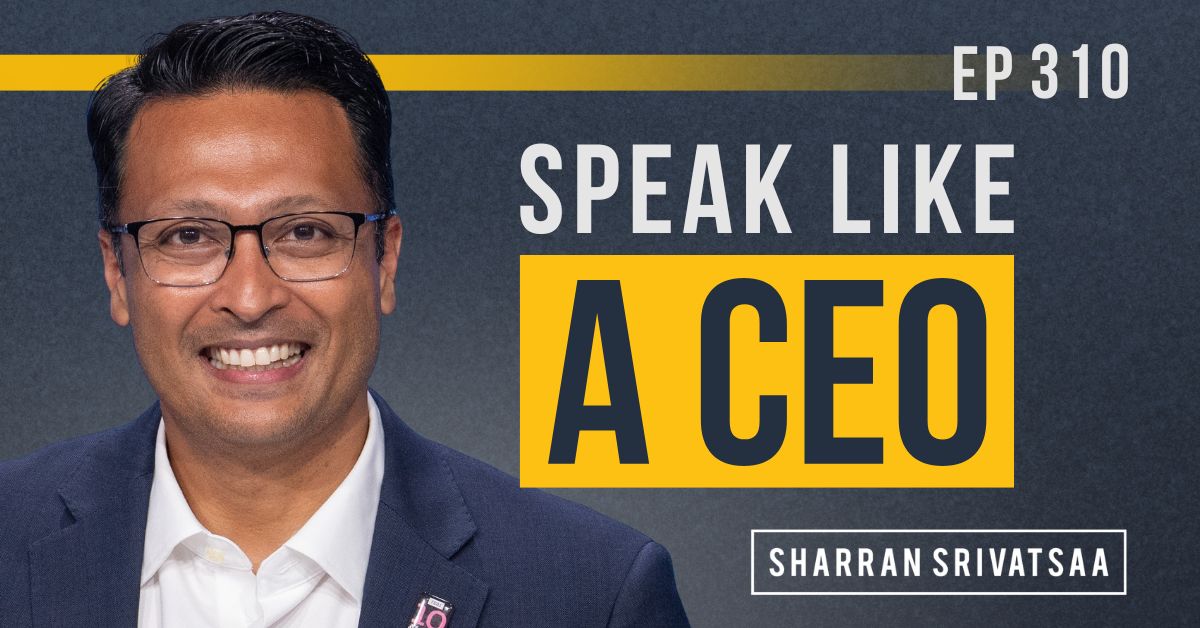
“The way you speak is a skill, and like every skill, it can be learned, practiced, and mastered.” Speaking like a leader is not about being charismatic; it’s about mastering the art of clarity, influence, and connection. In this episode, Sharran reveals the eight communication techniques that set CEOs apart and breaks down each tool to help you speak with authority and influence.
Whether you’re leading a team, negotiating deals, or simply looking to elevate your communication, these strategies will transform how you speak and connect with others.
Tune in to learn how to communicate effectively, gain trust, and lead with confidence.
“The single biggest superpower of a CEO is to be able to package an idea elegantly.”
– Sharran Srivatsaa
Timestamps:
01:17 – The importance of communication in leadership
01:43 – Technique #1: The 4-MAT framework
03:33 – Technique #2: The “Three Whys” approach to communication
05:48 – Technique #3: Using the ISL framework (Insight, Story, Lesson)
07:58 – Technique #4: McKinsey’s SCR method (Situation, Conflict, Resolution)
10:20 – Technique #5: High stakes negotiations with the ALH formula (Agree, Learn, Helpful)
11:51 – Technique #6: The diagnostic process for clear communication
13:27 – Technique #7: Unreasonable belief in a specific version of the future
14:42 – Technique #8: Borrowed language for clearer, more impactful speaking
16:58 – Wrapping up: How CEOs communicate for success
Resources:
– How to Communicate More Effectively Than 99% of People
– The Next Billion by Sharran Srivatsaa
– Board Member: ARC Multifamily Real Estate Investing
– Board Member: The Real Brokerage
Connect with Sharran:
– X
– YouTube
– Threads
Transcript:
[00:00:00] Hey, this is Sharran Srivatsaa. Welcome back to the Business School Podcast. And in this episode, I’m gonna break down for you the eight communication techniques to actually speak like a CEO. In fact, this was a full YouTube video that I made that totally went viral, and I break down each of these techniques and if you. Sell anything for a living.
[00:00:17] If you communicate with your team for a living, if you’re in high-stakes conversations for a living, if you negotiate for a living, how you speak and how you communicate is super important. The interesting part is there are frameworks that you can use that, once you have them, make everything really easy.
[00:00:32] So I break this down for you step-by-step, starting right now.
[00:00:41] One thing is for certain: just because it’s tried and true doesn’t mean it’s working right now. So the big question is this. Where can you learn what is working right now? The strategies, the tactics, the psychology, and the exact how-to. How to grow your business, how to blow up your personal brand and supercharge your personal growth.
[00:01:04] That is the question, and this podcast will give you the answer. My name is Sharran Srivatsaa, and Welcome to Business School.
[00:01:17] You don’t need to be a CEO to speak like one, but you do need to understand one thing first. The gap between people who get what they want and people who don’t is rarely about intelligence or strategy. It almost always comes down to how they speak, and most people just have never been taught how to do it.
[00:01:35] Well, in this video, I’m breaking down the eight communication techniques that separate the elite communicators from everyone else. Lemme tell you about the first technique. It’s called format. The single biggest superpower of A CEO is to be able to package an idea elegantly, and the best framework to do this was actually created by a kindergarten teacher.
[00:01:55] Most people communicate or teach by dumping information. They skip straight to what and wonder why nothing really sticks. The best communicators know that every person in the room is actually asking four questions of themselves before they truly learn about. Anything. Why, meaning, why does this matter to me?
[00:02:14] What, what exactly is it? How? How do I actually use it? And now what do I do right now with this information? So let’s break down format with a real-life example. One of the most important questions I get asked often with business owners is, ” How do you get to financial freedom? So let’s use that topic, the why, what, how, and now framework to explain why we say people go their entire lives without being taught about how to become financially free.
[00:02:39] The what? Well, the reason they don’t become financially free is because they don’t know how to define it. And the way to define it is where your passive income is greater than your monthly expenses. The how. Now you explain the exact components of how to do the thing. And I would say something like, there are two things to increase passive income, and that is finding your first investment or managing your cash.
[00:02:59] And there’s two things to manage your monthly expenses, like automatic cash flow or monitoring your lifestyle. And the last part is the now what do I do now with all of this information? Given that passive income needs to be greater in your monthly expenses, you can’t trade time for money. So you have to become an investor of sorts.
[00:03:14] So the first thing we need to do is actually to get our investor DNA. It’s like the disc profile for an investor. What are you comfortable investing in? So the first thing that anyone should do on their path to financial freedom is to get. The investor, DNA. That goes to the why. The what, the how, and what to do.
[00:03:31] Now, let me tell you about technique number two, which is the three why’s. The biggest mistake that people make is immediately talking about all the details without telling people why they should care. Before I teach you anything, I need to earn your attention first. Most people skip the step and jump straight into the content, and then they wonder why nobody’s actually listening to them.
[00:03:51] But the best communicators know that before. If anyone can understand what you’re saying, they need a reason to care, and this is why we call it the three why’s. The first why is, why is this important? This is the problem itself. The thing that exists in the world that most people haven’t really named yet.
[00:04:09] If you can’t. Clearly articulate why something matters. You haven’t thought about it deeply enough. The second is why something is important right now. Urgency is everything. And just because something’s important doesn’t mean it’s not easy to ignore. The second why creates the reason to act now, to listen now, and to pay attention right now instead of just waiting to do it later.
[00:04:31] And the third why is, why should you listen? To me, the speaker, honestly, this is not about ego. This is about trust through proof. Before anyone takes any form of advice, they need to know that the person is actually qualified to talk about it. So let’s bring the three why’s to life from the previous example of financial freedom.
[00:04:51] Why is this important? Why is this important right now, and why me? So for why is this important? I would say, hey, there’s no formal way to learn about financial freedom. So why is this important right now? Well, AI is coming for our jobs and it’s gonna change the way we work as we know it. And why me? I started with nothing.
[00:05:08] As an immigrant, I’ve been through two financial downturns, and I had to reinvent myself. And in that process, I built $2 billion businesses. And right now I spent. All of my time advising business owners@acquisition.com, the three why’s package together make up the Y frame. The Y frame sets up your entire presentation.
[00:05:26] It allows people to know why it’s important, why it’s important right now, and the urgency of it, and why you are the right person to deliver that message. The three why’s, tell people why they should care, but if you want people to actually remember. What you said and even repeat it to others, you need to wrap it into a story, and that’s what the ISL framework does.
[00:05:48] Step three to speaking like A CEO is making the conversations memorable. ISL stands for insight story and lesson. Here’s the problem. Most people don’t realize that they have. They share ideas and lessons and experiences, and nobody remembers any of it. Now, it’s not because that the information wasn’t valuable, but because facts alone are not enough, our brains aren’t wired to retain a list of things that just happen.
[00:06:16] We are wired for emotion and stories. When you wrap a tactical insight inside of a story, and you land it with a clear lesson. There’s a much higher likelihood that people actually remember it with the ISL framework; the same information lands in a more memorable way. This is one of the reasons that the best CEOs are such compelling communicators.
[00:06:37] They don’t just recite the facts over and over and expect you to remember them. They tell stories that make you remember exactly what they want you to remember. But there are bad ways and good ways to tell a story. Here’s the bad way. You just narrate the facts. This happened, and then this happened, and then this happened, and then this happened.
[00:06:55] That’s really boring, which is why no one remembers anything. For example, we had a client dinner, and we took our top clients, and they had a good time, and that’s what we do to show appreciation for our clients. That sucks. Now, here’s a good way. I wanna give you an example of how we use the ISL framework to show the client dinners we did in one of our previous companies, called Telus Properties.
[00:07:15] The insight here is, Hey, your best clients come from your best clients. Here’s the story. Every quarter we did. The Velvet Rope dinner, where we invited a dozen of our best clients. We spared no expense. We had the red carpet, the limo pickup, the plated steak dinner, and a pianist in the corner. We spared no expense to ensure that it was an amazing evening for everybody involved, and that one thing.
[00:07:40] Helped us grow our business more and more because our best clients come from our best clients, but because of some logistics, we missed doing it for just one quarter, and we saw the referrals dramatically drop off. Here’s the lesson. Invest in your best clients, and you will get more clients just like them.
[00:07:56] Insight. Story lesson. The next technique is how the number one consulting firm in the world communicates with CEOs. For over a hundred years, McKinsey has worked directly with the CEOs of the largest companies across the globe and is widely considered the best consulting firm in the world. This is a proven framework from McKinsey to break down complex ideas.
[00:08:15] SC. Situation, conflict resolution. Last year, we broke the Guinness Book of World Records. To say that on its own, without any context or story, means nothing. So here is the SCR framework in practice. Number one, the situation. So here’s what we did. We framed the situation we were launching. My partner Alex Hormozi’s book, A Hundred Million Dollar Money Models, and just like any other author, we wanted to hit the bestseller list.
[00:08:42] But when we started digging into how the bestseller system actually works, we discovered something that made us completely rethink our strategy. Number two. Conflict. Then we expose the conflict. The traditional bestseller system is rigged. We’re talking about a list dominated by state-funded figures. [00:09:00] Let me tell you who was on the list that we were trying to beat.
[00:09:02] Bill Clinton, George W. Bush, Michelle Obama, Barack Obama, and Prince Harry. These are politicians with government-backed publicity, media access, and distribution that no author can compete with. So we had a choice. We play the rigged system for an easy win and buy our way onto the list through bulk purchases and backroom deals like everyone else does, or we do something completely different.
[00:09:28] Number three, resolution. So here’s what we did. We bypassed the rig system entirely, and instead of chasing a bestseller title, we went after an authentic Guinness World record, which meant we had to outsell five state-sponsored figures combined in a single book launch. So we created an event and an offer so impactful that it’s sold $106 million worth of books in 72 hours, helping us set the new Guinness World Record.
[00:09:56] That’s what happened when we used the SCR framework. We framed the situation, we exposed the conflict, and we delivered a resolution that was undeniable. And when you structure your message with this kind of clarity, people understand what you did, and they understand why it matters. SCR helps with breaking down complex ideas, but managing high-stakes conversations in a different environment requires a whole new approach.
[00:10:20] The fifth technique that helps you manage high-stakes negotiation is called the A LH formula. Before acquisition.com, we ran a business called TELUS Properties. We grew that business 10 x in five years to $3.4 billion in sales and sold that business to Douglas Elliman. And since Douglas Elliman was a publicly traded company buying a very large enterprise, we were in high-stakes negotiations, high-stakes price conversations, high-stakes in emotional boardrooms.
[00:10:46] And when you’re in. In high-stakes or in price negotiations or with highly emotional parties, it is important to use. The A LH framework is agree, learned, and helpful. Let me give you an example. One of the terms of the acquisition was to rebrand our 22 offices and 700-plus agents completely under the Douglas Element brand.
[00:11:04] This, of course, was an emotional change for the partners of TELUS Properties. How do we use the agree learned and helpful framework? Here’s a script. I agree. This is an important issue to discuss. Number two, learned. I learned that having your brand is really important to you to build a nationwide footprint.
[00:11:22] Helpful. It’s helpful to know your thought process so that we can build a great operating plan together. Because we were able to use the ALH formula and have these high-stakes conversations, we were able to deliver one of the largest. Transactions between two independent brands in the history of the United States real estate.
[00:11:39] Now, ALH creates safety, intense, and emotional conversations, but once you have de-escalated, you still need to respond with authority, and the best way to do that is to never give your opinion. Technique number six is the most methodical way to approach any conversation, and that is the diagnostic process.
[00:11:57] The problem is not the problem. The problem is how you think about the problem, which means you don’t just deliver an opinion, you deliver your thinking process for that opinion. If a CEO leader. Gives the answer, then the company or team is always reliant on them for that answer. But if you share the framework that helped you get the answer, then you empower the team or the company to think independently of the CEO.
[00:12:23] The diagnostics allow you to transfer the skill of judgment to others. Lemme give you an example of a diagnostic that I use often whenever I look at a business. Especially a service business. I think about it as traffic systems and skills traffic as to how you fill the funnel systems, as to how you set appointments and convert, and skills as to how you deliver and get paid.
[00:12:43] Now, what does this have to do with being a good communicator? Well, if I was consulting with a business owner instead of just telling them that they should have better conversion, I would deliver this message completely differently. I would say that there’s three components for a healthy business.
[00:12:57] Traffic systems and skills, it looks like you are a plus in traffic. It looks like you are a plus in skills, but if we can just turn the dial and improve your conversion, improve the systems, you will have a much healthier business. Now, I’m not just giving them the answer to what they need to solve their business.
[00:13:15] I’m giving them the thinking process so that they can take that and overlay it on their business themselves. The diagnostic process positions you as a consultant, but even with the best framework, nothing happens if nothing happens. The seventh technique is to communicate an unreasonable belief in something so specific about the future.
[00:13:32] Every CEO communicates differently. Elon Stammers and Stutters Bezos talks about the things that will never ever change. Steve Jobs pulled that iPod out of his jeans pocket and asked why that pocket even existed. They’re all completely different, but they all share one common thing: an unreasonable belief in a very specific version of the future.
[00:13:54] So what does that mean for you if the world becomes an interplanetary species? Well, SpaceX wins. If the world gets all its information organized. Google wins. If an entrepreneur gets all the tools they need to build a great business, acquisition.com wins. It’s not about what your company does or how it operates; it’s about what the world looks like when you succeed.
[00:14:14] Most people focus on their company’s value proposition, but the best CEOs focus on how they’re going to change the world. They sell this unreasonable belief in the future, and because people believe in that future, they in turn, believe in the company that. The shift. So talk less about what your company does and talk more about the world you’re trying to create.
[00:14:38] Unreasonable belief will help you paint a picture to share with everyone, but this last technique is your unfair advantage to truly speaking like a CEO. Do you know what separates good communicators from great ones? It’s not charisma, it’s not confidence. It’s something that I like to call borrowed language, and once you understand this concept, you will never listen to conversations the same way ever again.
[00:15:00] When I was in college, I worked the night shift as a janitor. I wanted to get rid of my Indian accent, so while I worked, I would listen to Tony Robbins’ books on tape. I would study how he spoke and the tone of his voice. Eventually, I learned how to speak without a strong accent. By listening to his tapes, I learned something extremely powerful: the concept of borrowed language.
[00:15:23] So here’s what borrowed language actually is. When someone says something that lands perfectly, maybe a phrase or a way of explaining something, you capture it and you rephrase it in your own words. And you save it for later, you’re not copying them. You’re translating someone else’s clarity into your own vocabulary.
[00:15:41] Think about it this way. Every elite communicator that you admire, every CEO or every keynote speaker, every person who seems to just know how to articulate complex ideas, they didn’t invent their language from scratch. They borrowed it. They built an internal dictionary. Over the years of listening, capturing and adapting that language, most people hear something brilliant and think, ” Ah, that’s a great point.
[00:16:05] Then immediately forget it. The insight just evaporates, and the language disappears, and here’s what happens. Six months later, you’re in a conversation where that exact phrase would’ve been just perfect, but you can’t remember it. You know exactly what you want to say, but can’t find the right combination of words to say it.
[00:16:23] And trust me, I have been there. So here’s a three-step process on what you do instead. Step one: When you hear something you like, you write it down immediately. I just use the Notes app on my iPhone. Step two, you rephrase it in your own words. This is critical. You’re not creating a collection of quotes.
[00:16:41] You’re translating that concept into your language and to your style. And step three, you save it in a simple system like a notes app or a document. What you’re building here is your internal dictionary, a list of the clearest, most effective ways to communicate the ideas that matter most to you. The way you communicate determines how people perceive you, and if you can’t explain your ideas clearly, it does not matter how smart you are.
[00:17:06] When I was studying these Tony Robbins tapes, I wasn’t thinking about becoming a great communicator. I was just trying to be better understood, but what I discovered is that the way you speak is a skill. And like every skill, it can be learned, practiced, and mastered. These eight techniques aren’t about sounding impressive.
[00:17:22] They’re about making people feel something when you speak to them, making them remember what you said, and making them believe in the future that you’re describing. That’s what the best CEOs do, and now you have the same tools as well.
[00:17:43] Hey, this is Sharran. I have an awesome free gift for you just for listening to the podcast. As you may know, I’ve got a chance to build $2 billion companies the hard way. So if you like this episode, you’ll love getting the exact playbooks from those wins. It’s on my Substack, called My Next Billion. It has the exact frameworks I wish someone had given me when I was figuring it all out. Now you get the real lessons from the trenches as I go for a three-peat and build the next billion. So everything’s free at mynextbillion.com. Please check it out at mynextbillion.com.