
Click Here to Get All Podcast Show Notes!
Social media has become part of our everyday lives, but that doesn’t make it trustworthy. The most dangerous part isn’t the misinformation itself–it’s how believable it looks.
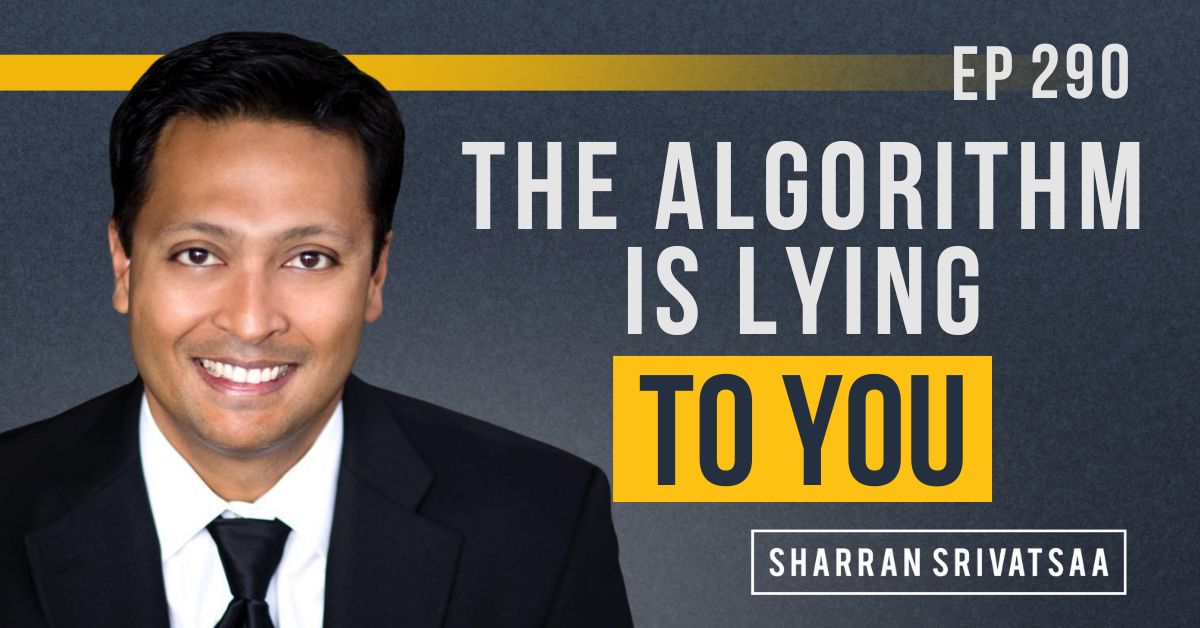
In this cautionary episode, Sharran exposes how social media algorithms manipulate what you believe, especially about money. He reveals that most viral financial content isn’t built to help you–it’s built to profit from your clicks. Backed by shocking data from FINRA, Sharran explains why over 70% of online finance posts fail basic compliance standards and how influencers earn more from your attention than your success.
He dives into the psychology of algorithmic incentives, showing how platforms reward confidence over accuracy and how that distorts the truth. You’ll also learn three simple rules to spot fake gurus and protect yourself from misleading advice online. Stop making decisions based on what you see or hear from social media-verify the information from more reliable sources.
“Whoever is shouting loudest–the biggest, loudest advice–about money is often giving the worst advice about money.”
– Sharran Srivatsaa
Timestamps:
02:04 – What FINRA discovered about viral finance posts
02:44 – Why algorithms push bad financial advice
04:31 – The “algorithm economics problem” explained
06:22 – The hidden business model behind finance influencers
09:09 – What good financial content should include
10:35 – The three rules to protect yourself from bad advice
12:43 – Why you should always verify with “boring sources”
Resources:
– The Next Billion by Sharran Srivatsaa
– Board Member: ARC Multifamily Real Estate Investing
– Board Member: The Real Brokerage
Connect with Sharran:
– X
– YouTube
– Threads
Transcript:
[00:00:00] Hey, this is Sharran Srivatsaa. Welcome back to the Business School Podcast. And in this episode, I’m gonna tell you about why the algorithm is lying to you. Not totally, but the main purpose of. These social media algorithms is to push content out to you. Now, they never check, fact-check the validity or the source or the accurateness of this content.
[00:00:17] Now, generally this doesn’t matter because business advice or health advice or whatever is different for people, but when it starts getting into money, advice. People start to just believe whatever’s on the internet, like the gospel. And I’m gonna break down for you why this is a bad idea. And I’m gonna show you the telltale signs where you can spot that this is a bad idea, and the one simple thing that you can do to make sure you are protected from all of this.
[00:00:38] And I break this all down step by step, starting right now.
[00:00:47] One thing is for certain, just because it’s tried and true doesn’t mean it’s working right now. So the big question is this. Where can you learn what is working right now? The strategies, the tactics, the psychology, and the exact how to, how to grow your business, how to blow up your personal brand and supercharge your personal growth.
[00:01:10] That is the question. And this podcast will give you the answer. My name is Sharran Srivatsaa, and Welcome to Business School.
[00:01:22] I hate to be the bearer of a cautionary tale, and that is not everything that you see, watch, hear, do on social media is real, is correct, is accurate, and most importantly is good for you. I’m gonna tell you about why, especially money-based advice, finance advice goes viral when it’s actually wrong on the internet and it gets ignored in a lot of ways when it’s right.
[00:01:48] But did you know, this is crazy, sta did you know that over 50% of Gen Z learns about money primarily from. Now you may not even have TikTok account. That’s fine. I’m still trying to figure out that app, but I will tell you what may not surprise you and why this is a problem. So, Finra, if I was a banker on Wall Street, I got all my licenses to be able to do investment advisory.
[00:02:10] Investment banking. FINRA is the body that actually protects and governs financial professionals, and FINRA reviewed over a thousand social media finance posts in 2024. Here are the stats. I wrote these down to actually share with you 70% of failed basic compliance standards. 55% hit the fact that they were paid for advertising.
[00:02:32] 38% never disclosed any of the risks. So the data actually tells us that. Whoever is shouting loudest, the biggest, loudest advice about money is actually the worst advice about money. And what do the algorithms do? They want to keep pushing those videos out because they know that more people will watch those videos.
[00:02:50] So there’s this weird kind of algorithmic incentives to figure out who is right and who’s wrong. And we have just started to believe that if some content creator says something about something online, whether you know this person or not, whether they’re sitting, hanging out with their t-shirt in on the beach or not.
[00:03:05] It’s now, that is the sign of success. Like if someone is sitting in a pool and is actually telling you something about finance, you think that’s right because they have kind of made it, but you have no idea that the pool may be AI or pool may be rented, or the pool may just be in the corner of their bathtub.
[00:03:19] The craziest part is I like, by the way, I’m not talking, I am not qualified to talk about anything. Please know that, but, and this is clearly not financial advice because I’m not talking about that, but this time I’m actually mildly qualified to comment on this topic because for a few reasons. Number one, as you may know, I’ve had a chance to build help build.
[00:03:35] Two public, $2 billion companies, one of which was publicly traded on the NASDAQ. I’ve messaged over a hundred plus deals. I actually have an MBA in with honors in finance, which I know doesn’t mean much, but I’m aware. I was a banker at Goldman Sachs and Credit Suisse on Wall Street. I have advised some of the biggest influencers in the world, which I know is ironic ’cause I’m bashing influencers right now.
[00:03:56] I’ve held Aldi. Licenses. I’ve held the Series 66, the series six, the Series 63, and the series three securities licenses. So I’ve done these tests, and I will tell you this, finance influencers. Do not optimize, do not care about your wealth. They care about views, and the algorithm pays them to do it. The sponsors pay them to do it, and the more they get, the more they can sell.
[00:04:19] Meaning this is not a content problem. This is actually an incentive problem. You are being shown stuff that is not accurate, and you need to know about it, and I want to show you why that happens and how you can actually protect yourself from this. So let me explain. There is something called the algorithm economics problem, and that’s, well, I just made it up.
[00:04:37] Yeah. I didn’t know what else to call it. TikTok Instagram. YouTube does not care about the accuracy of anything. They’re not checking for accuracy. The only thing that they care about is like piracy of, you know, the soundtracks, but. The algorithms care about watch time. They care about engagement. They care about how many times you share stuff.
[00:04:54] They care about how long you stay on the platform. A 32nd clip promising like, Hey, here are the three stocks that will explode this month. Are, is always and always gonna beat at like a, you know, a six, seven minute explanation of diversification or something that is actually good for you. The math is, I don’t know, raw, it’s, I heard this word, raw dog, and I’m still trying to figure out how to use that.
[00:05:14] The math is brutally simple because. The confidence of the creator sells, and the nuance the details don’t sell as much. People just wanna hear the headlines. So when a creator posts something like, oh, something, I dunno, leverage is the fastest way to wealth, that video goes viral. Most people don’t even know what leverage is, but when they post that leverage can destroy your account in two days.
[00:05:35] Well, that video dies. Did you know the 65% or more of viral finance videos imply guaranteed results? Because nobody wants to hear, this might only work if you hold and manage risk and do all of that boring stuff. Nobody wants hard things. They just want the easy way out. They just want to hear, do this, and get rich.
[00:05:54] They just want the easy button for. Everything. That’s what they want. And so when a video gives them that, when a video gives them confirmation bias, when the video tells ’em that this, you do this, and it’ll make it easy. When a video says, life is like a vending machine, you put a dollar in, and you get $12 out or a hot pocket out.
[00:06:08] When they do that. Everything starts to break. And the platform, what did the platform do? The platform trains all these creators to skip all the boring stuff, especially in important things related to money. And the boring parts are what actually keep the money in your pocket. So, where is the break? There is a hidden business model that not many people know about, and the hidden business model is this.
[00:06:28] These finance influencers do not make money from investing. Please let me say that again. Finance influencers do not make money from investing. Most finance influencers know nothing about money. They may have a stock, a bond, a mutual fund, or what have you, but finance investors do not make money from investing.
[00:06:44] Most of them. Did. You know that between like the last three years, one firm, only one firm alone played, influences a flat fee for every new account that was open using their referral link. So I just say, Hey, go to, I don’t know, X website or Robinhood or whatever. And they just paid influencers a flat fee just for doing that.
[00:07:03] Did you know more than 40,000 accounts were open through approximately 2000 influencers? That’s crazy. Meaning all these finance influencers often almost always earn massive commissions from you opening. Videos from you clicking links from you buying courses, from you joining communities, from you getting in their Discord chat, from you getting in their DMs.
[00:07:31] They just want you to click to add to buy so that they can pay, get paid something else. They content may not even be accurate because who’s gonna police them? Who’s gonna, you know what they say, Hey, I’m just a random, handsome guy on YouTube. I say that, but which is true? I’m just a random, handsome guy on YouTube.
[00:07:45] But the crazy part is that most people don’t even say that. I’m at least accepting the truth that I’m a random, handsome guy on YouTube, which is insane. And the reason is their income, their whatever money they make has nothing to do, whether you make money, their income has everything to do, whether you click.
[00:08:01] You watch, you share, and this creates this brutal mismatch of expectations. This crazy raw dog of expectations. So if an influencer says, Hey, invest in these index funds and wait 30 years, you are clearly not gonna click anything. You’re, you’re not gonna open an account, you’re not gonna buy the course, you’re not gonna, you’re, you’re, you’re not gonna join their group, you’re not gonna get them your email address.
[00:08:21] And because of that, the creator earns nothing. But if they say. Hey, buy the stock now before it explodes, and you can use my free link to do that. You click it, you open it, you buy it, and the influencer gets paid today. And sadly, you and I have to figure out who this person is. Figure out if they’re legit, and if the advice actually works six months from now.
[00:08:38] Most of them don’t even stick around for that. Or if they do, they’re just getting paid more commissions. Now what I wanna tell you is I wanna tell you to get, since this is related to money, I thought it would be important for you to know what, what good finance content actually looks like. When I see good finance content, I actually really like it.
[00:08:53] I’m like, man, this is awesome. Some dude did a good job, or some gal did a good job of really sharing this with the audience, and less than 20% of. Finance content actually offers educational value. That’s the research that I read, and for your benefit, here is what good finance content looks like. It’s got three pieces to the puzzle.
[00:09:14] Piece number one is it explains compounding and time horizons. Not sexy stuff, not get rich quick, seems not like, do this right now and get rich right now. That’s super important. Number two, it discloses like a bunch of risks. Because you and I both know that finance financial stuff hazardous. So, when did you know that influences are promoted?
[00:09:36] Like margin lending and explain margin calls and, and, and crazy things that are, you know, hard for people to understand, and FINRA actually finds firms with this money. Like it’s, it’s crazy. I’ll give you the last part of it. You want good finance content that teaches principles because they can’t pick hot stocks for you.
[00:09:55] If like a certain stock and. I shouldn’t advise it to you because you have, I don’t know what else you own. I don’t know what your goals are. I don’t know how old you are. I dunno what you want to do with that money. And when I say how old you are, I’m not like trying to, you know, age bias here. I would invest, you know, my son, if I’m investing one share of Disney for my son and he’s 14, that’s very different than doing something for somebody that is 45.
[00:10:19] Like it doesn’t move the needle as much. Right? That’s what’s important. So you want to look at finance content that actually teaches principles. That’s what’s super important. And when that happens, good things happen after that. Alright, so last three rules. I’ll give you these rules, and then I will give you back your day three rules for consuming this finance content because I was like, all right, so I can’t just bash finance influencers and then not give you something to actually work with.
[00:10:44] So rule number one, if it sounds guaranteed, it’s probably not true. If somebody says something like, okay, this stock will double, or this, you know, this is free money, or you could do this and, and save all, all, all your dollars in taxes, like that just does not work, right? That is a fake guru, but gurus are really good because they sound insanely convincing.
[00:11:00] I was talking to a guru recently, and I asked him, you know, why he promotes LLCs and I, I told him, I was like, have you even opened an LLCs? Like, no, I have never opened an LLC. I don’t, I understand what it is because, uh, when I, when I talk about LLCs, my content does really well. So he just reads up on Chad GPT, and then he just makes a script, and he tells it to you convincingly.
[00:11:17] It’s crazy. So if it sounds guaranteed, it’s probably not true. Number two, you wanna ask this question. Who benefits from this advice if the influencer’s finance posts fail to disclose that they were paid by advertisements, and you know that they don’t benefit you? So I would ask, Hey, do, does this person make money if I do what they say?
[00:11:35] That’s just a good, easy question to ask because the incentives are just mismatched. And last, but not late, least, I, this is the most easy thing. Whenever I see something that I, that it looks interesting, I send it, I do some research on it. Um, most of the time I send it to my friend, right? I’m like, Hey, if I get up.
[00:11:52] Piece of investment advice, I’ll send it to my financial advisor. If I get, if I get a piece of like trust estate planning advice, I’ll send it to my family office guy. If I get, you know, a, a piece of tax advice, I’ll send it to my CPA and be like, Hey, is this actually true? And so now I get a chance to revalidate that claim with people.
[00:12:08] By the way, I recently saw this, you know, mortgage strategy, which I thought was super interesting, and they said, you know, you can get rid of your fixed rate mortgage and actually do everything with a HELOC and run your HELOC, like your checking account. And instead of having a 30-year mortgage, you can pay it off in three years.
[00:12:21] Well, I sent it to three people. Who were three people who were all top mortgage professionals? One of them had no idea what I was talking about, which is interesting. The other was like, Hey, I’ve done something like this before, but, these numbers are not accurate. The third was, Hey, this person’s like totally cuckoo, which I thought was fascinating because someone is actually seeing that, and wanting to do that advice, which is crazy if you think about it.
[00:12:41] Right. So I wanna kind of leave you with this. I really believe that, you know, being online and social media is good for discovering new ideas because somebody has taken the, this idea and tried to wrap it in a, in a, in like a pigs in a blanket, and wrap it in, you know, with, with Turkey and bacon, and feed it to you and it’s good.
[00:12:59] Unfortunately, I just, I’m just gonna suggest it’s bad for making decisions. So don’t make any decisions with discovering these ideas. Don’t open accounts or don’t, you know, get stock tips from what you see online. Don’t be swayed by the stock is going up and somebody else invested in the stock. Don’t be swayed by that.
[00:13:15] You’re discovering new ideas. Just find a way to validate them. You know, are you gonna spend time looking it up on a different site or on ai or are you sending, gonna send it to a friend who’s an expert and have a have, have a group conversation about it. Just verify with boring sources. If you just did that, everything will get a lot easier.
[00:13:32] I just wanna tell you that finance influencers are not the problem. They are literally like a mirror, mirror on the wall that shows you what you want to hear. Because the more they do that, the more you view stuff, and the more you view stuff, the more views they get. And the more views they get, the more viral they go.
[00:13:44] More viral they go, the more they get paid for commissions, and then it gets in a really bad loop and they don’t know what to do. So they make more content that makes it, you want to click and vie,w and then now. Since we did that, we get bad content from them. Influencers are not financial advisors. They don’t know anything about five finances.
[00:13:58] Most of them they don’t. So please, please, please verify the with the boring sources because that will give you the best results overall. Alright, I hope that was helpful to you. That was my cautionary tale. Whenever you see stuff online, just verify with boring sources. If you like this, can you do me a favor?
[00:14:13] Can you screenshot this and tag me? That way, I can make more like this for you. So do me a favor, screenshot this, tag me, and I’ll make more like this for you.
[00:14:27] Hey, this is Sharran. I have an awesome free gift for you just for listening to the podcast. As you may know, I’ve got a chance to build $2 billion companies the hard way. So if you like this episode, you’ll love getting the exact playbooks from those wins. It’s on my Substack, called My Next Billion. It has the exact frameworks I wish someone had given me when I was figuring it all out. Now you get the real lessons from the trenches as I go for a three-peat and build the next billion. So everything’s free at mynextbillion.com. Please check it out at mynextbillion.com.