
Click Here to Get All Podcast Show Notes!
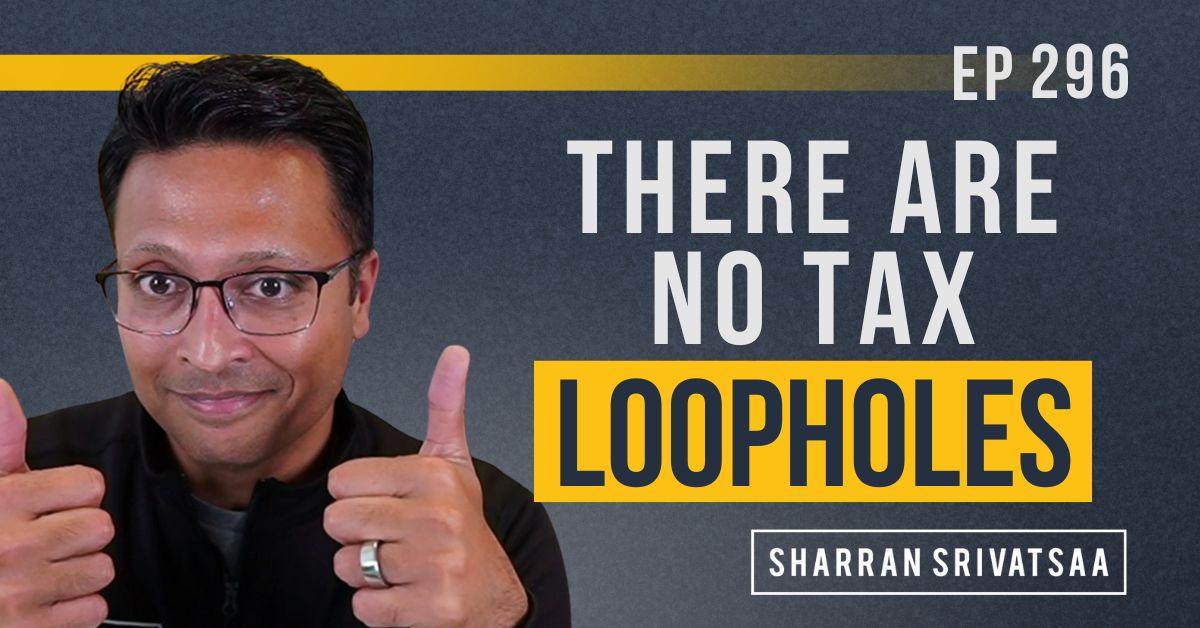
Tax loopholes sound like shortcuts to avoiding taxes, but the reality is that there are no loopholes. In this episode, Sharran breaks down the true meaning of tax incentives and why certain tax-saving strategies aren’t hidden traps but rather clear government incentives designed to promote specific business behaviors.
Sharran walks you through practical steps to navigate tax mitigation strategies effectively. Whether you’re a business owner, investor, or someone navigating personal taxes, you’ll learn how to know the law, follow the rules, and document the truth to ensure you’re maximizing your financial advantage legally and efficiently.
Forget the confusion around tax deductions and depreciation. This episode provides a simple, actionable framework for making smarter financial decisions. After all, understanding the rules is what truly allows you to win the tax game.
“There are no loopholes. These are all the rules. And the way you win the tax game, no matter where you live in the world, is to do three things: know the law, follow the rules, and document the truth.”
– Sharran Srivatsaa
Timestamps:
02:37 – The myth of tax loopholes
05:06 – How technical rules help, not hurt
06:09 – The three-step tax framework
07:04 – The real estate “loophole” myth
09:20 – Avoiding common business tax mistakes
10:38 – Why tax deductions don’t mean free money
11:43 – Think about this before you spend money
13:38 – Final thoughts on tax strategy
Resources:
– The Next Billion by Sharran Srivatsaa
– Board Member: ARC Multifamily Real Estate Investing
– Board Member: The Real Brokerage
Connect with Sharran:
– X
– YouTube
– Threads
Transcript:
[00:00:00] Hey, this is Sharran Srivatsaa. Welcome back to the Business School Podcast. And in this episode, I’m gonna tell you about why there are no tax loopholes, even though you’ve heard of them. There are no tax loopholes, but there are several tax mitigation strategies. There are several incentives. I wanna show you how to spot them, exactly what to do, no matter where you live in the world, and how to take advantage of them.
[00:00:18] I’m gonna break it all down step by step, starting right now.
[00:00:27] One thing is for certain, just because it’s tried and true doesn’t mean it’s working right now. So the big question is this. Where can you learn what is working right now? The strategies, the tactics, the psychology, and the exact how to, how to grow your business, how to blow up your personal brand, and supercharge your personal growth.
[00:00:49] That is the question. This podcast will give you the answer. My name is Sharran Srivatsaa, and Welcome to Business School.
[00:01:01] So if you pay taxes of any kind, I made this podcast for you, so check it out. I want to talk to you about one word that makes all of this tax and money talk really, really messy. And that word is loophole. By the way, lemme back up. I’m not your tax advisor. This is not tax advice. You should go talk to a real tax professional that is, is going to help you with the things that you need for your business.
[00:01:23] And I’m just a random, handsome guy on a podcast that you’re listening to right now. Alright. Please, I’m gonna give you some ideas that I do that maybe you could take advantage of, and then. Ask your advisor to ensure if it’s the right fit for you. So this is not tax or legal advice, and you should talk to your advisor because that’s always the right thing to do.
[00:01:41] Alright, let’s, let’s, let me get to this episode. People say random things like loopholes because they think there’s some kind of secret trick that exists. They think there’s some kind of hidden trap door for taxes. And I will tell you, most of the time, almost always, it is not that. Before I jump into all of this, here’s a general plan for today.
[00:02:00] I’m gonna tell you number one, what is all, what is this loophole Talk number two, I’m gonna tell you about why technical rules can be really helpful for you. And number three, I’m gonna talk about how real estate people make taxes seem like they’re just God’s gift. Number four, I’m gonna tell you where business owners kind of talk themselves into bad buys and bad investments using this.
[00:02:20] Oh, I can just write that off-type math. And number five, I have like a simple. Kind of the a few-step framework that actually I could step you through, that you can use anytime to ensure you’re doing the right thing overall while you’re thinking about this as a heuristic. Right? So number one, what do people mean by loophole?
[00:02:39] So when people say loophole, they usually mean one of two things. Number one, they say, oh, it kind of feels unfair that this person can do it or that person can do it. How is that allowed? Right? And the, the, that is, that’s what it is. It’s either like, Hey, it feels unfair. Or how is that allowed? And I will tell you that is a normal reaction.
[00:02:57] And sometimes there are some odd breaks in the rules, especially if it’s a new rule that happens. But most of the tax stuff that people kind of argue about is the law on purpose. It’s the government telling us, Hey, if you do more of this kind of thing, we will tax it in a better way. If you build more housing, if you put more money into new projects, if you use an opportunity zone, if you actually have employees and pay people, if you try new things like innovation, I.
[00:03:24] That, that’s the deal. Like we, we are going to incentivize you through the tax code to go do things, and that’s what the tax code is all about. It is a clear written set of agreed-upon incentives that have been pushed on for our economy. The government wants you to do a certain thing. The reason they’re giving you a tax break to buy machinery is because when you buy this machinery, you will hire people, you will build a factory and.
[00:03:50] And you will create more jobs and you will, you know, more people will relocate to the area and then that will create more, you know, economic activity in the local marketplace, which will then create, which will spur more, you know, economic benefit for the business, for the community overall, which will generally grow and increase GDP for the, the city, the state, the country, et cetera.
[00:04:09] There, there is some rationale and some. Some general public rationale for why there’s an incentive. So when someone says they did it for a loophole, I will tell you that’s what’s often true is actually really, really simple. They followed a rule that rewards some kind of behavior, and then they, then they actually kept the paperwork that they did.
[00:04:32] That meaning charities would not exist if you did not give money to charities. So. They give you a charitable deduction to give money to Goodwill. They give money to the Boys and Girls Club to give money to I, I, I don’t know, like the, the Shriner Children’s Hospital. And so, because otherwise they would not get the money, so you give money to them.
[00:04:52] And for that, you get a deduction, and then they give you a receipt, and you keep the paperwork. Like that is how this works. There is a very clear [00:05:00] incentive here, and there is not; there is no loopholes. And that brings me to like question like point number two, which is a lot of times people are afraid to do things because they think that things are technical.
[00:05:10] They say, oh, bonus depreciation is technical. A conservation easement is technical. Taking this, you know, this complex tax strategy with a charitable lead remainder trust is. Technical. Well, technical rules are very, very helpful, and I will tell you, not because they sound smart, but because they turn the technicality into steps and they cut out all the, uh, there’s no guessing for you or for me.
[00:05:35] A technical rule usually just tells you what matters and what doesn’t matter. They give, they tell you what? You need and what you don’t have to do. And I will tell you that’s way easier than all the loosey goosey talk that people have that it’s like, oh, it’s kind of for work. Like, you don’t say this uniform is kind of for work because the loosey goosey talk lets people talk themselves into random stuff, and it’s usually the wrong stuff.
[00:05:59] The people who do well with this aren’t the loudest or the craziest. They just follow steps. They keep the records, and they do it the same way each time. So let me give you the three rules that I use whenever I think about taxes. Number one, know the law. Number two, follow the rules. Number three, document the truth.
[00:06:17] You’ll hear me say this often. Know the law. Follow the rules, document the truth. If you know the law, that means you know exactly like what you can do with it. If you follow the rules, that means you know that technicality of the law and document the truth. You kept your receipts, you kept the paperwork, so you can prove that you actually did the thing that you said you did.
[00:06:35] That’s why this is important. So the more technical something is, you should be really, really happy because in today’s world, AI can deconstruct exactly what you need to do to do that technical thing. And when you do the technical thing, you get the significant benefit. Most people just wanna put their taxes in TurboTax and just say, and click a bunch of buttons, and then say, well, you know, rich people get better deductions.
[00:06:53] Well, they get better deductions because they know the law, they follow the rules, and they document the truth. That’s what you should do, right? Here’s number three. That brings me to the whole like rich persons get deductions conversation, which is, I think, real estate has created this strange view on the world of money, cash flow, real estate taxes, et cetera.
[00:07:13] So real estate’s kinda wild. So let’s say someone buys a property and then they rent it out. The rent comes in, and there’s some kind of cost, like mortgage expense, et cetera. Some money left over, hopefully. And that is called cash flow, right? Well then, you hear that their tax bill can look really low because they own real estate.
[00:07:30] Why? In fact, sometimes it can really, it can look like they have a loss on paper. And that’s when people say, oh, check out this loophole. Well, there’s no loophole. There are, there are just two numbers. One that actually happens and one that’s on your books. This is called like the real numbers, and the other is book value.
[00:07:47] They can both be different, and the book value is just the accounting value of things, and in real estate, they can be different because you’re allowed to count a part of the building. The cost each year on paper as a loss because they’re like, Hey, if this building is standing for 27 and a half years and you don’t take any maintenance associated with it, and you don’t actually take care of the building, this building will degrade.
[00:08:08] It will have wear and tear over time, and in 27 and a half years, it will have zero value. It’s agreed upon. It’s called Straight Line Depreciation. It is not a loophole. It just says that this is how you actually do it, which means that you can take the purchase price of the building divided by 27 and a half and take that, that, that number in that year as a paper loss, even though you may not have had any active losses in that business.
[00:08:34] That’s why people think it’s a trick. The big problem is it’s a technicality, and we just talked about technical rules. The best thing that you can have with technical rules is you’d be so happy that it’s technical, so that you actually understand it. You cannot get the steps and you can learn the steps to actually implement it.
[00:08:48] Now, of course, there’s extra methods in real estate that can change timing about this, like accelerated depreciation, bonus depreciation, et cetera, but that literally, that’s not the point. The point is, it is not written in any way. There’s no secret trap door. There’s no loophole in it. These are written in the IRS tax code.
[00:09:04] These are the rules. So whenever you hear something technical, and especially if it’s real estate, just ask, well, how does it work? What are the rules? And just research the rules. Now, what does it mean for people that are not buying real estate, like active business owners? So this is kinda like part four, and I, I will talk to you about the mistakes that people make.
[00:09:22] I will say, like, my friends who are entrepreneurs and business owners hear the real estate story and think, okay, cool, I should do that in my business. And so they start using these quote write-offs as a reason to buy stuff. So let me give you an example. They’ll say, oh, lemme go buy this big ass truck.
[00:09:38] I’ll put it in the business. I’ll depreciate it. So it’s basically free. No, it is not free. There may be some kind of discount to it, and you have to prove that you’re actually using it for the business. Or you could say, oh, let’s take this massive family trip. I’ll take it for a full week. I’ll go to Hawaii, and while I’m there, I’ll make one call.
[00:09:54] So now I can, now it’s business, and then I can just, that’s a vacation with a phone call. It’s not business, it’s not a reasonable, and, you know, and normal in the course of the, of the business, so you can’t like use it. You can be like, Hey, let’s, let’s book this a, a vacation, this nice resort. I’ll bring my laptop and I’ll sit in Hawaii, and I’ll answer emails in the morning so I can then just deduct it.
[00:10:16] Well, answering emails does not change what the trip is about. And like, I’ll tell you, my favorite one is this. My, my, my attorney, my CPA is not like this. It’s like, oh, I wanted to buy the thing anyway, so I bought it, and then my CPA will fix it. Your CPA will not fix it. That is not a good plan. That’s hoping that, like, you know, it’s just, it’s not, it’s not a good plan.
[00:10:37] So my, my point is this, most people don’t understand the difference between what a tax deduction is like. They don’t understand what writing something off means. So please, let me explain this to you. If your tax rate saves around 35%, a $1 deduction does not give you a $1 back. It gives you a discount back.
[00:10:57] So you might save 30, 35 cents because of the 35% tax rate, but you’ll still spend about 65 cents buying the thing. So if it wasn’t worth it before, it’s not worth it after. That’s not always true, but you know, if, if, but it’s really helpful if you know that. So the question I always ask is, the first question is, I say, Hey, would I still buy this if there was no tax break?
[00:11:20] And, and if the answer is no, I’m like, then why would I let the tax tail wag the investment dog? It’s probably not a business buy anyway. It’s just like a huge desire. And that’s fine. Now, if you get the tax quote deduction out of it, it’s a deduction. But most big businesses, when you buy stuff, you get an expense anyway.
[00:11:37] So it’s not that big a deal. The question just becomes, do you know the law? Alright, here’s the last one. Let me give you like a simple order before you actually spend something. I always call it, you don’t want the tax tail to wag the investment dog. And so the simple order is, number one, pick the goal.
[00:11:54] More money in, less money out. Literally, that’s it. You wanna pick the goal? You want more money in, less money out, more output, more time back, or something that pays off later. Like, what do you want? Right? For different people, it’s different things. I live in the state of California. I have a huge California taxable, I have a lot of active income, and I’m going to have more in the years to come.
[00:12:14] So I am constantly thinking about how I can reduce my taxable income. So I can live in 72-degree weather all year round. Second, I would pick the investment that gets you to that goal. Sometimes there is, sometimes there’s not. And if there’s not, I just don’t go try to finding one because I don’t try to stretch my dollar to put myself in.
[00:12:32] In risk. Number three, I would say you always wanna think about some kind of payoff. By the way, if you take nothing else from this episode, think about this. You should say some kind of payoff in one sentence. So, for example, I would say, Hey, this should pay for itself in 90 days, or this should pay for itself in three years.
[00:12:47] And when I know that, I know that I’m just literally. Getting a three-year mortgage on a jet, when I buy it, I’m getting a, you know, 10-year mortgage and a house. When I buy it, I’m getting a, you know, I, I’m making payments for [00:13:00] two years when I buy something, this should pay for itself in X number of days.
[00:13:04] And that’s really helpful because it explains to me, man, if I told myself this should pay for itself in 60 years, I probably am not gonna do that. And the, the last one is this. I, I told you about the three rules. Know the law, follow the rules. And document the truth, know the law, follow the rules, and then document the truth.
[00:13:21] And when you do that, you are not able to give your, your, your accountant or your, your tax advisor like, Hey, this is how I know the law. This is what I did, and here’s my documentation around it. And that’s when people really appreciate working with you. You wanna be a good client to your advisors.
[00:13:34] You don’t wanna be the client that they hate to work with. So, in all of this, do loopholes exist? Well, sometimes that just means that there’s some gray area in the law, but sometimes. But most of what people end up calling loopholes are just rules that reward certain behaviors. So I would say just keep it simple.
[00:13:52] A tax break is not a reason to buy a jet or a car or whatever. Sure, but you still have to write the check. If you, if you, if you wanted to write the check in the first place, then the discount makes sense; otherwise, it probably not. So I try to ask the question, would I still do this if the tax break went away?
[00:14:08] And if it’s yes, that’s pretty good. If it’s no, keep your cash right. There are no loopholes. These are all the rules, and the way you win the tax game no matter where you live in the world, is to do three things. Know the law, follow the rules, and document the truth. Know the law, follow the rules, and document the truth.
[00:14:24] Hopefully this is helpful. Sorry, a little technical. I wanted to give you like a little. Tax episode of the things that I’m thinking about. If you like this, can you do me a favor? Can you screenshot this and tag me? That way, I can make more like this for you. Again, if you like this, uh, do me a favor, screenshot this and tag me that way I can make more like this
[00:14:39] for you.
[00:14:47] Hey, this is Sharran. I have an awesome free gift for you just for listening to the podcast. As you may know, I’ve got a chance to build $2 billion companies the hard way. So if you like this episode, you’ll love getting the exact playbooks from those wins. It’s on my Substack, called My Next Billion. It has the exact frameworks I wish someone had given me when I was figuring it all out. Now you get the real lessons from the trenches as I go for a three-peat and build the next billion. So everything’s free at mynextbillion.com. Please check it out at mynextbillion.com.