
Click Here to Get All Podcast Show Notes!
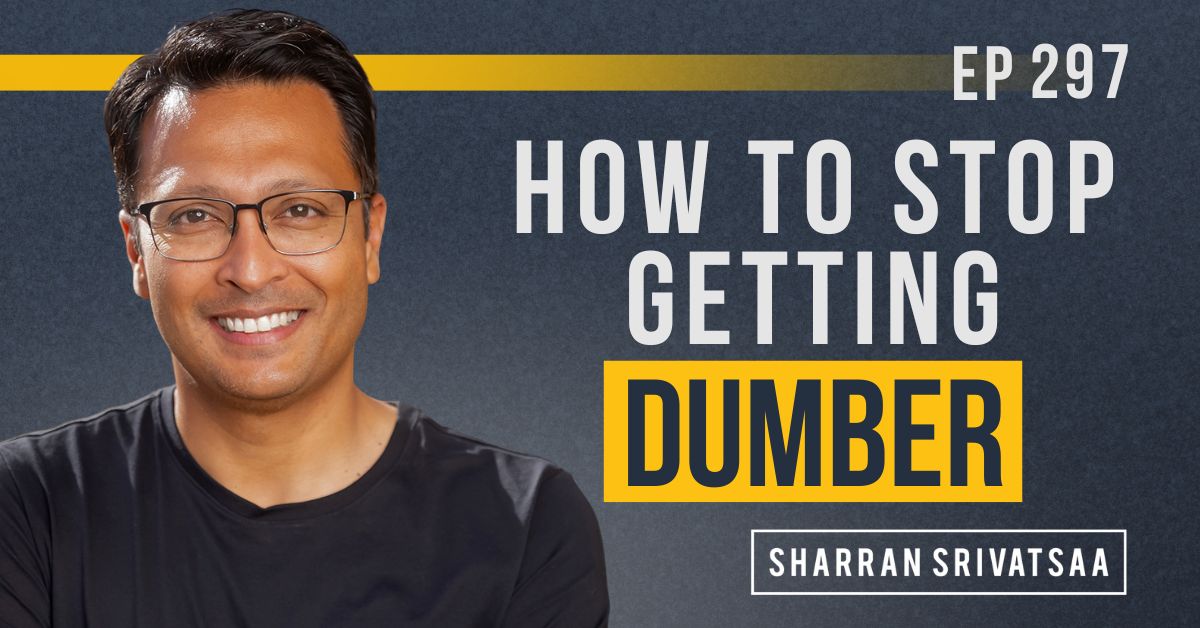
How can you keep your mind sharp in an environment that’s full of distractions and quick fixes? In this episode, Sharran reveals the five key strategies he’s using to sharpen his mind and avoid falling into intellectual laziness.
Sharran emphasizes the importance of reducing short-form content consumption, choosing long-form materials, rethinking how we outsource to AI, and even re-evaluating entertainment to improve focus. The most powerful strategy, though, is making writing a daily habit to keep your mind engaged and thinking clearly.
If you’re ready to start thinking more clearly and stop getting dumber, tune in to hear how these simple practices can make a big difference in your personal and professional growth.
“Our minds get stronger when we can actually think because when we think clearly, it’s easy to write.”
– Sharran Srivatsaa
Timestamps:
02:15 – Reducing short-form content consumption
04: 17- The benefit of choosing long-form content
06:31 – How over-relying on AI can stunt intellectual growth
11:01 – Stop taking advice from influencers
17:21 – Flipping the creation to consumption ratio
19:14 – Replacing mindless entertainment with more meaningful activities
22:14 – Writing as the antidote to intellectual decline
25:18 – Recap: How to stop getting dumber
Resources:
– The Next Billion by Sharran Srivatsaa
– Board Member: ARC Multifamily Real Estate Investing
– Board Member: The Real Brokerage
Connect with Sharran:
– X
– YouTube
– Threads
Transcript:
[00:00:00] Hey, this is Sharran Srivatsaa. Welcome back to the Business School Podcast. And in this episode I’m gonna tell you about how to stop getting dumber. By the way, it’s happening all around us. There is research to prove that humans are actually getting dumber. So while it is not your fault, it is your problem. So I’m gonna give you five ways to stop getting dumber.
[00:00:16] I’m gonna break it all down step by step, starting right now.
[00:00:25] One thing is for certain, just because it’s tried and true doesn’t mean it’s working right now. So the big question is this. Where can you learn what is working right now? The strategies, the tactics, the psychology, and the exact how to, how to grow your business, how to blow up your personal brand, and supercharge your personal growth.
[00:00:47] That is the question. And this podcast will give you the answer. My name is Sharran Srivatsaa, and Welcome to Business School.
[00:01:01] I cannot believe I’m saying this, but I really believe that humans are getting dumber. I will tell you this specifically. People are finding it hard. Because it’s so easy to get distracted. You easily just pull out your phone, and you want to do something that pings, bings, and dings make it very hard to concentrate.
[00:01:18] Forget reason that we just have outsourced to AI or problem solving, that we just try to take a picture and have AI answer it, or just look it up on Google. I really don’t think this is a hypothetical question that is discussed in random journals like the Harvard Business Review or Forbes anymore, or we talk about it in a shihi dinner party.
[00:01:38] I really think that there are, so, there’s actually so much research that makes it insanely clear that. Humans are getting dumber. And I will tell you this, I’ll tell you what scares me the most, that it’s even more true for young people. And as a father, this is one of my biggest worries for my children, that the current environment is making us dumber.
[00:01:59] And so I just thought that, well, what can I do about it? And if I’m gonna do something about it, I should probably tell you about it too. So I have five things that I’m actively doing, both for myself, my family, and my team, if they would listen to it on how we can get dumber. Lemme break it down exactly what those five things are.
[00:02:15] So number one, reduce short-form content. Just consumption. That is just reduce consuming short-form content. I will tell you that short-form content trains our brain to just reset every 30 to 60 seconds constantly, and you have one random clip that leads to another random clip, and our minds just go from one cat video to another.
[00:02:35] How to make money on. Online video to another celebrity video to another, you know, propaganda video. To a political video, to a sports video. It has to reset every single time. The neurons have to fire every single time. Can you imagine a movie that is just a bunch of short-form clips? There’s a reason why they don’t do that, ’cause it doesn’t allow us any kind of emotional control, and it makes us feel deeply unregulated.
[00:02:58] I will tell you after a while, it becomes so hard that] you, you can’t even follow anything at all, which is why you’re in this doom scrolling malaise most of the time. I honestly noticed this. And for myself, if I would watch Shortform video and then try to, you know, read something I could barely read, ’cause my brain was just mush, I, it would be so hard for me to do any deep work.
[00:03:18] I realized that if I had a deep work block, you know, and I needed to do something important in the morning, and I’d set that up, I will do whatever it takes to stay away from short form. Content completely, because as soon as I’m in that zone, it’s just very hard for me to do any kind of deep work. And I will tell you that it’s also just have, or after stopping a lot of short-form videos, it has helped me stay focused in conversations.
[00:03:41] Like my son will be talking to me, and I just get distracte,d and I’m like, what is wrong with me? I know that I’m getting distracted, but I can’t even bring myself back. So what am I kind of doing about all of this? So the first thing is I’m keeping short-form content to one literally small window per day.
[00:03:56] I’ve given myself 15 minutes a day to look at short-form content. Uh, sometimes I follow it, sometimes I do a second batch of 15. You may think this is crazy, but I have gone maybe like eight to 10 weeks now where have done less than 30 minutes of short-form content. Now, you may say, well, Sharran, that’s a lot.
[00:04:14] It’s, it was significantly more for me. Second, I actually choose long form, so I actually rather choose a podcast or a YouTube video where I choose at least one thing longer to stay with. If there’s a chance for me to read an article, I sit and read the whole article. If I can listen to. A podcast. I listen to the whole podcast, maybe I’m driving, whatever, but I don’t, I don’t click out of it.
[00:04:37] I want to listen to the full argument, the full thought, the full narrative, just like you’re doing with me right now. And by the way, if I open an app without thinking about it, I just close it, and I come back, and I’ll tell you how I did this. I inter, I installed an app blocker called One Sec, I think. And all it does is when you click on the app.
[00:04:56] It makes you; it doesn’t load it right away. It makes you take like a deep breath for two seconds, and then it asks you if you really want to open the app. I will tell you, there’s so many times where I’ve taken that deep breath and I just don’t wanna open the app anymore. Also, it tells you how many times you opened the app that day in the last 24 hours.
[00:05:16] And so sometimes I open Instagram, and it says, this is your 24th attempt, or 36th attempt opening Instagram. And I really got an insane amount of awareness to what I was actually doing, and I’m trying to figure out how to get rid of this. And so that’s, this is my hack. I just put the system in place so that I don’t need willpower to control it.
[00:05:33] My recommendation in all of this is to do whatever it takes to choose long-form materials over short-form materials. Just try to minimize short-form content for you. And if you have children or younger people in the house, like my daughter, my goodness, like I have tried so hard now I’m starting to limit her time.
[00:05:53] But there we actually have a. A routine where, after they’re done, after my daughter’s done being on her iPad, I try not to talk to her for five or 10 minutes because whatever I say, she just bites my ear off. And so I’ve realized how much it messes with your brain. Alright. So number one, if I have not, that could just, that could be the pod right there.
[00:06:14] So number one, please reduce short-form content consumption. That also, that’s also why I am reducing short-form content, uh, production because I don’t want to add to this slop in any way. Uh, that’s why I’m doing more carousels. I’m doing more writing and long-form content like this. Here’s. The second way, which is I, I’ve changed what I outsource to ai and I think that people are just blindly outsourcing everything to AI.
[00:06:39] Just like, you know, kind of call it five, 10 years ago, you outsource and ask Google the answer for everything. Now they’ve outsourced everything to AI, and I, I’m also, I would say, I’m embarrassed to say that I use. I have used AI in a way over the last year that has made my own thinking worse and own thinking, weaker own thinking, just more terrible.
[00:06:58] ’cause I’ve just outsourced everything to AI. And oh, normally what I used to do I used to let AI kind of create the first version of my ideas, and I’d be like, oh yeah, here’s the first version. You figure it out, and then I’ll take your angles, and then I’ll do something with it. And it, it would frustrate me in the beginning, but then I just realized, I was like, Hey, I’m just making a do that.
[00:07:18] Do, do making it do the easy work, right? Or the hard work. And so. The crazy part here is I was kind of disgusted by my own, I don’t know, intellectual laziness, if you will. I just realized how ridiculous that was. So I made, I just decided I wouldn’t do that anymore. So here’s what I did. Right now, I write my own first draft on things.
[00:07:43] No, before I do something, I just write my own first draft. It may not be perfect, but I write my own first draft. Number two, the first thing I do is don’t, I don’t ask AI to make it better. I ask AI to point out any unclear logic or missing steps. That has made me better. They’re like, oh, you’re, you know, it’s you, you’re missing this thing, or you have this assumption wrong, or what have you.
[00:08:03] That has been super helpful. And, number three, the thing that I’m doing right now is that instead of just copy pasting and putting in an AI, I’m using a voice-to-AI tool called Whisper (whisper.ai). I think it’s called Whisper Flow. There’s another tool called Willow Voice, but either are good. I use Whisper Flow.
[00:08:23] And now I just start talking to AI. And I think that has been more helpful because I’m actually able to get my ideas and thoughts out as opposed to having AI do the work. So instead of just outsourcing the entire thing to AI, I’m actually just giving it my thinking, my context, my ideas, and at least as I talk through it, I feel like it has got a lot of me in it overall.
[00:08:44] And I think this keeps me involved in the hard and kind of meaningful part. So now I. I’ve started to only ask AI to kind of analyze my concepts or break down my logic, or review. Is there a clean through line? I ask it for? Where are the holes in my argument? I’m not asking AI to write for me anymore. I am asking AI to be my.
[00:09:09] Editor, I’m asking AI to be my critiquer, if you will, and I tell the AI, Hey, ask me things like, have you considered X idea, or have you considered this thing in this way? And that’s really helpful because now it gives me the idea. Then I take it, and I massage it, and I rework it. I know where it goes. I know if it’s that valuable or not.
[00:09:28] And that’s been super helpful. What’s the big idea here? The big idea was to have AI kind of ba. Support partner in my work, as opposed to just like replacing my entire work product. And there’s so much AI slop out there. It’s crazy. And I think that, you know, I wrote this in one of my predictions for 2026, that especially platforms like LinkedIn are going to.
[00:09:50] Just be filled with AI slap, and I think that’s really good for the people who write in a human way. I actually think it’s really hard to write AI slap on Twitter because you have to spend so much time writing a two-three sentence thing that it sometimes feels, you know, ridiculously not valuable an investment of time, but it can produce a LinkedIn post so much faster.
[00:10:12] I think that’s why you see a lot of this AI slop on LinkedIn. So. My big idea here is when you give something to ai, before you ask it, to rewrite it for you, ask if there’s any unclear logic or if there’s any missing steps, or if there is any broken assumptions, or if there’s a different, you know, if there’s a different way of looking at it.
[00:10:32] Let AI start to point out the logical holds, and then you’ll, it’ll actually give you a learning algorithm, a heuristic, a way in which your thinking can get better. That way. You almost have like a writing coach or a thinking coach right beside you as opposed to, you know, I don’t know, a copywriter. So that’s kinda like my big idea.
[00:10:50] Here’s big idea number three that I’m stopping to do. I, I, I know this is gonna sound hard, and I really hope that you don’t consider me an influencer, ’cause I’m not your guru. I would stop taking advice from influencers. I, I follow just like you, I follow a lot of people online, and I often used to take a lot of people’s advice at face value.
[00:11:12] I’m like, oh, she said this and he said this, and over time, I am not joking. I realized many opinions from most of these people are shared without much real experience behind them at all. And I’ll tell you why. I have been an advisor to some of the biggest influencers in the world, and the number one reason why they like me as an.
[00:11:31] Advisor is because I don’t compete with them. I am not a threat to them. Like, two of the biggest influencers are not going to help each other. They may talk smack, but they’re not gonna help each other. They’re not gonna open up their books, they’re not gonna open up their business and show me stuff. And I like it because I don’t really care about the influencing component; I just care about the business component.
[00:11:50] And I actually found that there are two types of people online. Number one, those that have actually kind of done the work and learn the thing, and they talk about the thing. Hey, I wrote this book. I learned about how to write a book. I sold a lot of copies of this book, and I’m gonna talk about it. That’s one type of people, right?
[00:12:09] The other are just people that are good at making videos. Okay. You have to realize who is who, and I will tell you right now, right under your nose, there’s way more people in the second bucket. There’s way more people that are good at making videos than that have actually done the thing. And given that today, in today’s world, knowledge is ubiquitous, you don’t need some influencer to tell you, you know how to do a 10 31 exchange in real estate.
[00:12:35] You don’t need that if you just know that there’s a way to do a 10 31 exchange. You can go research it. So if you see an idea somewhere, don’t just take it at face value. For example, I will tell you this: I know an influencer who made some money by selling his business, and then he bought real estate, and he did not even understand the basics, right?
[00:12:53] I, I know him, I follow him. He has generally good stuff. By the way, he did not check the numbers well, ’cause he talks about it. He rushed into how he did it. He talks about it. He, his deal, his deals, all his deals went bad. And instead of learning from it, he just really decided that real estate itself sucks.
[00:13:10] And now he tells that story to millions of people, saying that he. I don’t do real estate because real estate sucks. The craziest part is it was not got anything to do with the real estate. It was just the fact that he did not know anything about real estate. That was the problem, and I will tell you that this whole influencer status is just rampant on the internet because, for example, if you spend 18 months at an analyst at Goldman Sachs, it doesn’t mean that you’re qualified to teach people about how to buy companies.
[00:13:35] Right. It does not work the way. Just because you made a million dollars once doesn’t mean you’re not qualified to teach everyone how to make a million dollars, and like, do not, let me get me started on influencers giving relationship advice. Like, there’s a reason why I don’t talk about my relationship online because
[00:13:51] Every relationship is super by our individual. It’s super hard, and then everybody’s like, oh yeah, you should do this with your spouse. Like, no one has any idea. And they have no, like, it is insane. Just because you’re famous doesn’t mean you have the right to, and the competence to give out. Money advice or relationship advice or whatever.
[00:14:11] It’s crazy to me, and so, sorry, I’m getting kind of irritated here, but just like you, I, so I had to kind of slow down and think about, all right, whose opinion was I actually going to listen to? And I wanna tell you, like what I came up with. What I came up with was, number one, I look at what they have actually done, not how well they presented.
[00:14:32] And number two, I ask if I want to swap lives with them. I. And number three, if the subject of the idea that they gave me is important, like a 10 31 exchange, I just do my own research. I’m like, okay, cool. That was an interesting idea. Lemme go do some research right now. Like now you’re, what is all this got to do with being dumb?
[00:14:50] I will tell you this. What, what, what makes you dumb is everything. Meaning if you blindly adopt views and ideas that were never thought through in the first place, because some, you know, run-of-the-mill influencer. Uh, told you about life or business or relationships, then that doesn’t make any sense. They are, you have to realize this.
[00:15:11] Influencers are in the business of getting views. There is nothing else that they care about. If they get more views, the algorithm rewards them. When the algorithm rewards them, they get more views, they get bigger, they get more followers. They can sell more stuff, they can do more brand deals, et cetera.
[00:15:24] That is the influencer model. Right? And I, I will tell you, most influencers are, they’re like nine outta 10. Influencers are so egotistical because this, this, just because they get more views, they think they’re hothead, right? And so they say whatever the hell they want. I will tell you the craziest thing happened.
[00:15:41] I am not joking. I have a friend who made a video about how you can get tax breaks by forming an LLC. So I asked him, he’s an influencer. I asked him maybe a few years ago, I was like, Hey man, where’d you get this video? He’s like, oh my, you know, I was like, you’ve never formed an LLC in your life. You have no idea.
[00:16:01] He’s like, oh, I know, but my team told me this is a hot trending topic to talk about LLC. So I talked about him. So this guy, right. Has never formed an LLC in his life. He does not know anything about a tax return in his life. He could not explain it if it hit him in the face, and he’s making these videos about how you should form an LLC because his team told him that they’re trending right now, and I want you to realize this.
[00:16:26] The teams of influencers, what they do is they, they scour the internet. They scour social media, and all they do is they try to find trending topics because their jobs depend on it. They’re like, “Oh, this ice bucket video is trending.” Hey, Sharran, you should make a video about it. Hey, this video about Donald Trump is trending.
[00:16:45] You should make a video about it. Hey, this video about taxes is trending. You should make a video about it. Hey, this video about this, or that is trending, you should make a video about it. Hey, this video about the Super Bowl is trending. You should make a video about it. This is what happens and then they research, do the script and the influencer just reads it and it pro, most of the time it’s not accurate.
[00:17:04] No one checks for accuracy. They just check for views. And that’s why we really want to like explain to you that I’m telling you, this happens to me too, right? My team does the same exact thing, but they know that I’m gonna go research it and only do it if it’s on brand. Right? Here’s kind of the fourth thing that I’m stopping doing right now.
[00:17:21] I have flipped. My creation-to-consumption ratio when it comes to content. And here’s what I mean by that. It’s very easy to just always be a consumer. So I think I told you about this app called, like, this one sec app, right? It, it forces me to stop for a moment before I open any social app. And by the way, you should download it.
[00:17:40] You could set it up for any app. So I click, say I click Instagram. Literally, it does not open the app. It takes a whole second or tw,o and it says, breathe in, breathe out. And it lets me pause before I actually do this. So now I’ve actually flipped my thinking that I don’t scroll for massive entertainment anymore, and I was able to get off of this in like, I don’t know.
[00:18:00] A week, 10 days, it took me about 10 days, and then now I don’t have this urge to go back and constantly binge social media anymore. And so now if I want something, I open the app, open whatever app with a very clear question, I get the information that I want, and then I leave it. I use the phone like a hammer.
[00:18:21] If I want to bang a nail, I go get the hammer. I bang the nail, I put the hammer back, and I think that’s what’s been really helpful. Now, when I say I flip the creation to consumption ratio, what I’m starting to do now is when I have an idea, I just write more. I write more. I draw on a whiteboard, I talk through ideas with someone.
[00:18:39] I’m like, if I can create the content, that’s way, actually, way better. And my realization is that I have noticed that I feel way better at the end of the day where I have created more than I’ve consumed. That was the big shift for me. And I will tell you a big hack for me on this one has been to use the AI talk-to-text app, which is like the whisper flow.
[00:19:00] I have it on my phone, I have it on my, my computer. I just hit a button. I just talk. That way, I feel like I’m creating and talking and thinking through the ideas with AI or with online as opposed to always just consuming, and that’s been really helpful to me. Alright, spaghetti number five. I have completely rethought what entertainment means, so.
[00:19:20] My kids, my kids have reached a point where fun meant watching short videos, literally to them. It’s like they will negotiate for iPad time, and so when the iPad gets turned off, I will kid you not, their bodies are just restless. Their, their minds are just mush, and getting them on a 15-minute car ride would be just crazy.
[00:19:38] We wouldn’t even be able to choose where we’re gonna dinner. I will even tell you that they, they would not even eat cereal without having their iPad next to them, and I started realizing that. My wife was doing the same thing. I’m not gonna tell my wife what to do ’cause you’re just gonna get mad at me.
[00:19:51] And so I don’t, I just do it with everyone else. Right? And so. I recognized that I was getting in the same pattern. My wife was getting in the same pattern, and if I told her something, she would just snap back at me, and it was really happening to her, too. And you know, at night I would get into bed, and I literally would sit there, I would sit back, you know, back up straight against, against, put my, you know, against the pillows, and I would just scroll.
[00:20:13] I left my mind so overstimulated and so empty, I couldn’t even sleep. So. But I’d be lying. Honestly. I’d be lying if I told you that. Oh yeah. Look at me. I quit cold Turkey. I did not. But what I realized was. I could replace one bad thing with something with another bad thing, just not, just not as bad, right?
[00:20:33] So if you drink a lot, I’m sorry, that’s a bad analogy. If you eat a lot of ice cream, you can, instead of just eating a pint of ice cream every night, you could eat one scoop of ice cream. If you end up eating one scoop of ice cream every night, you could eat a small piece of candy into eating a small piece of candy every night.
[00:20:47] You could have one bite of a, I don’t know, like a sugar cube, I’m not sure. You could always replace it with something less bad. And so. So at night, instead of watch, instead of kind of like just completely stopping, watching on my phone now instead of watching short form, I just watch a TV show, or I watch a long-form video instead.
[00:21:08] And I just realized that long-form entertainment, you know, helps me better. It kind of slows my mind. It makes me able to sleep. It sparks some ideas. It like it’s somewhat educational. And so if I’m worn out, I try to reach for a book. And like now reading is so hard at night, I’m just like, man, I’m too tired.
[00:21:26] I’m just gonna go to bed. But that’s what’s really helped me, which is I just replaced short form with long form. I just replaced a bad habit with a little less bad habit. I’m lying to you if I said there’s no screen. Screens are still there, but it’s no longer the center of what we call fun.
[00:21:47] And if you ask my children when they’re in the car with me, we turn on grok and we do a quiz or, you know, we will play games when we’re at dinner. And the, the fact that I’ll try really hard to get my kids to interact in such a way that there is, there is more human interaction, and we can learn more from each other.
[00:22:06] And it takes time, it takes effort, they’ll fight it, but once they get into it, it’s way better. So we have to redefine what entertainment means. And so I. I say all of this to you because I really think that I have found the antidote to getting dumber, meaning what is the magic pill? What is the panacea?
[00:22:23] And of everything that I have tried, I will tell you that this one single practice, this one single big idea, has made the most difference for me in my life, which is writing. Not doing voice memos, not talking into AI, not videos to my team, but writing, like writing in Google Docs. When I, like, I open a Google Doc, I write an essay.
[00:22:43] Sometimes I’m like, my son the other day asked me, he goes, Hey dad, do you know what happened, you know, at the Berlin Wall? And I, you know, I kind of knew what happened at the Berlin Wall, but I didn’t really know exactly what happened. And so I researched what happened at the Berlin Wall, and I wrote myself like a short essay.
[00:22:59] When I say a short essay, it was probably like. 10, 15 sentences on exactly what happened. But I took the time to do the research, and then I wrote myself this essay, and now I understand what happened, or a memo or a strategy draft. I just realized that if I just write about something, there’s something magical about taking scattered thoughts and giving them, you know, giving them structure, organizing our thinking to, because you, you can’t write crap.
[00:23:25] ’cause when you read it, you’re going to say, that’s crap. You’ll be ashamed. You’d be embarrassed. So you, you’ll reorganize your thoughts. I, I was reading this book about how in the original, kind of like the intellectual Greeks, you know, the Greek empire, the Greeks used to use writing the same exact way.
[00:23:45] Like they would do all these intellectual debates, and then after they did those debates, they would kind of chill out and write and think, and they would practice an argument. And that’s why we read Greek philosophy even today. And. There is a reflective process when it comes to writing because you get to the core idea, and then you’re able to actually write this, and so I gave myself a rule about six months ago, and I said I write something every day.
[00:24:14] So no matter what, no matter when, every single day I write something every single day, and sometimes it’s good, sometimes it’s not good, but I write something, not AI slop. I write something, and I really believe that one thing keeps my thinking sharp. It, it helps me stay it. More present with my kids.
[00:24:32] It really reminds me that our minds get stronger when we can actually think, because when we think clearly, it’s easy to write. The reason writing is difficult for most people is not because they don’t know how to write. The reason writing is difficult for people is because they don’t know how to think.
[00:24:45] If you can think clearly, writing is very easy. And so the reason I’m sharing all this with you, by the way, I actually, my son Neil’s 14 years old, I actually enrolled him in an online writing academy where he’s just watching videos. In a community learning how to write as a 14-year-old, like this is outside of schoolwork, because I told him that once you can think clearly, once you have the right tools and the skills, you’ll be able to write, and when you can write, you just conquer the world.
[00:25:14] The reason I’m sharing all this with you is I really think the world’s getting dumber, and so just to, just to recap, so five things that I’m trying to, trying to stop, right. Number one, I’m reducing short-form content consumption. Number two. I’m changing what I’m outsourcing to AI. I’m actually asking it to be a critique partner, saying, “Hey, where’s my logic wrong?”
[00:25:34] Uh, number three, I stop taking advice from influencers. I essentially just don’t anymore. Number four, I flip my content creation to consumption ratio. I’m creating more than I’m consuming, and the way I’m doing that is I’m just blocking my. App usage. And number five, I’m just rethinking what entertainment means, both for myself and my family, and hopeful, and anybody that will listen, because I think that’s way easier if you just flip what you think about entertainment.
[00:26:00] And most importantly, I know this is hard. I know you don’t wanna do it, but if you can get into a practice of writing, I think it will really be helpful to you. Now, if you don’t wanna write, that’s okay, but at least try one of the other things, ’cause I think that will be helpful to you overall. This is my antidote to getting dumber.
[00:26:16] Five ways to stop getting dumber is probably the better way to say it. Hey, if you like this, can you please share this with a friend or share this someone that has children, and maybe a mastermind group or your spouse? And I think it’ll be helpful to all of you because I’m not trying to sell you anything.
[00:26:28] I’m just trying to sell you what I’ve learned. So if you like this, can you please screenshot this and tag me? That way, I can make more like this for you, and I’ll know you liked it. So please screenshot this and tag me, and I’ll make more like this for you.
[00:26:46] Hey, this is Sharran. I have an awesome free gift for you just for listening to the podcast. As you may know, I’ve got a chance to build $2 billion companies the hard way. So if you like this episode, you’ll love getting the exact playbooks from those wins. It’s on my Substack, called My Next Billion. It has the exact frameworks I wish someone had given me when I was figuring it all out. Now you get the real lessons from the trenches as I go for a three-peat and build the next billion. So everything’s free at mynextbillion.com. Please check it out at mynextbillion.com.