
Click Here to Get All Podcast Show Notes!
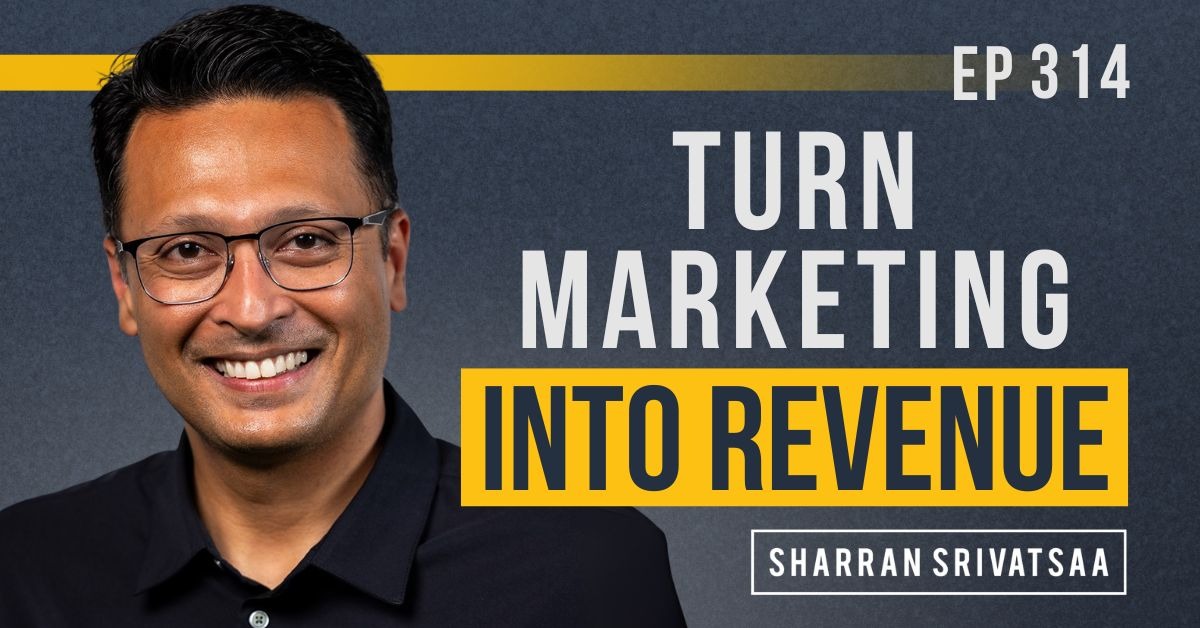
Most businesses think customer acquisition costs money, but what if you could get paid before a customer even buys? In this episode, Sharran explains how businesses can turn marketing into revenue instead of just spending on acquisition. He introduces the concept of negative CAC (customer acquisition cost) and shows how this approach transforms customer acquisition from a cost center into a profit center.
Sharran highlights four big ideas: Acquisition doesn’t have to remain expensive, trust changes customer behavior, combining multiple business functions into one system increases efficiency, and attention you own is more valuable than attention you rent. Using examples from workshops, memberships, and social media, he demonstrates how building trust assets before a transaction makes sales faster, easier, and more profitable.
This episode provides insights for founders, marketers, and business leaders looking to optimize their customer acquisition, reduce friction, and turn marketing activities into tangible revenue streams.
“Whenever one activity performs multiple economic jobs, your business will get dramatically more efficient.”
– Sharran Srivatsaa
Timestamps:
02:06 – Understanding CAC and negative CAC
04:27 – How paid workshops generate profit before a sale
06:55 – Idea 1: Acquisition doesn’t have to stay expensive
09:30 – Idea 2: Trust changes customer behavior
11:44 – Idea 3: Combine multiple functions into one system
13:43 – Idea 4: Attention you own is better than attention you rent
16:38 – Recap of the four big ideas
Resources:
– The Next Billion by Sharran Srivatsaa
– Board Member: ARC Multifamily Real Estate Investing
– Board Member: The Real Brokerage
Connect with Sharran:
– X
– YouTube
– Threads
Transcript:
[00:00:00] Hey, this is Sharran Srivatsaa. Welcome back to the Business School Podcast. And in this episode, I’m gonna break down one idea that completely changed how I think about customer acquisition, meaning how to get customers. Because most businesses assume that this idea of generating customers is supposed to cost you money, meaning you run ads or you hire salespeople, and you spend money to get these customers.
[00:00:19] Fine, I get that. But when I first saw a company that I invested in kinda change this model and flip it on its ear, where instead of paying to acquire customers, they built a system where they got paid before the customer even bought, that’s when it changed everything for me. And after I saw this, I started seeing the same pattern everywhere.
[00:00:38] So I’m gonna break this all down step by step for you, starting right now.
[00:00:49] One thing is for certain, just because it’s tried and true doesn’t mean it’s working right now. So the big question is this: where can you learn what is working right now? The strategies, the tactics, the psychology, and the exact how-to. How to grow your business. How to blow up your personal brand and supercharge your personal growth.
[00:01:11] That is the question, and this podcast will give you the answer. My name is Sharan Srivatsaa, and welcome to Business School.
[00:01:25] So the main premise of this episode is this: most businesses that I see spend all their time, like, optimizing ads or trying to get referrals or getting more leads, when all of those are good, but they should actually be building what I’m trying to call trust assets. And, well, what does this mean? By the way, when I say acquisition, I just mean how do strangers become customers, right?
[00:01:46] How do you get somebody to pay you something? That’s all that is. So a lot of us say, well, maybe you use ads or content or events or referrals or podcasts or cold outreach. All of that is acquisition. Maybe now you know why we called our business acquisition.com because we like to figure out formulas to acquire customers well.
[00:02:05] And the main part of this is I wanna explain to you this, if you’re technical, you under- understand these terms, I wanna explain this idea of negative CAC to you. So if you’ve never heard the term CAC before, it just means CAC. It means customer acquisition cost. It’s a fancy way of saying, “How much money do I have to spend to get a customer?”
[00:02:23] Meaning, how much money do I have to spend to get somebody to buy from me? That’s it. So if I spend $8,000 on ads and commissions and marketing and software and salespeople and all of that, and I get one customer, that means my CAC, which is my cost of acquiring a client, is $8,000. That simple. Now, I’ll tell you how I learned this, right?
[00:02:41] So a few years ago, I had invested in one of our companies, and by the way, most businesses don’t even know any of these numbers. They think, “Oh, I gotta know revenue and my total profit.” They’re worried about taxes. But if you don’t know CAC, like, it’s super hard to run a business. And doesn’t matter if you know your ad spend, they don’t actually know what it costs to get a customer, and this company did.
[00:03:00] And so their setup was really normal. They would do paid ads, essentially online on Facebook ads, that would drive people to a sales call, and then they would sell them something. That’s it, right? And every customer that they got, that they acquired, cost them a little over $1,000. So let’s say $1,000. Now, by the way, you may be thinking, “Wait, that feels like a lot.”
[00:03:19] Well, well, if you’re selling a $32 e-book, then $1,000 is a lot, but it’s not automatically bad if what we call the lifetime value works. Now you may say, “Well, wait, Sharan, you just told me what CAC is, customer acquisition cost, which is how much money do I have to spend to get a customer? Now you’re saying lifetime value.
[00:03:36] You’re saying this lifetime value works. What is lifetime value?” Well, how much total money does a customer spend with you over time? Those are the only two things that actually matter, right? ‘Cause if you can make CAC as low as possible and LTV as high as possible, you have a great business, and that’s why we often call this a CAC to LTV ratio.
[00:03:52] Most software companies don’t understand this. Like, they think about CAC, but it, but when you are in a service business, you, if you, if you can figure out CAC to LTV, you will, you will destroy it. You will crush it. You will demolish it. It will be dirty, as my 14-year-old will say. So what I’m trying to tell you is I am not anti-ads.
[00:04:10] Now that I’ve defined CAC to LTV, I’m not anti-ads. I love ads. We s- we spend more on ads than most businesses will make in their lifetimes in a month, right? So but the second you stop spending on ads, you have to realize that this pipeline will slow down if that is your only source of acquisition.
[00:04:26] That’s just how it works. And so this company that I was invested in tried something different. Instead of sending cold traffic, meaning instead of, instead of buying just cold ads and then sending them into a sales process like a f- like, you know, like a funnel and a call, they decided to build a two-day workshop instead, where they thought that they would just teach these people how to do things.
[00:04:45] So they s- they priced the workshop at $2,000, and the crazy part was the workshop itself made money, meaning if the CAC is $1,000 and the, the workshop is $2,000, then net-net, they actually made money, right? ‘Cause after they acquired the client and delivered the workshop, they actually made some money, made some profit.
[00:05:05] Before anyone became a customer, before there was any upsell, before there was any backend offer, before there was any sales conversion, just by doing the workshop and selling this workshop ticket, they, they net-net got customers for free, meaning the workshop made money on its own, and this is, by the way, very, very hard to do.
[00:05:21] This is also, by the way, most service businesses, real estate agents, mortgage brokers, coaches, consultants love to get referrals because referrals don’t cost you anything on the front end. It’s free, and on the back end, you have to pay a referral fee, which you don’t mind paying at all because y- and you may say, and, and a lot of people just get kind of, uh, resentful that they have to pay this big 25 or 30% referral fee on the back end, and they’re like, “Man, I can’t believe I’m writing this check to this person that they didn’t do anything.”
[00:05:44] I’m like, “Yeah, because you didn’t do anything on the front end to pay for the lead for, for, to acquire the customer.” That’s all this is. You either pay CAC on the front end or you pay CAC on the back end. You pay CAC on the front end to acquire the customer, or you pay CAC on the back end with a referral fee.
[00:05:55] That’s all this is, right? But this is what negative CAC means, right? The entire process of meeting prospects itself was profitable And so I have four big ideas for you today. Uh, this may be a little technical episode, uh, but it will– If you can o- just listen, probably listen again, uh, I will put the entire transcript of this on the, on the sh- in the show notes so you can copy-paste the whole thing into AI and deconstruct it.
[00:06:20] But if you understand this, it will change your business forever, okay? So here are four big ideas. Big idea number one: acquisition, meaning ac- acqui- the cost of acquiring a client does not have to stay expensive forever, number one. Number two: trust changes customer behavior. Number three: the best businesses combine multiple functions into one system.
[00:06:41] And number four: the attention you own behaves differently than the attention you rent. So please, please, please, I know they were all generally complex. Let me just explain it to you so you understand it, ’cause I think you’ll get the big idea, ’cause it probably directly applies to you. All right, so here’s number one.
[00:06:56] Acquisition does not have to stay expensive forever. Now, what does that mean? Most businesses, I think, uh, kind of see this problem the same, same way. They’re like, “You know what? Hey, let me just make my ads better,” or, “Let me just make my creative better,” or, “Let me just make my targeting better,” or, “Let me just make my funnel better,” or, “Let me just, you know, take people out to dinner.”
[00:07:12] Like, there is a… That’s fine. That’s just it, what we call incremental optimization. The more interesting question is this: Can the process itself of finding the customers become valuable? Can you get paid to actually find a customer as opposed to can you get paid to service a customer? Let me explain this.
[00:07:30] Imagine you are a plumber. Instead of actually getting paid to fix somebody’s leak, imagine you got paid to show up. Like, think about how crazy that is. This is, this is exactly why a lot of the, this, like, pest control model changes, right? They’re like, “Hey, if you want us to show up, it’s $282.” And whatever the cost is on the, on, on the service after that.
[00:07:53] What, what do we do? We have no choice, right? And, and I’ll give you a different way of thinking about it. Think about Costco. They have a membership. They get paid before you even go to Costco. Think about Amazon Prime. There’s a membership. They get paid before you actually buy anything from Prime. Th- some communities get paid before they even generate referrals.
[00:08:10] Some newsletters get paid before they actually even sell you anything. The front end, as they call it, becomes more economically useful in this case, and that’s what the different model is. I will tell you, 95% of people don’t have this because you only get paid when you actually do something for the client.
[00:08:24] You only get paid when you actually sell something. Imagine the other way around. So you may say, “Archon, you’re being ridiculous. I can’t charge $2,000 for a workshop.” I know. That’s not the point. The point is, can you create something useful enough, valuable enough that the people that you, your, your primary avatar are willing to spend time or energy or attention or money or en- or what have you with you before they actually buy something from you?
[00:08:48] That could be a workshop, that could be a community, that could be a, you know, a report, that could be a certification, that could be an event, that could be a mastermind, that could be a challenge, that could be a, um, a, you know, a diagnostic, a consultation, that could be a quote, that could be whatever. A workshop is just one example in this case, and I think the, the real kind of thing that should click for you is the trust became valuable before the transaction happened.
[00:09:14] That’s why people use social media for that reason, right? What is social media? In a lot of ways, you get paid. Like y- you don’t get paid in this way like I have to pay to put this podcast or put this ad in front of you. But what do they do? They pay to get trust so that when they actually sell you something, the trust is easier.
[00:09:29] That, that gets me to big idea number two, where trust changes customer behavior. And I will tell you this in a very specific way. If you have not found this to be true, not all leads behave the same way All right? Not all leads behave the same way. And a cold lead that, who saw your ad for 30 seconds ago, uh, there’s no way– They behave entirely differently than somebody who spent two days learning from you.
[00:09:54] It is a completely different conversation. They will generate completely different objections. They also may have completely different expectations. Why? Because there’s a 30-second relationship of like, “Okay, does this person really know what they’re talking about?” Or a two-day relationship where like, “Oh my gosh, this guy or this gal is the master,” right?
[00:10:12] And I think this is where a lot of businesses get insanely confused. They, they’re like, “Oh, let’s measure lead volume,” where they should– you should probably me- be measuring this, the depth of trust, which is kind of hard to measure in a lot of ways. I call that time on brand, but it’s hard to measure because the trust changes a lot of downstream behavior of the, the, the prospect.
[00:10:31] If you have trust, the sales call gets shorter and easier. The… And if, if you have trust, then these customers tend to ask better questions that actually make it go further along. The refunds will dramatically go down. The referrals will dramatically go up, and, uh, worst of all, you’re not gonna get random questions.
[00:10:46] Support gets a lot easier. And the, as soon as you can figure out… The, the question I always ask is, “What can I do on the front end? What can I do before I actually have to get into a sales conversation, which makes the sale significantly easier?” Everything that you do from a marketing, branding, positioning perspective that you can do that makes the sale easier, that makes the sale dramatically easier, that makes the sale orders of magnitude easier, means that you are putting all the friction reduction on the front end.
[00:11:15] That’s what marketing is. Just getting the lead is not enough. All leads are not made the same, right? So if your business only meets people for the first time during the sales conversation or the, the customer acquisition, CAC, will almost always feel extremely expensive because you’re trying to create trust under pressure.
[00:11:30] And honestly, that is hard. People are like, “Oh, let me think about it.” The reason they say, “Let me think about it,” is not because they need to think about it. The reason they say think about it is because they have a trust gap, and that trust gap has not been filled before they actually get to you, right?
[00:11:42] All right, that’s number two. Here’s number three. Hopefully this helps you on the third one, which is the best businesses actually combine multiple functions into one system. Let me try to explain what that means. Most businesses in general separate everything. They’re like, “Oh, let me do some marketing, and then I got a sales team, then I’m gonna do some onboarding, then I’m gonna do education, then I’m gonna have a community, then I’m gonna like try it all together.”
[00:12:01] It’s really hard, and that’s how a business looks like in your head does not look like that for the consumer or the client. The workshop, in this case, in this example that I gave you, works because it was doing all of these six jobs at once. It was marketing, it was selling, it was educating, it was onboarding, it was doing the community, it was qualifying.
[00:12:18] It was doing all simultaneously, right? And because of that, the, that’s the, the, that’s what makes it really, really fun. So imagine like doing one activity with all six. Like my, my partner Alex Hormozi always calls it, he’s like, “Hey, when your marketing and your delivery are the same thing-” When you, like when you have to, when you get essentially that means you’re marketing it and you’re delivering it simultaneously.
[00:12:40] Like, c- ima- imagine how crazy that is, right? That’s a self-licking ice cream cone. That’s the great craziest thing ever. So that’s why in all, in the situation that the, the economics got better. So I will tell you this, though, whenever one activity performs multiple economic jobs, your business will get dramatically more efficient.
[00:12:55] And w- w- I’ll give you an example that’s live. Think about Apple stores. If you have ever been to an Apple store, they have a retail store, they have support, they have this great brand experience, they have this education experience, they have this customer support function, customer success for all in one place.
[00:13:09] And like you look at acquisition.com, our content engine, we exactly do this. We have education, we have branding, we have positioning, we have support, we have volume, we have awareness. Like, and then we can do call to actions all simultaneously ’cause you then you start seeing it everywhere. So that’s like the, this is a really big, big idea where, which is like you want, instead of separating everything, you want to like tie everything together.
[00:13:32] When you have one activity that performs multiple jobs, businesses get significantly more efficient. Now you may say, “Well, Sharan, I have, don’t know how to do that.” Well, that’s why you have to like start to think about it, right? I’m giving you examples on that. Here’s number four. Last but not least, attention that you own, you probably know this, owning is better than renting.
[00:13:49] Attention that you own behaves differently than attention that you rent. And I, I am not, I, what I mean by this is I, I don’t mean to stop running ads. You’re running ads on a rented platform, that’s fine. You’re posting content on a rented platform, that’s fine. But when y- you don’t want these extremely, uh, you don’t wanna turn business ideas into these extreme online situations, which are, oh, y- y- y- you know, it like ads are amazing.
[00:14:12] I, I, like I would be the first one to tell you like, ads are amazing, right? If I run ads to cold traffic, I have to build trust from zero every single time, right? But if somebody already knows you from podcasts or newsletters or, uh, YouTube or events or referrals or what have you, the entire process of you interacting with them completely changes because people already know you.
[00:14:31] They feel like they understand your language, they know your philosophy, they know that you’re real, they’ve gotten value from it. They’re like, “Man, I really like that. That made me feel better.” And that dramatically lowers friction. I’ll, I’ll give you a practical example I know businesses right now that are spending hundreds of thousands of dollars on paid acquisition while barely even talking to the audience that they already have on social, in their newsletters, in their email, et cetera.
[00:14:52] That’s crazy because honestly, the easiest customer conversation is usually with somebody who already knows who you are. Your best clients come from your best clients, right? So I would ask myself three simple questions, because you’re probably gonna have to listen to this again. Number one, what part of our acquisition process, client acquisition process, could become independently useful?
[00:15:12] Number two, where are we forcing scale sales conversation before the trust exists? Like, what can you ha- what can happen before the sales conversation, before trust actually exists? And number three, what asset, what trust asset that are, are we building that gets more valuable over time? A YouTube video is a trust asset that gets valuable over time.
[00:15:28] A newsletter is a trust asset. It gets valuable over time. A Twitter feed is a trust asset. It gets valuable over time. A, a blog is a trust asset that gets valuable over time. A workshop is a trust asset that gets valuable over time. Like, what is a trust asset that you have that gets more valuable over time?
[00:15:42] Because otherwise, in five years, you’re gonna wake up and you’re gonna start to figure out that you have to spend more money on ads, and that’s no fun at all. By the way, this stuff takes a minute, right? That’s why I said five years. The company that I invested in earlier took almost 18 months before this workshop model really even worked.
[00:15:56] And like I will, I, I will tell you, the early versions were insanely messy. They, they, they had to figure out the ads. The operations got messy. They had to figure out fulfillment. That got messy. They had to figure out, like, what’s the positioning in the marketplace? Are they gonna sell something on the back end?
[00:16:08] That got messy. I’m sorry. Welcome to business. It is messy. But once you figure it out, something insanely cool starts happening, and that’s when your system starts to compound. Your job is not to try to figure out for now. Your job is to try to make a better future for yourself, because you always have to ask the question, in five years, do I have a better business or a worse business or the same business?
[00:16:25] Well, in five years, if you have the same business, be like, “What the heck?” You– That, that makes no sense. In five years, if you’ve not made it easier for yourself to sell more, give more, deliver more, make it easier, then we’re– then what’s the payoff in all of this, right? So big idea number one, acquisition does not have to stay expensive forever.
[00:16:43] Idea number two was trust changes consumer behavior. Idea number three, best businesses combine multiple functions into one system. And idea number four was, uh, attention you own is better than attention that you rent. So hopefully you like the framework. I really believe that when… if you can [00:17:00] really think about the future, it doesn’t matter if business is hard today.
[00:17:03] Your goal is to make business easier for tomorrow, and everything starts to work. Hey, I hope this is helpful to you. You may have to listen to it again. I have this full transcript in the show notes. Copy it, put it into AI, like work through it if you’d like. And if you like this, you know, send it to your marketing team.
[00:17:17] If you like this, send it to your, your, your founder, your partner. I don’t get a lot of feedback whether people like this or not, because they don’t actually raise their hand or tell me that I suck or whatever. So if you like this, can you do me a favor? Can you screenshot this episode right now from your phone or wherever you’re listening, and then post it on social and tag me?
[00:17:30] That way I know that you liked it, and I can make more like this for you. So if you like this, screenshot this and tag me, and I can make more like this for you.
[00:17:46] Hey, this is Sharran. I have an awesome free gift for you just for listening to the podcast. As you may know, I’ve got a chance to build $2 billion companies the hard way. So if you like this episode, you’ll love getting the exact playbooks from those wins. It’s on my Substack, called My Next Billion. It has the exact frameworks I wish someone had given me when I was figuring it all out. Now you get the real lessons from the trenches as I go for a three-peat and build the next billion. So everything’s free at mynextbillion.com. Please check it out at mynextbillion.com.