
Click Here to Get All Podcast Show Notes!
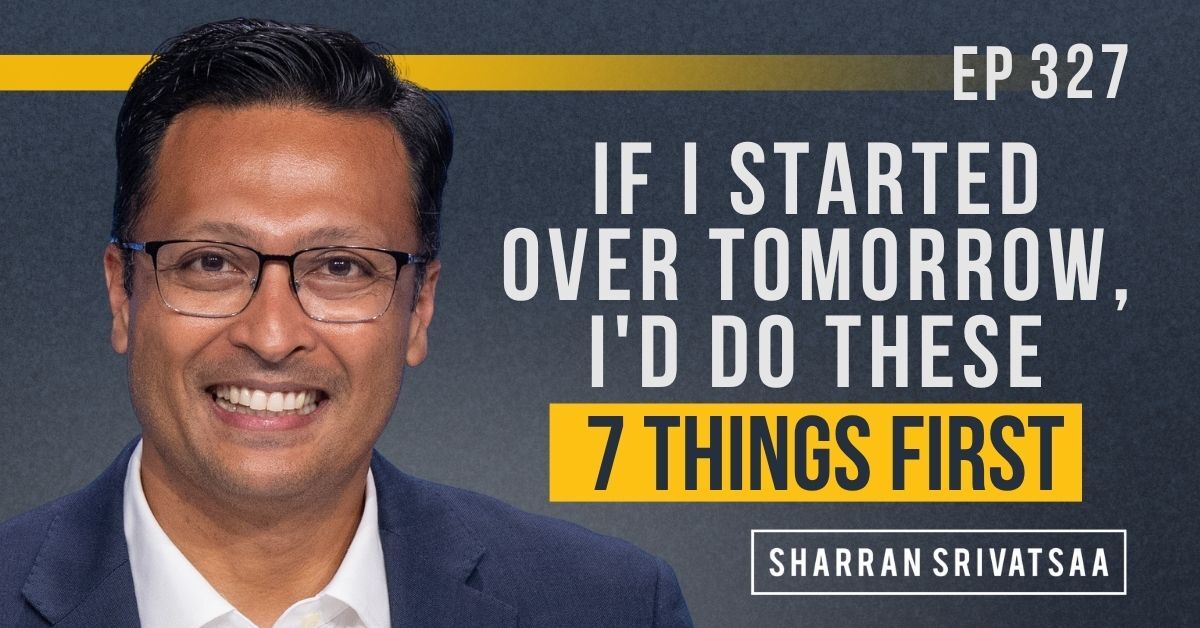
You can spend decades learning lessons the hard way, or you can learn from someone who has already built billion-dollar companies, lost millions, and started from dumpster-diving for food. In this episode, Sharran reflects on the seven lessons he wishes he had learned earlier in his entrepreneurial journey.
He explains why persistence can be more powerful than having a perfect “why,” why entrepreneurs should build the biggest possible business, and how creating a competitive moat can turn massive upfront effort into long-term leverage. He also explores why building a business is less about the exit and more about creating options.
Sharran then shares his belief that everything has a playbook, warns against risking an entire “empire” for a short-term opportunity, and explains his definition of being “deserving.”
Success leaves clues. Don’t waste decades figuring it out through trial and error; steal the seven lessons from Sharran so you can start winning.
“Everything in life has a playbook. I’m a strong believer that everything in life has a way to win. And I call that the input-output equation.”
~Sharran Srivatsaa
Timestamps:
00:00 – Introduction
01:06 – Lesson #1: Never give up today
03:47 – Lesson #2: Build the biggest possible business
05:43 – Lesson #3: Create a competitive moat
08:35 – Lesson #4: Build for options, not just an exit
10:03 – Lesson #5: Everything in life has a playbook
12:41 – Lesson #6: Don’t risk the empire for a pot of gold
15:25 – Lesson #7: Ask intelligently by becoming deserving
Resources:
– The Next Billion by Sharran Srivatsaa
– Acquisition.com
– ACQ Real Estate
– Board Member: ARC Multifamily Real Estate Investing
– Board Member: The Real Brokerage
Connect with Sharran:
– X
– YouTube
– Threads
Transcript:
[00:00:00] My parents made the ultimate financial sacrifice to send me to college in the US. In fact, I… There were times where I was even dumpster diving for food to make ends meet. And as I reflect, I think about from that point onward, life has been a, a, an insane rollercoaster. I’ve had a chance to build two billion-dollar companies, uh, be a banker at Goldman Sachs, invest in over 100 plus businesses, and today I’m the CEO and managing partner at acquisition.com with my friends Alex and Leila Hormozi.
And my goal is to buy the Anaheim Ducks for a reason, so you should check that episode at, at some point. But the, the, the reason I’m making this episode is that sometimes I reflect back and think about, man, how does somebody go from that position to having a decent life and a lot more, lot more to grow, but having a decent life?
And there are some lessons. If I had to do all of this over, what, what advice would I give my younger self to make [00:01:00] this process go faster, go smoother? And hopefully I, I have, um, I have these seven lessons that I’d like to share with you. Lesson number one is an- a quote from Aquaman, and it says, “Not giving up is the most heroic thing you can do.”
Now, without context, that would make no sense, so let me explain how this worked. When I was a freshman in college, I… There was a situation where I, I just didn’t have as much money. My, my card didn’t have the meal plan. So for a couple of weeks I did not have a lot of food, and I ended up dumpster diving to get some pizzas and a Subway sandwich, et cetera.
And I even had to fight with a raccoon to do that at one point. Fast-forward 22 years, I was invited back to be the commencement speaker at college. When I went back to speak as a commencement speaker, I was able to… I told this story. I told the very story of the exact dumpster that I dumpster dived on. [00:02:00] I told them exactly what happened that day.
I told them what, what, what, what had to have happened over the last 22 years. And after I finished that commencement speech, the dean did something. He took me back to that same dumpster. I got to see the same dumpster that I dum- dumpster dove, and on the side of the dumpster was this poster, “Not giving up is the most heroic thing you can do.”
And that’s what hit me so hard. It felt like life was full circle. It helped me see, man, that, that’s what happened over those last 22 years, that not giving up was the most heroic thing that you can do. So if there is something that you are working through in your life that right now and you believe so much in it I, I tell myself this one thing that I, I wanna give you today, and you probably can just be done with this video after that, which is I just won’t quit today.
I can quit tomorrow, but I just won’t quit today. And I tell myself that every single day. If something gets hard, I just won’t quit today. I wake up the next day and I just tell myself, “I just won’t [00:03:00] quit today.” ‘Cause not giving up is the most heroic thing you can do. You gotta come up with some kind of personal heuristic for yourself to keep yourself in the game.
People say, “Oh, I, I… It has to be about having a bigger why. I, my, my children are my why. Making $55 million is my why.” Like, none of that means anything to me because when things get really difficult, you want to quit. And sure, you may do it for your children, but what if you’re tired? What if you had a fight with your wife?
What if, uh, your business partner screwed you? What if you’re like, “Man, I don’t want the $55 million anymore, I just want my piece back”? What if all of those happen? The whys are very interesting because they’re very negotiable. To me, I want the non-negotiable thing is the simple heuristic that allows me to win every single day.
And if not giving up is the most heroic thing you can do, the heuristic that I have is I will not give up today, and I say that to myself every single day. That’s number one. Here’s number two. If you have a business, uh, I want you to really internalize this. When a business sells, it is valued on a multiple.
So if you, uh, if you have a $5 million business, uh, and you’re, you [00:04:00] make a million dollars in, in EBITDA or profit, you probably are getting a four times multiple. I’m just making it up. So 4X. Well- Small companies get small multiples and big companies get big multiples. All right? So a $5 million business with $1 million EBITDA will probably get a four times multiple based on the industry.
So you go with the idea. But a $15 million business with $3 million of EBITDA would get a significantly higher multiple. Now, the EBITDA ratio from gross pro- from profit to, um … I’m sorry, from revenue to profit is probably the same, but the multiple that you get is significantly higher. So imagine if for $3 million of EBITDA, you get 10 times multiple, but for $1 million of EBITDA, you only get a five times multiple.
Well, that’s crazy. From a thinking perspective, that is y- that, that, that’s … it’s, it’s not even in the same ballpark, right? So there should be a lesson here for all entrepreneurs, which is you want to build the biggest [00:05:00] possible business. There’s zero reason to play small. You should not think about having one auto body shop.
You should think about how you can get 10. You should not think about one restaurant. You should think about how you get 10. You should not think about having one coaching program. You should think about how you get 20. You shouldn’t think about having four good clients. You think about having 40, right?
And I’m not telling you that, uh, you know, it, it’s gonna change your life to do that. I am saying that small companies get small multiples and big companies get big multiples. And I say this because having run a couple of different small businesses and having run two billion dollar companies, I will tell you it, the, the, the determining factor was just figuring out that when you have a smaller company, you have s- a smaller multiple, and a bigger company will get a bigger multiple.
That is lesson number two. Here’s lesson number three Every business needs a competitive advantage, and, you, you know, people call it the moat. If you don’t know what a moat is, it’s like, uh, you know, in the traditional old days, there’s a, a, a little, uh, uh, little bed of water around a castle, and that prevented…
It had crocodiles [00:06:00] and whatever, and it prevented people from entering the castle without the drawbridge, right? Well, what is a moat? A moat is where you can get massive effort on the front end. When you get massive effort on the front end, that’s when you can start making money because the money is a elegant business model on the back end.
So let me explain what that means. The moat is massive effort on the front. It’s very hard to build a moat like that, right? So what do you need to do to build a moat? You need to dig and trench around this castle that you’re thinking about building, and then you need to go build a castle. So building the moat is hard work, but once you build it one time, no one can beat you.
I’ll give you an example for, like, content, right? So if you’re thinking about making content in, in the world, well, you make a lot of volume, a lot of content. There’s a massive effort on the front end. But once you’ve made it, once you’re famous, once you have five million followers, once you’ve done that, you’re automatically a winner.
You’ve created the moat. You can, you can reuse that moat over and over again [00:07:00] because and then based on that moat, based on that moat, you can then create an elegant business model on the back end. That’s why you have a lot of, quote, “influencers” these days who will spend all the time, all the effort, all the money on the front end trenching this moat.
And once they have the moat, they will a- be able to create a business model on the back end. I’ll give you an example of, uh… I had this idea early on, and I was like, “How do I build a moat?” And I didn’t know what to do, so I thought, “How amazing would it be to have an email list?” This was before email lists were even a thing, right?
And I started doing speaking engagements and, um, I would say, “Hey, uh, my speaking engagement fee was,” at that time, at that $10,000. And I said, “By the way, uh, since you’re a friend or you’re a first-time client or whatever, I would l- I’d be happy to waive the fee for you. Uh, eh, I’m assuming you have no problem sharing the invitee or registration list with me.”
So wherever I would go to present, I would just trade my fee for their registration list, which [00:08:00] the organizer were happy to do, and then that is how I started building my email list. So if you’re considering this some way and you are speaking on other people’s stages, you can say, “Hey, my fee is blank,” and you can waive your fee to build your list.
And if you did that, I don’t know, if you did that 20 times, now you have a 2,000-person email list for every 100 people that came on a Zoom. Those 2,000 people is starting to build your moat. And once you have the moat, it’s very, very hard for anybody to displace you. A moat is massive effort on the front end, and then you create money by having a elegant business model on the back end.
But if you– Once you have a moat, you can do whatever you want to make the money. So that is lesson number three. Here’s, uh, lesson number four. It’s not about the exit, it’s about the options. And what do I mean by that? I’ve had a chance to sell five different companies, two of them billion dollar businesses.
One privately traded, one publicly traded on the NASDAQ. And the crazy part in this is e- everybody wants to sell their business. So when I talk to somebody, “Oh, I wanna sell my business.” Well, sure, but you don’t want it to be about the [00:09:00] exit, you want to be about the options. Meaning, if you go to market and you wanted somebody to buy your business, they may value it at a certain level.
Well, how is it worth more? Well, the only way it’s worth more is if you have more options, if you don’t need to sell. Well, if you need to sell, that number’s actually worth less, ’cause it’s gonna detract from the value. You want a value adder, not a value detractor, right? So the more options you have, the more value there is.
So if I, if somebody… If Google offered me $100 million for a bus- business that I built and I didn’t need to sell, now Google, if they really wanted the business, they have to pay me more. They have to pay me more than all my options. So our job is not to build a business to sell. Our job is to build a business where we have a lot of options, the option where you can step out of the business and still have it print money for you, the job where you can sell a part of the business and take some money off the table, the job where you can maybe potentially sell the business to Google outright.
When you think about how it’s not about the exit and it’s about the options, it changes the way you [00:10:00] kind of like think about, think about everything. So that’s lesson number four. Lesson number five is As soon as I realized this lesson, it changed my life, and this is the one lesson that I teach my children.
And if I teach my children, it’s probably good enough for you too, which is everything in life has a playbook. I am a strong believer that everything in life has a way to win, and I call that the input/output equation. So if you want to do something, uh, if you wanna get a result, the output, all you have to do is figure out the inputs to get the result.
Well, what does that mean? Um, if you want six-pack abs, there is a formula to get six-pack abs, right? You, you eat right, you exercise, you sleep well, you take some supplements, whatever, but there is a formula. You can go to a, uh, a fitness coach or a, or a weight loss thera- uh, doctor or whatever, and they will give you a protocol.
They will give you a playbook. And if you actually ha- were disciplined enough to follow that playbook, you will win. If you believe that there’s an input/out- e- e- equation for everything in [00:11:00] life, it makes life significantly easier. And I will tell you the craziest part. Most of the playbooks that you’re looking for in your life are available publicly.
Now, there may be a small percentage like that you don’t know that is available privately, but even that is available for a small fee. And there, uh, my, my son wanted to learn how to do the Rubik’s Cube, and he was trying to do this online, uh, watching YouTube videos. And in one of the videos that he watched, he saw that there was a…
The person that made the video on teaching how to do the Rubik’s Cube was offering, um, private, private tutoring. And so I looked at it, and it was $200 an hour, right? So my dad- my son was like, “Hey, Dad, do you think I can get an hour of coaching from this guy?” So I literally messaged this guy on Instagram, and he did a one sess- he did one session for $200 with my son, and my son instantly was able to get through all the blocks to solve the Rubik’s Cube.
Now, my son can solve a Rubik’s Cube in like 14 seconds. He was interested, but he got a coach associated with it. But somebody was there to build [00:12:00] an input/output equation for you. I will tell you, e- almost every goal that you have in life, there is somebody there that has already done it or has the path on how to do it, and the, the fee that they need is so small compared to the goal that you wanna achieve.
So small. And most of the time you don’t even need to… Like, you don’t even need it. I, I’m giving you the playbook for so many things. You don’t even need it. Most of the information that you need is probably available through AI or in, uh, uh, on the free domain that gives you the exact playbook. Your job is to, is to take and collect and curate all this information and build a playbook for yourself so that you know this is the input to get the output that you want.
All right, that was lesson number five. Um, lesson number six, don’t risk the empire for a pot of gold Don’t risk the empire for a pot of gold. Well, what does that mean? As you build something important in your life, may it be your family, may it be your, uh, relationship with your children… [00:13:00] Man, that car is just ripping it.
It’s crazy. Uh, this is why you drive a Tesla. No one can even hear you coming. May it be your family, may it be your friends, may it be whoever, may it be your business, um, you want to make sure that the empire that you’re starting to build, like sometimes empires start small. Every empire starts at zero.
You don’t want to risk the empire for a pot of gold. You don’t wanna risk the empire for a novel, new idea, and that is, uh, a reputational risk can crush you. Um, there’s this, there’s this guy, you know, Dr. Peter, Peter Attia, I believe. He was a well-renowned, you know, health, um, expert. I had multiple people pay him $100,000 to go do one, a one-day kind of, uh, health retreat in, in his offices.
As soon as Peter Attia’s name came out in the Epstein files, he lost his entire business. Now, that’s sad. We don’t know the details, et cetera, but he risked the empire for a pot of gold. You may [00:14:00] say, “Hey, I’m going to go bet on this client and this one client, and I’m gonna like neglect all the other clients.”
Well, because this client may be a big, big, uh, opportunity for me. Well, you’re risking the empire for a pot of gold. Uh, i- in your personal life, you know, I, I actually had a friend who I, I’ll tell you the truth, he ra- he run their, um, mortgage company. His… I know his personal net worth is over $75 million, which I, you know, is extremely meaningful, and he cheated on his wife.
Well- Th- he risked the empire for a one-night stand, right? Now, it’s bad enough that that’s wrong and it’s against your ma- marital vows, but even from a just a straight risk perspective, he lost half his company and had sh- had to sell parts of his business to actually, like, pay it out. The… Even in, even in the business, there are risks that you can take.
Like, so if you’re like, “Man, should I, should I actually let go of this person?” Like, if you have an A player that is now saying, hey, they need a, a [00:15:00] 10% more bump because they just had a child and they have to move, uh, to work with you, a- a- and, and they can’t work in, in your office anymore, they need a remote job, you’re risking the empire for a pot of gold.
Just pay them the pot of gold. Don’t risk the empire for a pot of gold. Sometimes I, I ask myself this question when I’m investing in something and I feel like it’s risky, and I’m like, “Hey, am I risking the empire for a pot of gold?” Last, last but not least, lesson number seven, keeping all this straight in my head, is the world will give you whatever you ask for.
You just have to ask for it intelligently. That is a fancy thing that someone will say. Well, what does that mean? Um, I think that forces me to, to, to think about what I’m actually asking for and whether it’s reasonable. So this makes me, um… Have you heard the phrase, oh, you know, uh, “Little Jenny deserves being on the golf team,” or, “Kobe deserved the rings that he got,” or, “Michael Jordan [00:16:00] deserved, you know, the, the success that he had,” or, uh, “Tiger Woods deserves the success he had,” or, “Oprah deserves the success she had.”
Like, what does that mean, right? It means to me that they, if somebody deserves something, I had to… I, I wanted to be the one that was the deserving of that. Well, what does deserving mean? If you can, if you can, um, understand the definition and you can be deserving of whatever you want, the world will give it to you.
That is asking for it intelligently. So here’s what deserving means to me, and I, I thought a lot about this actually for multiple years, and I came up with a definition for deserving, and I run my life through this definition. If I don’t get something, I feel like I’m not deserving of it. Deserving is having unreasonable effort, but having a reasonable expectation.
Okay? Having unreasonable effort, but a reasonable expectation. So if little Jenny was getting on the golf team and you say, “Man, J- Little [00:17:00] Jenny deserves that,” well, d- do you know why you say she deserves that? Because she took private lessons four times a week. She practiced with the golf team every single day.
She hit balls, uh, at the driving range, you know, four times a week. She s- did a golf simulator. She trained. She, uh, you know, she, she watched game tape. What did she do? She put an unreasonable effort. And what was the reasonable expectation? That she would make the golf team. So I, I, I’ve started to think about how can I rebuild my life with that one thing in mind?
If you believe that you want something, the way you’re gonna get what you want is if you ask for it intelligently. And the way to ask for it intelligently is to just be deserving of it. And now you know the definition for deserving. For you to be deserving of the love from your spouse, and if you’re like, “Man, I sh- he doesn’t love me.
She doesn’t love me,” w- well, you’re, you’re not deserving of it, right? ‘Cause if you were deserving of it, you would get it. Well, what does deserving mean? You, you need to show unreasonable effort and have reasonable expectation. If you did that, you would get what it is. [00:18:00] If you wanted to build, um, an amazing YouTube channel, right?
Uh, it’s like I deserve to have a, a, a million followers, a million subscribers. Well, if, if my reasonable expectation is to have a million subscribers, my unreasonable effort would be that I would spend 400 hours a day doing this because I know that if I spend that unreasonable… Again, clearly I’m joking.
You don’t have 400 hours a day. But my, my point is if you create an unreasonable effort standard, you’re like, “Man, I did all of this. It’s only a matter of time in this input-output equation for me to get that result.” Unreasonable effort with reasonable expectation. And I think everything in the world can be hacked with just that because you can just say, “I’m not getting the thing because I’m not deserving of it.
If I just need to be deserving of it, I need to have unreasonable effort with reasonable expectations.” And if you just kinda create that dichotomy and you know what you want, it is so much easier to get what you want. And the only way to do that is you can’t be deserving of a lot of things. You, like, you’re not superhuman.
You’re not Zeus. Like, you’re deserving of a few things. [00:19:00] And to be deserving of those things, you have to have unreasonable effort and reasonable expectations. Now, my question for you is this. It took me 30-plus years and Having built two billion dollar companies, having lost everything that I have multiple times along the way, having done 100-plus deals, having lost millions of dollars of my personal money, having, having, you know, uh, built, built a social brand, having, uh, built an email list, having, uh, invested in 100-plus businesses, I…
These are the lessons that I wish I had learned when I started out, and I hope that these end up being clues for you because success leaves clues, and I hope one of these is a great clue for you to have a great life, so be deserving of that life