
Click Here to Get All Podcast Show Notes!
Do you ever feel like you need more followers, more money, or a bigger audience before your business can really take off? What if you could build something big without any of those things?
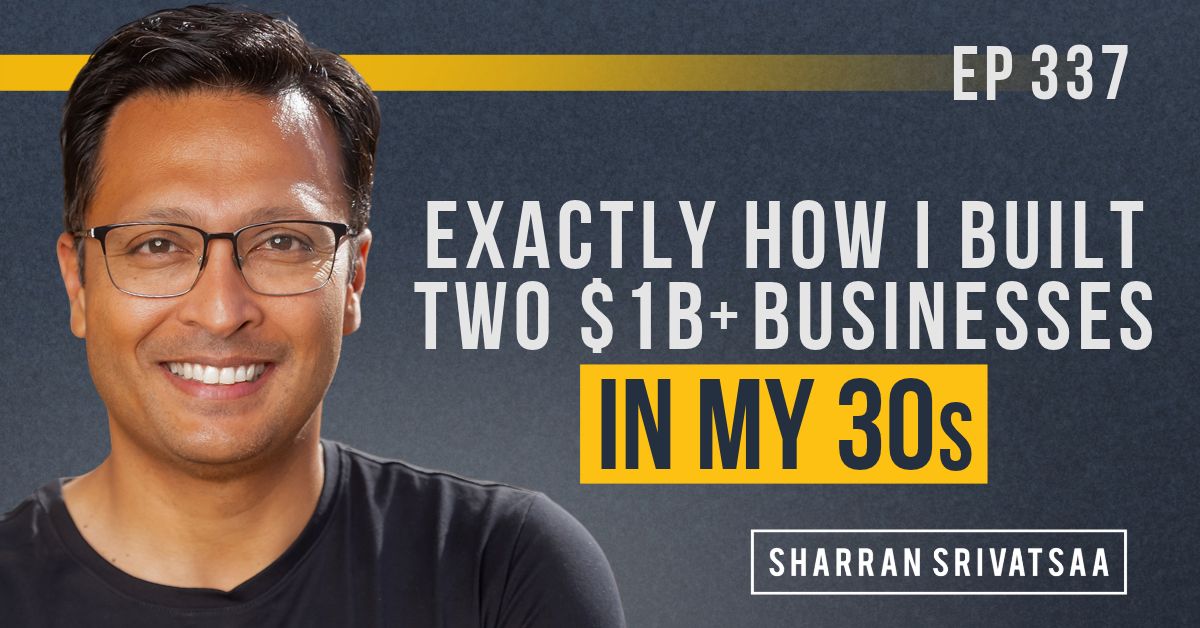
In this episode, Sharran explains how entrepreneurs can build a big business even with a small personal brand. Drawing from his experience helping build billion-dollar companies, Sharran breaks down the three pillars of business growth.
Sharran also shares why giving away your best work can build trust, reduce customer acquisition costs, and turn customers into brand advocates, and how a podcast and Instagram helped fuel major business growth.
To build a powerful brand, all you need is to create something people genuinely value, communicate it clearly, and build a simple system that makes it easy for the right people to find you.
“You can use a small brand to build a big business if your funnel is really simple. That way, you knew when you woke up exactly what you were going to do.”
~Sharran Srivatsaa
Timestamps:
00:00 – How a small brand can build a big business
01:02 – Identifying your value proposition
06:58 – How a strong brand reduces customer acquisition costs
13:22 – Content and funnels to help grow a business without ad spend
18:40 – The most efficient business model
Resources:
– The Next Billion by Sharran Srivatsaa
– Board Member: ARC Multifamily Real Estate Investing
– Board Member: The Real Brokerage
Connect with Sharran:
– X
– YouTube
– Threads
Transcript:
[00:00:00] In 2011, I left my job at Goldman Sachs to take the biggest risk of my life. In fact, I reverse mortgaged my house to invest in a struggling business. And in a five-year period, that risk actually paid off. We were able to build a business 10X in five years. We grew from $300 million to $3.4 billion and got, uh, bought by Douglas Elliman.
[00:00:22] Then I was lucky enough to do the same thing again. In 2022, I joined a company called Real, and we took that business from $250 million enterprise value on the Nasdaq to over $1.2 billion in just 30 months. Hey, my name is Sharran Srivatsaa. As you can see, I’ve had a chance to build two billion-dollar businesses, invested in 100-plus companies.
[00:00:42] I was investment banker at Goldman Sachs, and today I am the CEO of acquisition.com. And what I wanna tell you about in this video is how you can build a extremely large business with a very small brand. And I believe that there’s three, pillars to this. And the first pillar is you get your value prop right.
[00:01:01] Well, what is a value prop? A value prop is the message that you give to the marketplace that differentiates you from everyone else and explains your exact value of why you exist. And the best way I can explain the value prop to you is by giving you the value prop of both billion-dollar companies that we built.
[00:01:20] The first one is Tellus Properties. Tellus was a small business in the real estate space in Beverly Hills, California, when I took it over. It had one office and 28 agents in Beverly Hills. And we got a chance to build that from one office and 28 agents to 22 offices and 700-plus agents in a five-year period.
[00:01:38] That was 10X in five years, and then sold the business to Douglas Elliman. Now, in that five-year period, I have to tell you this one truth, which is I left Goldman Sachs to become the operator of this business. I’d never run a business before. In fact, I was googling how to be a CEO. And I realized that I needed to figure out something.
[00:02:00] I needed to figure out how to run this business. But I had a friend tell me that it was not about figuring out how to run the business; it was about figuring out the value prop. And so I looked around, and I asked everybody in the business. I asked all 28 agents why they chose to be at Tellus, and that was the big switch for me.
[00:02:20] As I went through and figured out why they chose to be at Tellus, they dispelled all the myths that I thought was the answer. I thought it was the brand, or I thought it was the leadership, or I thought it was the competitive fee structure, or I thought it was, you know, the culture that we’d built.
[00:02:36] And those were all secondary reasons. But the primary reason that everybody stated to me was that being on that platform saved them roughly one day a week. Think about that. Every single person said some version of that to me. And so I then package that into a value proposition, which is if you’re a real estate agent in California and, uh, you, you want to save at least one day a week, then you should come to tell us.
[00:03:07] So the question always became, “Hey, if our platform could save you one day a week, what would you do with another 52 days a year?” And now that created an entire business. That created an entire movement. That created a 10X in five-year story. I actually happened upon it by accident, by doing the interviews of asking people why they like to do that thing.
[00:03:29] And I think the goal in understanding your value prop may not be the reason you actually started the business. The goal may be why someone else signed up to work with you, to coach with you, to buy from you, to invest in you because their reasons may not be your reasons, and we need to find the value prop in them.
[00:03:49] A lot of times marketers and salespeople think that they can come up with the value prop themselves. I think you can get a starting point of it, but it’s really hard to know why someone else bought. So it’s really important to ask that person why they bought. And the way you figure that out is by asking one important question, which is, “What is one thing, if I took away that, you would not want to work with us anymore?”
[00:04:12] If you can answer that question, they will go to the heart of what the value prop of why exactly they are with you. And a lot of people in their business, um, get afraid to ask that question because they think that, “Wow, if I’m asking this question, it’s gonna make the client or make the customer think and, and double think as to why they’ve actually done it.”
[00:04:30] But, but I will tell you, we all know why we go to a restaurant. We all know why we go to a store. We all know why we go on vacation. We all know why we choose one airline over another airline. We know exactly why we do that. No one’s ever asked us that. If I could give you one day back a week, what would you do with an extra 52 days a year?
[00:04:47] That was the value prop that built a $3.4 billion business that we then got to sell to Douglas Elliman. That was example number one. I’ll give you a separate different example. The second example was, uh, uh, Real. Real was a publicly traded, uh, real estate brokerage on the Nasdaq. We took it from a $200 million valuation to a $1.2 billion valuation in less than 30 months.
[00:05:09] Got to do all of this on the back of a small personal brand. Um, and I’ll tell you exactly how I did it in just a second. But from a value prop perspective, I realized the same exact story. Different people had joined the business for different reasons. When I figured out and I asked them why, I found the same common theme, which was The multiple streams of income.
[00:05:32] At Real, there was a opportunity not to just make money one way, but to make money multiple ways, and that was a very clear method overall. So you could make money, uh, you know, through selling real estate. You could make money through stock options. You could make money through revenue share. You could make money through affiliate businesses.
[00:05:49] There were, there were eight different ways to make money at Real. And so we created this, um, you know, value prop, which is the eight ways to make money at Real. But for most people at any other company, there was only one way, and they instantly knew that eight ways to make money at Real versus the what I have right now was a very compelling reason why people were interested in that thing.
[00:06:12] And just by figuring out the value prop got us in the eyes and hearts, and minds of more people, and that allows you, one, to attract the right people, and two, it gives them a way to spread the message about you. Let me tell you what I mean by that. The people that joined us, people that worked with us, people that cared about us then became evangelists of the brand because now they are able to take the value prop that you give them and tell that same value prop to others.
[00:06:37] They now become this referral army for you because your value prop is so tightly packaged. So pillar number one of using a small brand to build a big business is to have your value prop very tight because then you only have to sell people once, and their, um, the package value prop, you know, kind of spreads like wildfire overall.
[00:06:58] Number two is that brand reduces CAC. Well, what does that mean? When you have a big brand, it dramatically reduces your customer acquisition costs. Uh, let’s take a step back and explain how any business model works. You have to spend money to acquire clients, and then you have to now deliver on the value and make some money.
[00:07:20] So essentially, you would spend money, which would be your cost of acquiring a client, and then hopefully the client pays you more than what you spent money to get them for. So if you spent, you know, $100 acquiring a client, either through a lead gen or through a referral or through whatever, but they turn around and bought $250 worth of product from you, then your CAC, which is your cost of acquiring a client, is $100, but their lifetime value with you is $250, so you made another $150.
[00:07:47] The difficult part is most businesses run out of cash. They run out of money. They go out of business. Why? For one reason: because their c- cl- their CAC, which is their customer acquisition cost, skyrockets. It’s too expensive to acquire more clients, and because it’s too expensive to acquire more clients, they have to shut their doors.
[00:08:07] Which is why people, um, think that just because you have a brand, you get a lot of leads. Like, you know, me and my partners have a very large brand. But even though with that large brand, everyone assumes that we just get a lot of leads that just come pouring into our DMs or emails. That is not the case.
[00:08:27] The reason the brand helps is that when we actually do marketing and advertising, it reduces the cost of those leads. So I’ll give you an example. Let’s say Um, I ran an ad tomorrow on Facebook, right, that, that told you that you can buy a book. But let’s say Oprah ran the same ad. Well, who’s going to get a cheaper cost of client acquisition?
[00:08:53] I’ll tell you, it’s gonna be Oprah. Why? Because more people know Oprah; therefore, it feels more familiar. Therefore, people wanna click on it because the familiarity drives the trust. The entire idea of the brand is to increase awareness and familiarity so that it drives trust and reduces customer acquisition costs.
[00:09:11] Why does Coca-Cola invest in a billboard at the US Open golf tournament or at, um, the World Cup or at the NBA finals? All that it says is Coca-Cola. It says nothing else. It just says Coca-Cola. It, there, it does not tell you to go buy a Diet Coke, right? Why do they do that? Because the next time you walk into a grocery aisle, or the next time you walk into a convenience store, or next time you walk into a gas station and you have five drinks there, the reticular activation system kicks in and you’re like, “Man, the familiarity of that Coca-Cola brand reduces my friction, and I’m just gonna reach for that because I don’t have to think through buying another drink.”
[00:09:53] And that is the same with, you know, a company brand, especially personal brands that help you drive more business. People misunderstand that they really think that, uh, just because you have a big brand, you get a bunch of leads. No. The job of the brand is to be so big that it creates familiarity and trust so that when you use that to advertise and create marketing campaigns, there’s trust built into it and it reduces customer acquisition costs, and that is what helps you run the business. Now, how do you do that?
[00:10:23] Well, you do that by giving away your best stuff for free. Meaning whatever you would pay for, whatever someone would pay to work with you for, what if you gave that away for free? Instead of building a course that you would sell for $2,000, can you build a course and give the $2,000 course away for free?
[00:10:38] Because when you do that, now you actually build a positive association with your brand related to the quality of the work product that you have. Now, that may be an online course that you gave for free. That may be, uh, you know, a dental treatment that you gave for free. That may be a chiropractic, you know, consult appointment that you gave for free.
[00:10:57] That may be a coaching session that you gave for free. That may be… Y- you know, that’s, uh … Have you ever noticed you walk into a, a, a Costco or a food court, and you’re walking by, and they hand you a piece of teriyaki chicken? Why do they do that? Because there’s seven restaurants out there, and the only line is in the line with the restaurant that has teriyaki chicken.
[00:11:19] Why? Because there’s a person out there in front handing people with their toothpick pieces of teriyaki chicken. They’re giving away their best stuff to taste their stuff, which reduces the uncertainty of what everything else could be. Therefore, you want to actually work with the thing because it reduces the stress, it reduces the uncertainty, and dramatically improves the connection with the brand, and it gives them safety.
[00:11:42] That’s what’s extremely important. Now, I will actually tell you for us at acquisition.com, we have created such a brig- brand engine with Alex, my partner Alex Hormozi, with his wife and my partner, Leila Hormozi, and our brand that you’re participating in. Thank you for doing that.
[00:11:59] Between, you know, the tens of millions of followers and the, the, you know, billions of impressions that we get on an annual basis, we’re able to reduce CAC so much that we, we actually have negative CAC. That means the marketplace pays us, the marketplace pays us to actually generate business, right?
[00:12:22] And it actually costs money, a significant investment to, to create brand assets just like this, to be with you, to share this with you, that we’re doing that in a very specific way. It’s actually 99% self- selfless and 1% selfish. The 99% selflessness has got to do with us giving you the best stuff. It’s us telling you all the back end of what’s happening.
[00:12:42] It’s us not gatekeeping any information so that you know that I’m telling you everything. But because of that, the 1% selfishness is that because you get trust and association with the brand that, hey, I talked to the Sharran guy on camera, and he told me everything. He told me the exact numbers. He told me what he did at Telus.
[00:12:59] [00:13:00] He told me the exact value prop. He told me the real val- uh, heck, he told me everything that I needed to know. I trust him more because he was authentic; he was real. And because of that, what happens? It reduces the cost of acquiring a client. It creates safety, and that safety goes a long way when you can actually have a small brand that can build a big business.
[00:13:20] That’s pillar number two. Here’s pil- pillar number three of having a small brand that builds a big business, which is, um, I’ll give you both those examples of Telus and Real again. We built two billion-dollar companies of a really small brand. The first one was on a podcast, by the way. Uh, this was when podcasts were cool and just started, and I’ll tell you exactly what happened.
[00:13:44] We had one office in Beverly Hills, and we were starting to grow the business. And as the business grew, we started opening more and more offices. We ended up with 22 offices total. But as we started growing the offices, I was spending time driving 450 miles a week. And if I was in one office in Santa Barbara, I was not in another office in Malibu.
[00:14:04] So I asked my, you know, director of IT, “Hey, is there a way that I could create some content that everybody in every office could hear and see so that I wouldn’t have to be in multiple places at the same time?” So what we did was we, um, every day I, at 9:00 a.m. I did a drive call. So I would, I would do a m- I would make a podcast while I was driving in LA traffic, and I would create a podcast.
[00:14:29] And my director of IT would put it on a podcast. And he said, “Hey,” he created this podcast which was, uh, secret, private to all our offices only. And I thought that was a great idea. Well, after a few months, we realized that that podcast was not private and it was actually public, and everybody in all the companies knew about everything that we were talking about.
[00:14:53] And I didn’t realize that that was the thing. The… We made an error, and we made this private podcast public, and that public podcast is what showed the in- the, the internal authenticity of the company. It showed every lesson that we learned. Literally, I imagine if you could, uh, if you could just listen to your competitor’s internal company calls.
[00:15:17] That’s what this was like. And it was so raw and so real that it made more people want to join our business, made more, more people want to work with us, and that’s what helped the business grow. And we took it from one office and 28 agents to 22 offices and 700 agents in five years, completely organically with no ad spend, all by, on the backs of my podcast.
[00:15:37] That’s how you build a big business of a small brand, but you had to like, you know, uh, ride the trend of what the podcast was happening at that time. The second is, uh- on the business called Real. We had 6,800 agents at Real, uh, 6,800 agents at Real in North America, and in a 30-month period we were able to grow from 6,800, uh, to 25,000 agents overall.
[00:16:01] And during that time, we were able to become the fastest-growing publicly traded real estate brokerage in the world, and we did that all off of one simple, uh, engine, which was my Instagram. And all we did was to take my Instagram and use that to promote speaking engagements. So I would say, “Hey, I’m going to be in Raleigh, North Carolina, to deliver this, you know, keynote on how to grow your real estate business.”
[00:16:27] And I would then go show up and go to the real estate business and, and based on me showing up there, people would show up, and we would use that to funnel them back into a, um, into a, into a chat sequence and a DM sequence, and they would then use that to come into our funnel, and we would… And our team would talk to them and grow the business.
[00:16:43] So we used that same exact format to grow the business from 6,800 agents to 25,000 agents in 30 months. Again, at that time, my Instagram following was maybe under 300,000 people total, of which maybe 200,000 were Instagram f- or real estate agents. But that was one of the smallest niche brands you could find, but the monetization was able to build a billion-dollar business.
[00:17:07] So you can use a small brand to build a big business if your funnel is really simple, right? That way, you know when you wake up exactly what you were going to do. And the great part in all of this is it allows you to first drive the correct value prop to tell people that, e.g., who you are exactly who you are.
[00:17:26] Second, it allows you to build this brand that lowers CAC. But the third is you do the same thing over and over and over again, and after a while you do it, the, the, the machine gets so well-oiled that you’re, you truly, like, it flips your mind to realize that you can use a small brand to build a large business.
[00:17:42] I will tell you right now that most companies, it is an anomaly for companies to actually have large brands. Uh, if you noted recently, uh, Ryan Reynolds bought Wrexham, the football club out of Wales, and it was a fourth-tier football club, soccer club. And him and his partner, like, used their big brands on a bad club to grow a big business, and it’s one of…
[00:18:05] and it’s a really popular club right now. However, most industries, may it be in garage doors, or may it be in home services, or may it be in mortgage, or may it be in title, or may it be in a real estate escrow, or may it be in chiropractic, there are very small niches on exactly who you want to do and who you want to work with.
[00:18:24] You can build a big business off a small brand because it allows you to be bigger in life than you are, because no one else is doing that thing overall. That is the third big pillar. You can build a big business with a small brand. I tell you all of this for one important reason, which is fame is the most efficient business model.
[00:18:44] And when you figure that out, you start to realize that the velocity in which fame can help you build a business is that it helps you business build a, build a business your way with the right value prop and reduce CAC all simultaneously. Fame is the most efficient business model. So if there’s anything that you can do right now is to ask yourself, “How can I create so much value in the marketplace that my brand becomes so big in such a small market?”