
Click Here to Get Your Free Personalized Wealth Roadmap!
You get a raise, upgrade your lifestyle, and start earning more, but somehow, financial freedom still feels just as far away. What if the problem isn’t how much you earn, but the money milestones you’re working toward?
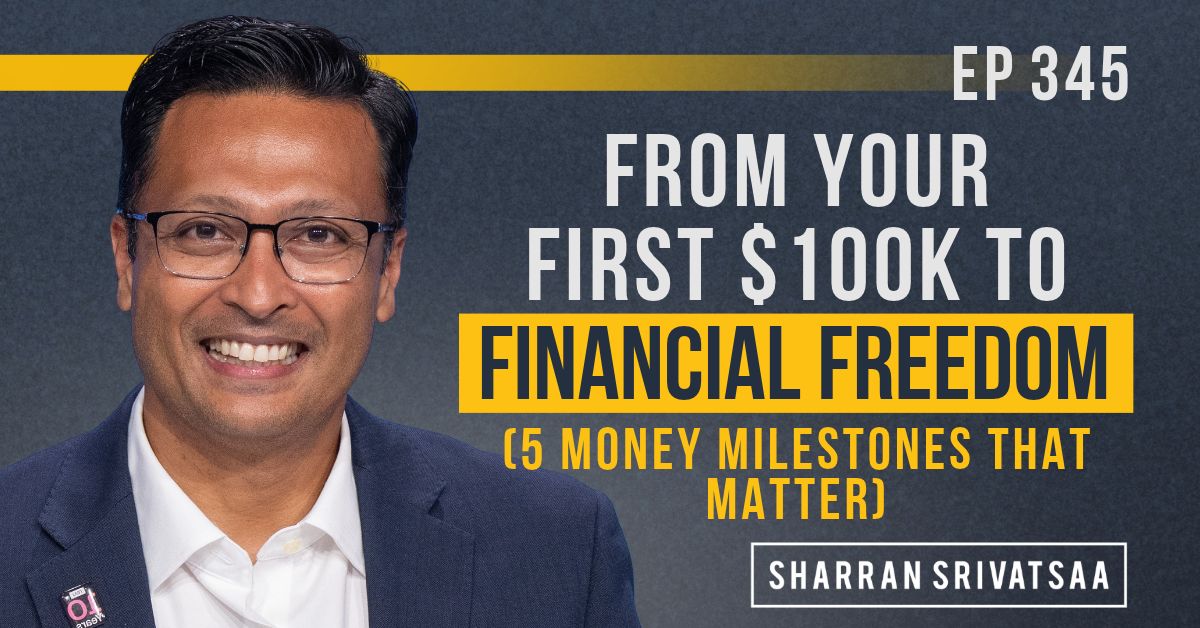
In this episode, Sharran shares a five-part framework for building wealth and creating financial freedom. Using the acronym MONEY, he explains the milestones that matter: Margin, Optionality, Net Assets, Equity Rich, and Living Life on Your Terms.
He breaks down why spending less than you earn is only the beginning, how lifestyle inflation slows down wealth building, and how building your first $100,000 in financial assets can set the foundation for long-term wealth. He also explains how growing your net worth can lead to new investment opportunities and why true financial freedom comes when passive income exceeds your monthly expenses.
The goal isn’t simply to reach a certain age or net worth. It’s to build the financial options that let you decide how you want to live.
“You can’t become financially free if you’re living a lifestyle that doesn’t create margin.”
~Sharran Srivatsaa
Timestamps:
00:00 – Introduction
00:34 – Milestone one: Create margin between income and expenses
01:40 – Milestone two: Build financial optionality with a transition fund
04:27 – Milestone three: Reach your first $100,000 in net financial assets
08:07 – Milestone four: Become equity rich
12:49 – Milestone five: Live life on your terms
13:14 – Passive income: pre-fund it with money or effort?
14:50 – Where are you on the path to freedom?
Resources:
– The Next Billion by Sharran Srivatsaa
– Board Member: ARC Multifamily Real Estate Investing
– Board Member: The Real Brokerage
Connect with Sharran:
– X
– YouTube
– Threads
Transcript:
[00:00:00] There’s a simple framework that explains every money milestone that you need to become financially free. This framework took me 30 years of investing and building two billion-dollar businesses to learn. But most people today still believe that money milestones are if you have a house by the time you’re 30 years old, or about how much you have in your retirement account at 40, or if you have a $55 million net worth by the time you’re 55.
[00:00:22] The truth is, nobody ever became financially free by maxing out their retirement accounts. Today, I’m gonna share with you the exact money milestones that you need to hit so that you can become financially free. Now, the first money milestone has nothing to do with chasing hot stocks or crypto coins. In fact, it’s much simpler.
[00:00:41] Milestone number one is margin. Well, what is margin? Margin is the difference between what you earn and what you spend, and that is your active income- the money you’re bringing in- and your monthly expenses. And the monthly expenses are everything that you spend in a given month, like Netflix or your car payment or even rent.
[00:00:57] But what is active income? Active income is [00:01:00] trading time for money. It doesn’t matter if you’re working in the business every day, or you’re LeBron James playing basketball, or you’re Elon Musk running Tesla. The goal is to be cash flow positive because you want more money coming in than going out.
[00:01:12] Meaning, you have margin. And so this is why the first money milestone for every single person in the world is to ensure that they have active income greater than monthly expenses, meaning they have margin. And your margin is the money that you have left over after your monthly expenses that you can use to invest in assets like an ETF, or pay off debt faster, or learn high-income skills to widen your margin.
[00:01:35] But you can’t become financially free if you’re living a lifestyle that doesn’t create margin. The next money milestone is how you protect your active income and the margin you have made, and I believe this is one of the most underrated milestones today. This is milestone number two, which is optionality.
[00:01:51] At this stage, the most important thing in your life is your active income, so we need to have protection if something happens to your active income. We need to [00:02:00] create optionality. Well, what is optionality? Optionality is a financial backup in case something happens to your active income. What if you lost your job?
[00:02:09] What if you wanted to reinvent yourself? What if you wanted to walk away from that job that you hate? But here’s the thing: what do the gurus say? They want you to have a $1,000 emergency fund. A $1,000 emergency fund does not get you far in an actual emergency. Most emergencies cost way more than $1,000, and the biggest emergency of all is losing your active income, especially today when it feels like it has never been harder to get a job.
[00:02:35] People are losing their jobs to job cuts, and AI has completely changed the job market. But there’s something that you can create instead to give you options without a $1,000 emergency fund. This is a transition fund where you have six to 12 months of expenses saved so you can completely transition and reinvent your life.
[00:02:54] The question is, can you replace your income for 6 to 12 months? Can you give yourself time to reinvent [00:03:00] yourself or even get a new job? Let me give you an unfortunate example. Let’s say you’re laid off unexpectedly. If you had an IT job that paid you $100,000 a year and your monthly expenses after taxes was $4,000 a month, if you built a transition fund for $2,000 a month for 12 months, you now have a six-month transition fund, which is $2,000 times 12 months is $24,000.
[00:03:23] This gives you time to find a new and better-paying job to replace your active income. $24,000 in the fund divided by $4,000 a month gives you a six-month buffer. This is how you create real options without the stress. You can walk away from a job. You can get a better job. You can reinvent yourself.
[00:03:43] Here’s a pro tip: Instead of just a bank account, consider one or two other things. You could take your transition fund and either invest it in a high-yield savings account, which pays more interest so that your money still grows and keeps up with inflation, or you can invest in stocks, where the compounding [00:04:00] works in your favor, and you still have access to it on a daily basis.
[00:04:04] And so the bottom line is that milestone number two has always been to protect your active income and give yourself transition time in case something goes wrong. But this next milestone is where you go from playing defense with optionality to playing offense for creating financial freedom. This is where you take the margin you have after the transition fund and start to turn it into real wealth.
[00:04:27] Milestone number three is net assets. The goal is to have $100,000 in net financial assets. So now you must be thinking two things: What are net financial assets, and how am I gonna get $100,000 in net financial assets? I will tell you in just a moment, because first we need to understand what net financial assets are.
[00:04:44] Net financial assets are your financial assets minus the debt owed against them. Well, what does that mean? Let’s say you have a house that is worth $400,000 and you owe $250,000 on it. That difference of $150,000 is your net [00:05:00] assets: what you own minus what you owe. But why is this milestone $100,000 in net assets?
[00:05:06] Because it’s the hardest. It’s your own savings and your own effort to create this liquidity. What is liquidity? It is how fast you can turn an asset into cash. And so when you have your first $100,000 liquid, it starts to work in your favor. Now, you must be wondering, how does this work in my favor? Let’s say you earn 10% a year without adding another dollar.
[00:05:28] In year one, it’s $110,000. In year two, it’s $121,000. And by year 10, you have over $250,000. Net financial assets are the foundation for creating financial freedom so you can stop trading time for money and never have to work again. But there is a way that you can reach this milestone even faster. You need to protect yourself from lifestyle inflation.
[00:05:50] Well, what is lifestyle inflation? When your income goes up, your lifestyle sometimes goes up with it. Say you got a new job, and then you took the extra money that you made from the job, and you got a new [00:06:00] apartment, a new car, and new expenses. The margin that you originally had from the new income is completely wiped out.
[00:06:07] This is one of the biggest drags on wealth creation. So what can you do to protect yourself from lifestyle inflation? When I left Wall Street, my wife and I needed to live entirely on her salary, so I even made her a pitch deck. We had no idea how long my wife would need to support our family, but I had the opportunity to build a real estate brokerage to billions of dollars.
[00:06:28] She was a consultant at Deloitte at that time, so I assumed that pitch decks were her love language, and I’m glad that she said yes. For the next two years, I made almost nothing. And then when I started making money from the business, we made each other a promise. We wanted to live on the same amount. A little later, we took that business to $3.4 billion in sales and sold it to Douglas Elliman.
[00:06:50] And now, 14 years after I first made that pitch deck, our net worth is 50 times what it was back then, and we still live on that same [00:07:00] monthly amount. We kept that promise to ourselves for 14 straight years. And so what I realized is that most people earn more and immediately find new ways to spend more.
[00:07:09] But my wife saw around the corner. She believed in me from the start and knew that we would get to a better place. But we wanted to avoid this lifestyle inflation. If you freeze your lifestyle as your income grows, that difference becomes your margin, and that margin is the money that you can use to learn new skills to increase your income or buy assets to build your net worth and ultimately build financial freedom for yourself.
[00:07:34] And so while it may seem like a massive sacrifice, I promise you that doing this will change the very financial bloodline of your family. So temporarily freeze your lifestyle to live on the same monthly income. If you just live below your means, you’ll start to build towards your first $100,000 net assets so much faster, which means you will be ahead of most people in the money milestones.
[00:07:58] But $100,000 in net [00:08:00] assets isn’t going to make you financially free. It’s milestone number four where you realize how the first $100,000 can start you down the path to financial freedom. Milestone number four is equity rich. What is equity rich? Equity rich is when you have a million dollars in net worth, not including your personal residence.
[00:08:16] Well, then, what is net worth? Net worth is everything that you own minus everything that you owe. And by the way, it’s milestone number four where the top 1% have opportunities that 99% of the world doesn’t even realize that they exist. And this is because when you have a million dollars in net worth, excluding your primary residence, you become an accredited investor in the United States.
[00:08:38] This gives you access to an entire open market of private deal flow, and these private deals are only what the top 1% can access, things like hedge funds or startups or private equity. But here’s the thing: Most people are just in the retail investor mindset. They invest their own money in stocks or bonds or funds or even crypto.
[00:08:59] They use [00:09:00] normal platforms like brokerage applications or 401Ks or Robinhood, and they have no ability to invest in private deals. This is why hitting milestone number four is so important for financial freedom. I call this the tale of two investors. Retail investors get S&P 500-like returns, but private investors get much bigger returns.
[00:09:18] Not 10 or 20% more, 54% more. It’s like the difference between riding a bicycle and driving a sports car. But when you get there, this is your golden ticket to financial freedom. You need to do whatever it takes to get there as fast as possible by doing these three things. Number one, learn more skills to increase your earning income.
[00:09:41] Number two, reduce lifestyle creep. And number three, invest in the public markets as it is all that you have access to at first. Unless you’re an accredited investor, you will not have a chance to invest in the best possible deals. You will dramatically limit yourself only to the public markets. But when these investment opportunities open up for [00:10:00] you, there are three things that you can do to grow your wealth.
[00:10:03] You can grow your assets, meaning you can add to the assets that you already have. You can grow your yield, meaning you can increase the cash flow. And in the best case, you can do both. So how do you make your asset base bigger? You can get more properties or more stocks by adding to it, or you can take the duplex that you have and buy a fourplex by upgrading the real estate that you already own.
[00:10:23] So how do you grow your cash flow? You can intentionally replace a lower cash flow asset for a higher cash flow asset. Say you have a dividend fund that gives you 3%. You can now swap that out and replace it with a dividend fund that gives you 5%. If you put this entire example together, you start with $100,000 at 3%.
[00:10:42] That’s $3,000 a year. You grow your asset to $120,000 at 3%; that’s $3,600 a year. Now you grow the yield, or the cash flow, to $100,000 at 5% a year. That’s $5,000 a year. But if you can do both, you now have $120,000 at 5% a year, [00:11:00] which is $6,000 a year. That is double what you started with. And now you may say, “Well, Sharan, why shouldn’t I just invest in the S&P 500 like all the financial influencers tell me to do?”
[00:11:11] Because the S&P 500 is not going to make you financially free in the timeline that you want. You will still be trading time for money, and the last thing that you want to do is work until the day you die. Before I was an accredited investor, 100% of my investments was in the public markets like the S&P 500.
[00:11:30] But today, my portfolio looks completely different. Less than 5% of my net worth is in S&P 500-like investments. The other 95% comes from the ability to make the accredited investments, the private deals that no one else has access to because of hitting milestone number four. And once you have a million dollars in net financial assets, you can invest in these private deals so that you can grow your assets.
[00:11:54] You can grow the yield, or in best case, you can do both. To understand exactly how to take the money that you’ve made, to [00:12:00] keep it and to grow it, I put together 21 years of my wealth knowledge and created a free wealth roadmap for you. I wrote down all the lessons that I’ve learned from Goldman Sachs, building two billion-dollar companies, and I reverse-engineered everything into a framework called the Wealth Roadmap.
[00:12:16] It breaks down the five stages of wealth that you need to hit to achieve financial success. It gives you actionable steps that you can use to make yourself wealthy, and it tells you exactly what to do in each stage to get to the next stage. Now you have the wealth knowledge I wish I’d had 21 years ago.
[00:12:33] I believe that if you apply what I’ve just told you, you could be ahead of 99% of people today. Just click the link in the description to get a free personalized wealth roadmap. But getting to the $1 million in net worth may actually not make you financially free, because it’s milestone number five where the financial freedom becomes a true reality.
[00:12:53] Milestone number five is living life on your terms. This is where you get truly financially free. Well, what is financial freedom? [00:13:00] Financial freedom is when you can wake up in the morning and ask yourself, “What would I like to do today?” This is where your passive income is greater than your monthly expenses, because when that happens, you can truly live life on your terms.
[00:13:13] You must be thinking, “Is passive income even real? Is it a scam? Is it even possible for someone like me?” I used to think the same thing until I was a banker at Goldman Sachs, and I saw how the wealthiest people in the world invested. They bought stocks and municipal bonds, corporate bonds, REITs, multifamily real estate, all to generate passive income, and that is when I redefined passive income for myself.
[00:13:37] Passive income is pre-funded income. It is where you’re not trading time for money, but you can pre-fund it with money, or you can pre-fund it with effort. Let me give you an example. Let’s talk about pre-funding your passive income with money. You take your first $100,000, and you invest it into a dividend-paying ETF, say, at 4%.
[00:13:56] That generates $4,000 a year that you don’t have to [00:14:00] work for. Or pre-funding it with effort. Maybe you spent six months building an online masterclass, and then that masterclass continues to sell without any more work from you. The moment everything changed for me was when I invested in my first multifamily property.
[00:14:15] We invested in an apartment complex in Atlanta, Georgia, and I got my first passive income check. I didn’t even know the address of this property. That changed everything for me. It made me believe that passive income was not a scam and was actually accessible for you and me, and we’ve just never been taught how to access it yet.
[00:14:35] And once your passive income starts to become greater than your monthly expenses, you have reached financial freedom. Work now becomes a choice. You can wake up in the morning and say, “What would I like to do today?” Instead of saying, “Oh, man, I gotta wake up and get to work.” The reason I built these five money milestones was to give you the gauge to recognize where you are and what your next specific milestone is.
[00:14:58] Once you’ve hit all five [00:15:00] money milestones, you know you have reached financial freedom. So let’s figure out where you are. Milestone number one is margin. This is where your active income is greater than your monthly expenses, where you trade time for money and the lifestyle that you have. Milestone number two is optionality.
[00:15:14] It’s about building the transition fund, not an emergency fund. What would happen if your active income source was dramatically reduced in some way? Do you have enough money set aside during this transitional period of your life? Milestone number three is getting to $100,000 in financial assets. This is where you can start to get the first big milestone.
[00:15:33] You’re investing on working to get your first 100,000 in financial assets. Milestone number four is being equity rich, having a million dollars in net worth, not including your primary residence. And so now you’ve become an, an accredited investor in the US that gives you access to private investments that most people will never get access to.
[00:15:53] And last but not least, number five is to live your life on your terms. This is where your passive income is greater than your [00:16:00] monthly expenses, and where you can wake up and ask yourself, “What would I like to do today?” This is the money framework. The first letter of every money milestone spells M-O-N-E-Y, money, so you never forget how to get to financial freedom.
[00:16:14] If you enjoyed this video, you will enjoy the next one where I talk about what I believe is the greatest wealth-building opportunity in America today.